


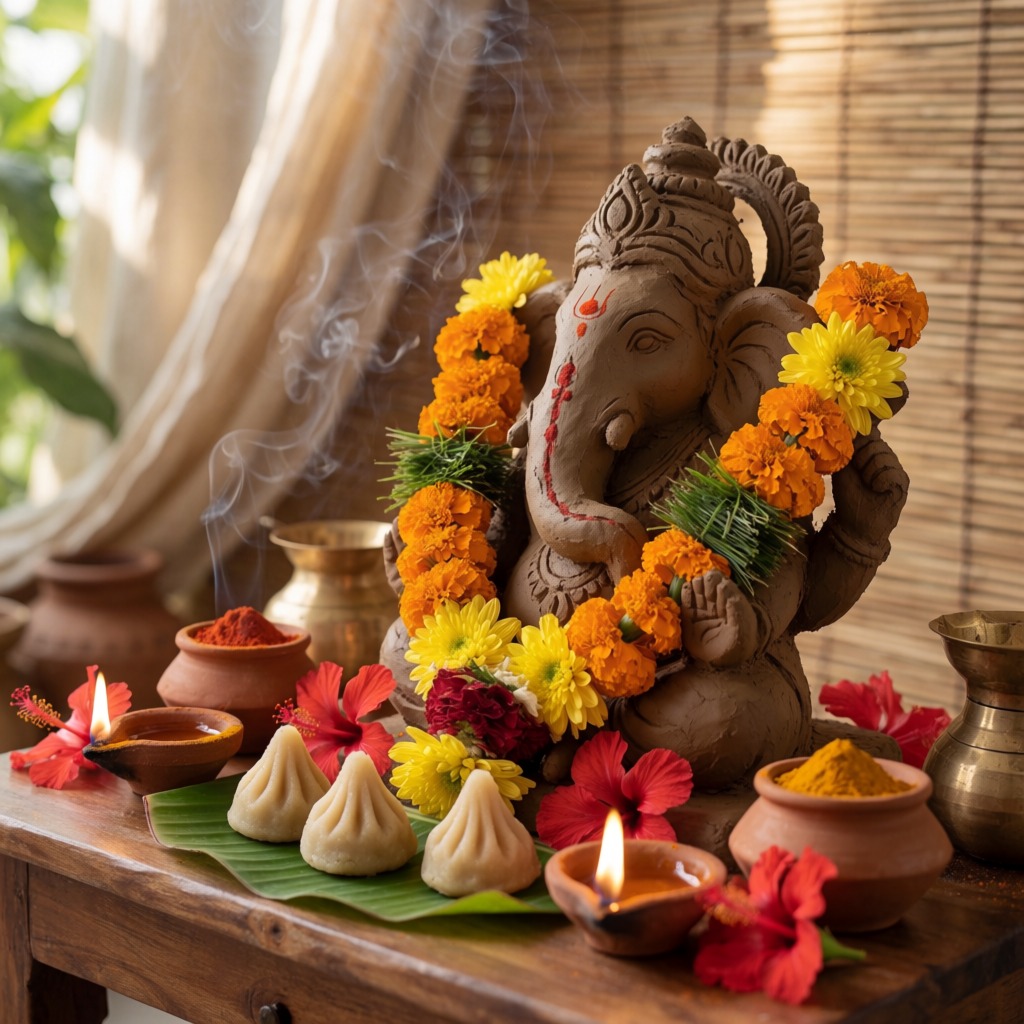

Ganesh Chaturthi celebrations are shifting toward eco-friendly practices, moving away from toxic Plaster of Paris (PoP) idols toward natural Shadu clay and innovative “seed Ganeshas” that grow into saplings. Cities are supporting this transition by providing free clay, setting up artificial immersion tanks, and managing floral waste and Prasad through composting and biomethanation. With active participation from communities, schools, and civic bodies, the festival is successfully balancing traditional devotion with environmental sustainability.
Environment Pulse Desk: There’s a particular sound that used to mark the end of Ganesh Chaturthi in most Indian cities — the thud and splash of a plaster idol going into a lake, followed, days or weeks later, by a milky, chemical-streaked residue that just never fully went away. This year, on 14 September 2026, that sound is changing. Increasingly, what goes into the water is clay, and what comes back out — eventually, gently — is soil.
It’s a small shift in physical terms. An idol is still an idol; a festival is still a festival. But it represents a fairly significant recalibration of how millions of people are choosing to practise a ritual that’s thousands of years old, without pretending the planet can simply absorb the consequences forever.
The Problem Nobody Wanted to Name Out Loud
For decades, the idol of choice was made from Plaster of Paris — cheap, easy to mould into elaborate shapes, and disastrous for water bodies. PoP doesn’t dissolve so much as it lingers, sometimes for years, releasing gypsum and whatever heavy metals were mixed into its paint into rivers, lakes, and coastal waters. Fish died. Water turned turbid. Everyone kind of knew, and for a long time everyone kind of looked away, because the alternative felt like asking people to give up something sacred.
What’s changed isn’t the sentiment behind the festival — it’s the materials devotees are reaching for, and the infrastructure now standing behind that choice.
Clay That Actually Goes Home
The centrepiece of this year’s shift is Shadu mati — a natural clay that dissolves cleanly in water and leaves nothing toxic behind. Guidelines from the Central Pollution Control Board have been explicit about favouring untreated natural clay over PoP or fired clay, and pushing organic colours drawn from turmeric, sandalwood, gerua, and other plant sources instead of synthetic paint.
Cities have backed the shift with actual logistics rather than just advisories. In Mumbai, the municipal corporation gave away hundreds of tonnes of free Shadu soil to idol-makers, effectively removing the cost barrier that used to push artisans toward cheaper PoP. Hyderabad’s development and municipal authorities together aimed to hand out lakhs of free eco-friendly clay idols, and similar distribution drives popped up across Andhra Pradesh, Telangana, and other states — often bundled with clay diyas and pots, so the festival’s smaller rituals got greener along with the main idol.
Perhaps the most striking image of the season came out of Navi Mumbai, where more than 10,000 students sat down together and moulded Shadu clay idols at the same time, setting a Guinness World Record and doing it under the eye of Maharashtra’s Chief Minister and other officials. It’s the kind of event that’s part environmental messaging, part civic theatre — but it also meant ten thousand young people spent an afternoon actually shaping the material with their hands, which tends to stick with a person longer than a poster ever could.
A Ganesha You Can Plant
If Shadu clay is the mainstream shift, the “seed Ganesha” is the idea that’s captured people’s imagination this year. These idols are built from clay, cocopeat, and coconut fibre, with seeds — often neem or tamarind — folded into the mixture itself. Immerse it, or simply let it break down in soil, and instead of vanishing, it eventually becomes a sapling. The ritual doesn’t end with a dissolution; it continues as growth.
It helps that the idea has celebrity backing. Actors including Vijay Deverakonda, Chiranjeevi, and Pooja Hegde have publicly adopted seed Ganeshas this year, tying the choice to campaigns like the Green India Challenge and nudging their considerable fan bases to consider doing the same. Whatever one thinks of celebrity endorsement as a mechanism, it does something useful here: it reframes an eco-friendly idol from a compromise into something aspirational, which is a harder trick to pull off than it sounds.
Where the Water Goes
Immersion practices themselves have been quietly redesigned. Rather than defaulting to a river, lake, or stretch of coastline, cities have built out networks of artificial ponds, tanks, and mobile immersion units specifically so natural water bodies don’t have to absorb the brunt of the festival. For smaller clay idols, many families are now immersing at home — a bucket or tub does the job just as well — and once the idol has dissolved, the resulting clay-rich water goes straight into garden soil or a potted plant instead of down a drain. Mumbai, Pune, and Hyderabad have all set up large numbers of these tanks and collection points, and online slot booking systems have helped spread out the crowds that used to jam immersion ghats into a single frantic evening.
The festival’s other by-products are getting the same treatment. Nirmalya — the flowers, leaves, and offering materials left behind — is increasingly being collected and composted into fertiliser rather than dumped, a practice that’s already turned hundreds of tonnes of floral waste into usable farm input in cities like Pune in past years. Even food waste from major pandals is being put to work: Mumbai’s Lalbaugcha Raja, among the most visited pandals in the country, is part of a “Prasad to Energy” initiative that channels leftover organic waste from food counters into biomethanation plants that generate electricity for municipal hospitals. It’s a genuinely circular idea — devotion, in a roundabout way, ending up as hospital lighting.
Beyond the Idol
The greening hasn’t stopped at the idol itself. Thermocol, once the default material for pandal decorations because it was cheap and light, is being phased out in favour of bamboo frames, jute and cane matting, banana leaves, marigold and mango-leaf torans, dried flowers, and recycled paper — materials that, notably, tend to look more authentically festive than polystyrene ever did anyway. Single-use plastic plates and cups are being swapped for biodegradable alternatives, and LED lighting has largely replaced the more excessive illumination pandals used to favour.
Some of the most durable change may be happening in classrooms and community halls, where schools and resident welfare associations across Maharashtra, Telangana, Karnataka, and Andhra Pradesh have been running workshops teaching children — and their parents, by extension — how to shape a simple clay idol at home using natural colours. It’s hard to overstate how differently a child relates to an eco-friendly ritual they built with their own hands compared to one they were simply told was better for the environment.
A Ritual That Learned to Return
None of this erases the scale of the challenge. Old habits, cheap materials, and sheer festival volume don’t disappear in a single season, and artisans who spent years working with PoP are still in the process of being supported through the shift to clay — a transition that matters as much for livelihoods as it does for water quality. But the trajectory across recent years has been steady: more eco-friendly idols, more home and tank immersions, less of the old chemical residue lingering in the city’s water.
What Ganesh Chaturthi 2026 seems to be demonstrating, city by city and household by household, is that a ritual doesn’t have to choose between meaning and consequence. An idol dissolving into a garden bed rather than a river; festival waste becoming fertiliser or electricity instead of pollution; a seed idol growing into a tree long after the festival lights have come down — these aren’t dilutions of devotion. They’re devotion figuring out how to leave the world exactly as whole as it found it.
Also Read: The Quiet Greening of Lucknow