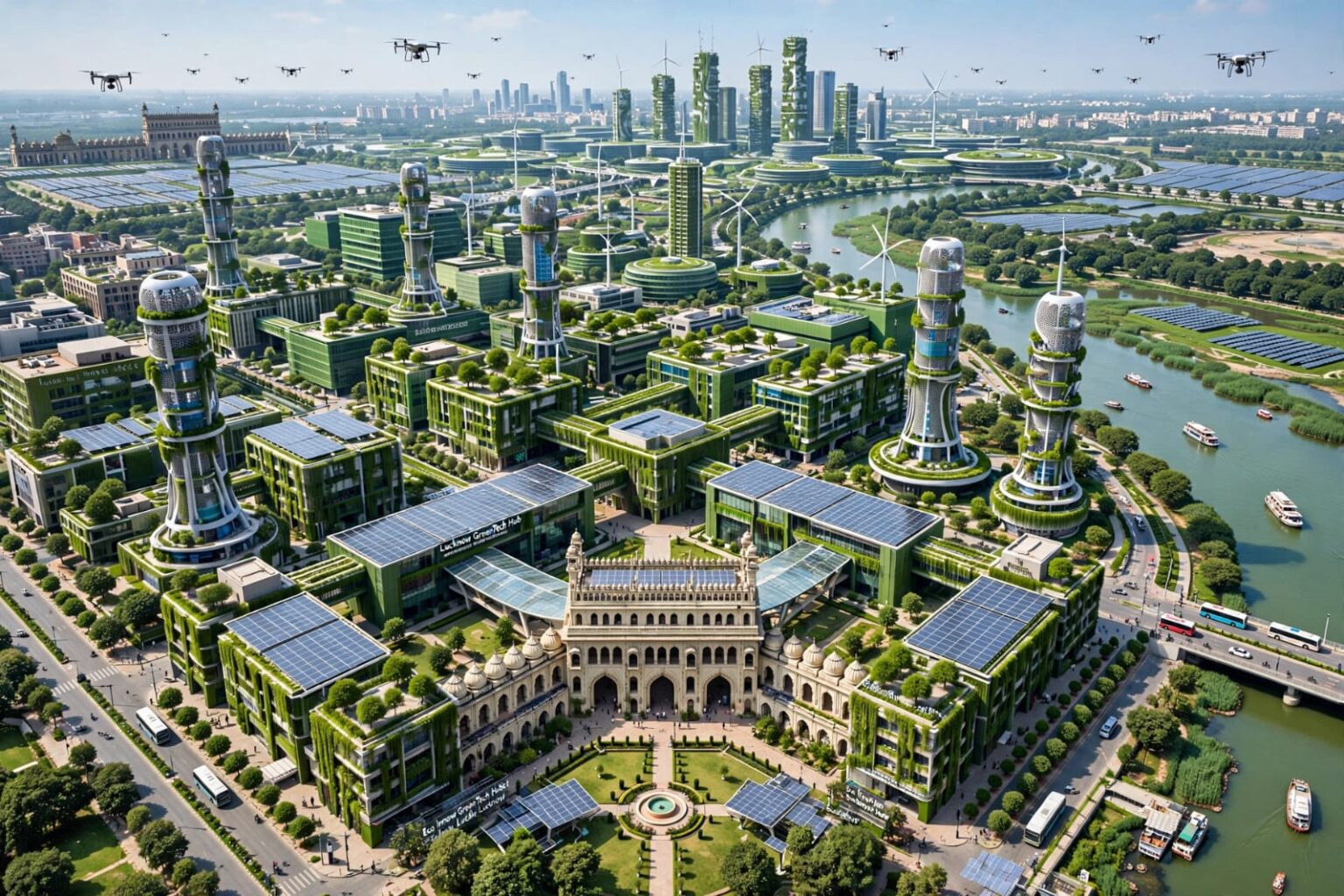

Lucknow is rapidly emerging as a strong contender to become India’s “Green Tech Capital.” Driven by rapid development over the past three years, the city benefits from 12 large-scale research centers (including NBRI, CDRI, and IIT-Kanpur extensions), over 40 green start-ups, and robust government initiatives like the “Green UP Startup Policy” (offering grants, land discounts, and tax exemptions) alongside a 200-acre Green Tech Park in Nadarganj. Key advantages include a powerful scientific research ecosystem, local environmental challenges acting as testing grounds for green tech, and lower land and labor costs compared to Bengaluru.
Environment Pulse Desk: As India has designated Bengaluru its IT Capital, and Hyderabad its Pharma Capital, it is only natural to ask if Lucknow can become India’s Green Tech Capital. The short answer to that question is, “yes,” without a doubt, as Lucknow is rapidly developing into such.
The development that has taken place in Lucknow in just the last three years has been nothing less than revolutionary. There are now 12 large-scale research centers (NBRI, IIT-Kanpur, BBAU, CDRI), more than 40 green start-ups and substantial government funding – all elements in Lucknow’s favor. Why could Lucknow evolve into the Green Tech Capital? 5 key factors: 1. A Powerhouse for Research
The city of Lucknow currently houses 4 CSIR laboratories. Bio-char was created by NBRI; fog to water was created by CDRI. The extension facility for IIT Kanpur in Lucknow is working on creating smog towers and air purification systems. Bengaluru is home to a large number of IT experts whereas Lucknow is home to a large number of environmentally-focused scientists. An IIM Lucknow professor stated, “Bengaluru was able to establish their software industry based upon the proximity of IISc.
Lucknow has the potential to become a leader in environmental science as a result of the ecosystem that exists there including NBRI, BBAU, and IIT.” 2. Problem Is Solution:
Lucknow has numerous problems – air quality; management of solid waste; pollution from the Gomti River; and extreme heat. All of these problems are opportunities for testing green technologies (i.e., “laboratories”). When a city experiences significant problems, it creates a huge opportunity for businesses to develop products or services that can help solve those problems.
Although the Delhi Smog Tower Trial failed, the Lucknow Smog Tower Trial was successful. This success was due to the difference in types of dust found in Lucknow compared to Delhi. Residents of Lucknow are currently working on developing solutions locally to the problems they experience.3. Cheap land and cheap labor:
The cost to start a green business in Bengaluru is three times higher than starting a green business in Lucknow. For example, if you were to rent a 2,000 square foot laboratory space in Gomti Nagar, it would be around Rs. 30,000 per month. If you rented the exact same laboratory space in Bengaluru, it would be around Rs. 100,000. Each year, BBAU (Babasaheb Bhimrao Ambedkar University) and Lucknow University graduate a combined total of 500 environmental science students.
Most of these graduates are willing to work for an initial salary of Rs. 40,000. Graduates with similar credentials from universities in Bengaluru seek initial salaries of Rs. 100,000.
The government of Uttar Pradesh introduced the “Green UP Startup Policy” in 2025. The policy offers financial support to green technology start-ups by providing grants of up to 50 million rupees, 50% discount on land acquisition, and tax exemption for five years. The government of Uttar Pradesh has allocated 200 acres of land for the “Green Tech Park” located in Nadarganj, Lucknow. Yogi Adityanath said, “We are going to make Uttar Pradesh a Green Manufacturing Hub.”
Lucknow is located in the middle of the Ganges River Basin. The quality of water, soil health, and farming techniques used in this area have all been heavily affected by climate change. Therefore, it may be the most important “testing site” for new technologies related to water management, farming technology, and capturing carbon dioxide. An example would be ‘Jalvayu,’ which is a start-up company that produces hydrogen gas with water taken from the Gomti River. Three Primary Obstacles
- Funding Deficit — There are numerous Venture Capitalists (VCs) in Bangalore (they appear to be on each street corner), however, funding for Green Technology (GT) in Lucknow comes mostly from Delhi and/or Mumbai. Investors in Lucknow continue to invest their money into real estate projects instead of GT.
- Market Connection Missing — Products made in Lucknow find it difficult to sell locally. A smog tower was built, but it took the Municipal Corporation two years to complete the bidding process.
- Brain Drain — Many graduates from Babasaheb Bhimrao Ambedkar University (BBAU) leave to look for work in Bangalore or Pune because salaries are much higher there. As a result, Lucknow needs to create systems to keep its educated workforce. Conclusion — What does the future hold? Experts believe that Lucknow will not become the “next Bangalore”; instead, it will develop as the “first Lucknow.” Just as Bangalore changed the Information Technology industry, Lucknow can change the GT industry.
However, Lucknow must have one large success story. For example, just as Flipkart created Bangalore as a worldwide center for IT, Lucknow needs to create a Green Unicorn. There are positive signs. Three GT startups that were started in Lucknow received 100 Crore in funding in 2026.
If this trend continues, Lucknow will most likely become India’s Green Tech Capital by 2030. When this happens, people will say — Bangalore codes, Lucknow cleans the air.
Also Read: Tens of Thousands March in Brussels Demanding Stronger, Faster Climate Action


