

Indian homemakers are transforming the domestic art of saving and recycling into green businesses centered on waste-to-wealth, solar technology, and organic products. This grassroots shift is not only reducing carbon emissions and waste but is also making India’s ‘green economy’ more inclusive
Environment Pulse Desk: For generations, homemaking in India has involved an intimate understanding of resources: how to stretch a household budget, reuse containers, repair clothes, preserve food and ensure that nothing goes to waste.
Today, many homemakers are turning these everyday skills into something bigger — green businesses that generate income while addressing some of the country’s growing environmental challenges.
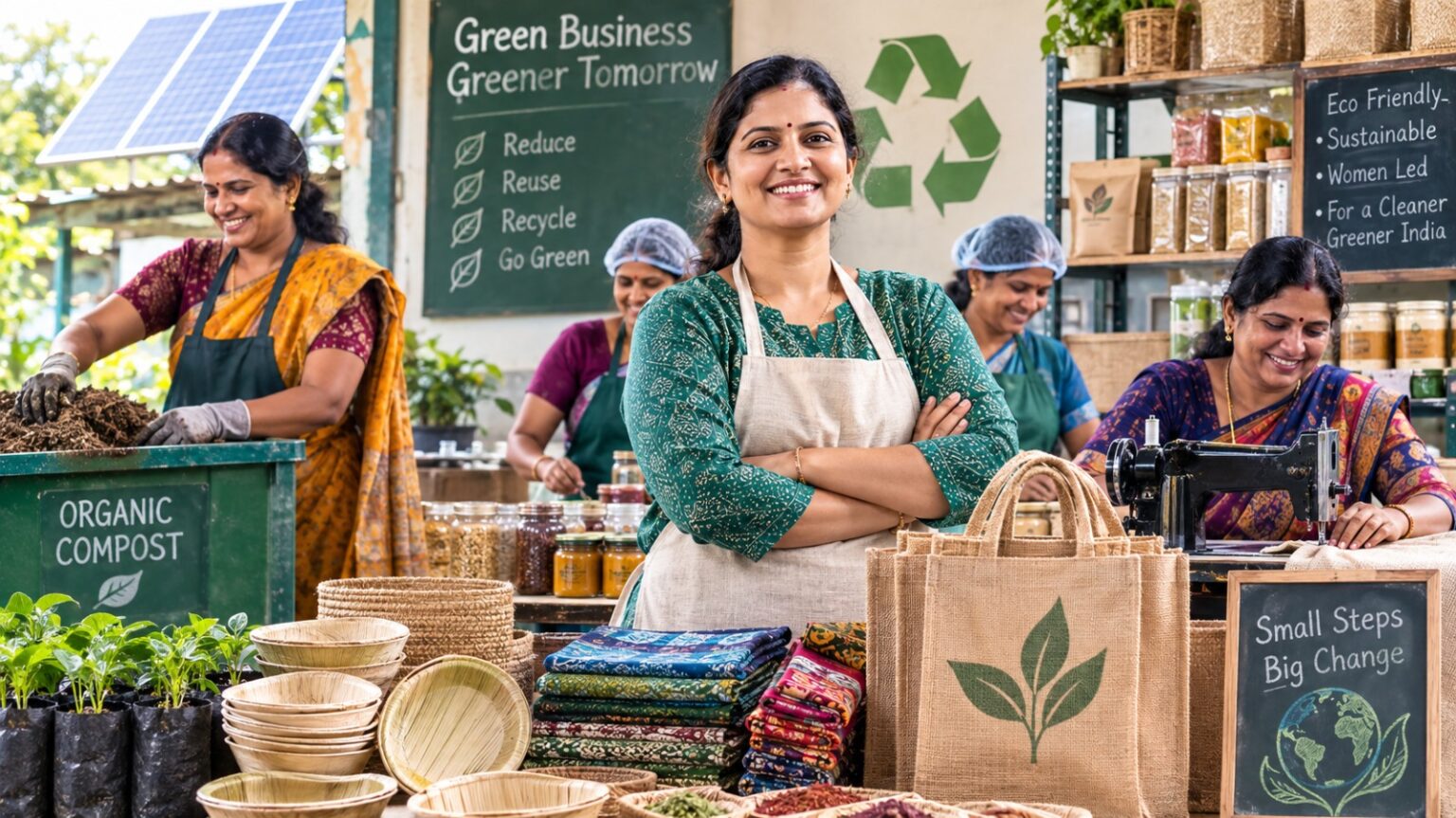
From converting discarded fabric into fashionable bags and home décor to producing natural foods, compost, eco-friendly packaging and recycled products, women are increasingly discovering that sustainability can also be a viable livelihood.
What was once dismissed as household thrift is becoming an entrepreneurial advantage. The opportunity is particularly significant because India has a vast network of women’s Self-Help Groups (SHGs).
Under the Deendayal Antyodaya Yojana–National Rural Livelihoods Mission, more than 10 crore women had been mobilised into around 90.9 lakh SHGs by mid-2025. These networks are increasingly becoming platforms for enterprise, skills, credit and market access.
For homemakers, green entrepreneurship often begins close to home.
A woman who has been stitching clothes may start making reusable shopping bags from discarded textiles. Someone skilled in cooking may turn to millet-based foods, pickles, preserves or other locally sourced products. Others collect household waste, segregate recyclables, make compost or convert discarded materials into saleable products.
This low-entry model is one of the biggest attractions of green business. Women do not necessarily need a factory or large investment to begin. Their homes, neighbourhoods and existing skills can become the foundation of a micro-enterprise.
From Waste to Wealth
Waste management is emerging as one of the most accessible areas of green entrepreneurship for women. Instead of viewing discarded material as worthless, homemakers are increasingly looking at it as raw material. Textile waste is a particularly promising area.
Old garments, factory offcuts and discarded fabrics can be transformed into bags, pouches, rugs, accessories and home furnishings.
A recent government initiative demonstrated the potential of this model: more than 300 women received structured training in textile identification, segregation, repair and upcycling, while over 150 women began earning between ₹9,000 and ₹15,000 a month through sorting, stitching and product transformation.
Similar models are emerging in cities and villages. In Mumbai, women associated with self-help groups have been involved in upcycling textile waste into products for consumers, with some participants earning an income for the first time. Kerala offers another example of how waste collection can evolve into entrepreneurship.
Women working through Haritha Karma Sena have moved beyond waste collection into activities such as upcycling old clothes, repairing LED bulbs and replacing single-use plastic products. A group of 28 women reported monthly incomes rising from around ₹15,000 to ₹25,000.
The significance goes beyond income. Every product made from recovered material potentially reduces demand for virgin resources and keeps waste away from landfills or incineration. The Kitchen Is Becoming an Enterprise India’s homemakers also possess an often-underestimated business asset: culinary knowledge.
Traditional recipes, local grains, seasonal produce and indigenous preservation techniques can become the foundation of sustainable food businesses. Millets, for example, have created opportunities for women to produce flour, snacks, cookies, mixes and ready-to-cook products.
The same principle applies to pickles, papads, spices, herbal products and other locally produced foods. When these businesses rely on local ingredients and minimise packaging and transportation, their environmental footprint can be relatively small.
The transition from household production to commercial enterprise, however, requires more than skill. Branding, food safety, packaging, bookkeeping, digital payments and online marketing can determine whether a home-based activity remains a supplementary income source or becomes a scalable business. This is where SHGs and entrepreneurship programmes become important.
Collective purchasing can reduce costs, while common production facilities and shared branding can help women meet larger orders.
Upcycling Meets Fashion
Sustainable fashion is another area where homemakers are finding opportunities. The basic concept is simple: instead of throwing away clothes that are no longer wanted, they can be repaired, redesigned or transformed into something new. Sarees can become bags or quilts; denim can become accessories; fabric scraps can become toys, pouches or decorative products. This approach connects traditional Indian skills such as stitching, embroidery and weaving with contemporary consumer demand for sustainable products.
The result is a business model that combines environmental value with cultural identity. Handmade products can command a premium when customers understand their story — where the material came from, who made the product and how much waste was diverted from disposal.
Clean Energy Opens New Doors
Green entrepreneurship is not limited to recycling and handicrafts. Renewable energy is creating opportunities in rural and semi-urban communities as well. Women can participate in businesses linked to solar-powered equipment, clean cooking solutions, solar drying, energy-efficient appliances and maintenance services.
Decentralised renewable-energy technologies can support income-generating activities while reducing dependence on fossil fuels. Research by the Council on Energy, Environment and Water has highlighted their potential to strengthen rural livelihoods, reduce emissions and build climate resilience.
One striking example is Babita Raheja, co-founder of Raheja Solar Food Processing. Her enterprise uses solar drying technology, and she has trained more than 4,500 women to adopt solar dryers.
The model demonstrates how a woman-led green enterprise can become a multiplier, spreading both technology and income opportunities among other women. In Uttar Pradesh, research into Varanasi’s weaving community has also highlighted how solar-powered technologies can reshape women’s participation in traditionally male-dominated or undervalued economic activities.
Digital Platforms Are Changing the Market
Perhaps the biggest change for today’s homemaker entrepreneur is that the market is no longer limited to the neighbourhood. Social media, digital payments, e-commerce and government-backed marketplaces allow women to display and sell products beyond their immediate communities. A woman making sustainable products from her home can potentially reach customers hundreds of kilometres away without opening a physical shop.
The government’s eSaras platform, for instance, connects rural women-led SHGs and producer collectives with consumers through digital commerce.
As of 2026, the platform featured more than 1,400 products, with hundreds of buyers accessing SHG products through ONDC-enabled applications. Government procurement is another emerging opportunity.
More than 2.1 lakh women-led enterprises had registered on the Government e-Marketplace, securing around 13.7 lakh orders in FY 2025–26, with contract value exceeding ₹28,000 crore.
For homemakers, this digital shift can be transformative because it reduces one of the traditional barriers to entrepreneurship: access to customers. The Challenges Remain The green-business opportunity is substantial, but it is not without obstacles.
Women continue to face difficulties in accessing finance, technology, training and formal markets. Social expectations can also restrict mobility and the amount of time women can devote to enterprise.
Research on SHG enterprises has identified digital exclusion, infrastructure gaps, mobility constraints and weak market coordination among the challenges affecting sustainability. Green enterprises face additional problems. Sustainable raw materials can sometimes be more expensive than conventional alternatives.
Customers may appreciate an eco-friendly product but remain unwilling to pay a higher price. Small businesses may also struggle to maintain consistent quality while fulfilling large orders. There is therefore a need to move beyond simply encouraging women to start businesses.
Training must include financial literacy, digital marketing, product design, quality control, bookkeeping and access to formal finance. Green entrepreneurs also need stronger links with retailers, e-commerce platforms, corporations and government procurement systems.
The Council on Energy, Environment and Water has argued that unlocking women’s participation in India’s green economy requires changes across the entrepreneurship ecosystem, including support from financiers, accelerators, enterprises and investors.
From Homemakers to Green Entrepreneurs
The most important change may be cultural. A homemaker starting a recycling, food-processing, handicraft or clean-energy venture is not merely earning a supplementary income. She is participating in the circular economy, creating employment, reducing resource consumption and demonstrating that environmental action can begin at household level.
India’s green transition will not be driven only by large renewable-energy companies, electric-vehicle manufacturers or climate-tech startups. It will also depend on thousands of small enterprises operating in homes, villages, neighbourhoods and local markets.
Women are uniquely positioned to lead this grassroots transition because many of the principles behind green business — reuse, repair, conservation, resource efficiency and local production — are already embedded in everyday household practices. The next step is to give those practices an economic identity.
When an old sari becomes a marketable bag, kitchen waste becomes compost, agricultural residue becomes clean fuel, a solar dryer becomes a livelihood tool or a traditional recipe becomes a sustainable food brand, the boundary between homemaking and entrepreneurship begins to disappear. India’s homemakers are therefore not simply adapting to the green economy. In many cases, they are quietly building it from the ground up — one household, one product and one enterprise at a time.
The challenge now is to ensure that these women have the finance, technology, training and markets needed to turn small green initiatives into durable businesses. If that support reaches them at scale, India’s green economy could become not only cleaner, but also considerably more inclusive.
Also Read: 80 साल बाद भी गोवा में ज़मीन, विकास और पर्यावरण को लेकर जंग जारी