

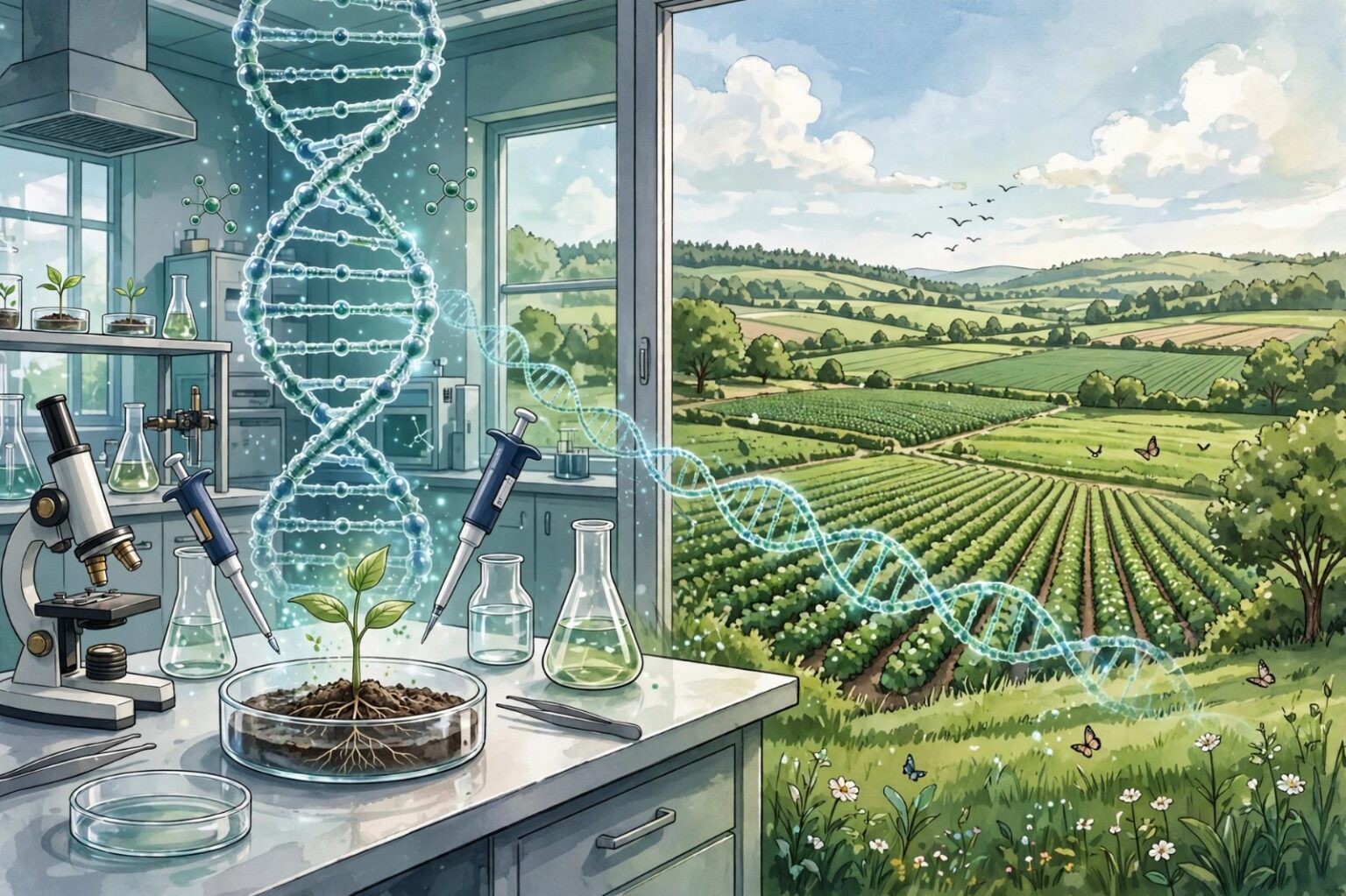

Genetic Modification (GM) is a powerful yet controversial technology in modern agriculture that alters crop DNA to produce desired traits quickly. While it offers significant environmental advantages—such as reduced chemical usage, lower soil erosion via no-till farming, climate resilience, and habitat conservation—it also carries notable risks like gene flow into wild relatives, threats to non-target organisms, loss of agrobiodiversity, and the rise of resistant “superweeds.” Ultimately, the environmental impact of GM technology depends on proper governance and sustainable application, requiring rigorous ecological risk assessments, refuge strategies, and public investment to balance food security with ecological protection.
Environment Pulse Desk: Genetic Modification (GM) is one of the most effective and controversial technologies developed in modern agriculture. Through direct modification of the DNA of crops, scientists have been able to develop new traits that would typically require decades of breeding. Although GM technology provides a number of environmental benefits, there are also many potential risks associated with the technology that must be weighed against these benefits.
- Possible Environmental Advantages The primary reason for supporting GM technology based upon its environmental advantages is the ability of the technology to allow for the production of greater quantities of food on smaller areas of land using fewer resources.Lower Chemical Usage: GM technology was first applied to create plants with resistance to pests and herbicides. For example, Bt crops contain genes from the bacterium Bacillus thuringiensis that produce their own insecticides. As a result, the application of broad-spectrum insecticides has declined dramatically in crops such as cotton and maize. Studies conducted in India, China and the United States demonstrated that Bt cotton reduced insecticide usage by 30-50% in its initial years of implementation, protecting both agricultural workers and beneficial insects.Protection of Soil and Land: Herbicide-resistant crops (e.g., Roundup Ready soybeans) enable farmers to eliminate weeds through a single application of herbicide rather than through mechanical tillage. Consequently, farmers can utilize no-till farming practices, which leave crop residues in the fields. No-till farming significantly decreases soil erosion by as much as 90%, retains soil moisture, and prevents carbon from being released into the atmosphere as carbon dioxide.Resilience to Drought and Water Stress: Recent advances in GM technology have focused on developing plants resilient to various forms of environmental stress. For example, researchers have created drought-tolerant maize, flood-tolerant rice (Sub1), and nitrogen-efficient crops that are capable of maintaining high yields with reduced water and fertilizer applications. If these technologies are implemented widely, they could significantly decrease the 70% of global freshwater utilized by agriculture, and decrease nitrous oxide emissions resulting from fertilizers, a potent greenhouse gas.
Conservation of Biological Diversity: By improving yields on existing agricultural lands, GM crops alleviate pressures to convert natural habitats such as forests and wetlands into agricultural lands. Norman Borlaug’s assertion remains applicable today: if we can produce more food on 20% of the land that currently produces 40% of our food through irrigation and high-yielding cultivars, we can maintain more intact wild lands.2. Possible Environmental RisksThe possible risks associated with GM technology arise primarily from the interactions between highly homogeneous engineered organisms and complex, variable ecosystems.
Gene Flow and Superweeds: One of the most frequently discussed risks associated with GM technology is the potential transfer of transgenes to wild relatives via cross-pollination. A gene conferring resistance to herbicides that is transferred to a weedy relative could result in a herbicide-resistant “superweed,” necessitating that farmers apply even more toxic herbicides to manage the weed. This has already occurred with herbicide-tolerant canola cross-pollinating with wild mustard.
Effects on Non-Target Organisms: Bt toxin is intended to kill specific pests; however, early laboratory investigations raised concerns regarding whether pollen from Bt maize could harm larvae of monarch butterflies. While subsequent field investigations indicated that the actual threat posed by Bt maize to monarch butterfly populations was minimal, the investigations emphasized the necessity of conducting case-by-case assessments of GM technologies. Furthermore, widespread utilization of a single pest control strategy enhances selection pressure for resistance to that pest control strategy, as pests adapt to survive it.Loss of Agrobiodiversity: Due to economic factors related to GM seeds, monoculture practices predominate. Farmers around the globe adopt a limited number of high-yielding GM cultivars replacing numerous locally-adapted traditional cultivars. This genetic homogeneity increases vulnerability of the global food system to a newly emerging pathogen or climatic disturbance, similar to what was observed during the Irish Potato Famine.
The Pesticide Treadmill: Although GM technology reduced pesticide applications initially, the excessive use of glyphosate on herbicide-tolerant crops has generated over 50 glyphosate-resistant weed species globally. Consequently, farmers are increasingly reverting to older, more toxic herbicides such as dicamba and 2,4-D to manage the weeds generated by excessive glyphosate usage. Therefore, some of the early environmental benefits associated with GM technology have been lost.
GM technology itself is neither inherently beneficial nor detrimental to the environment; rather, it represents a tool that generates outcomes depending on how it is employed.The environmental aspect of GM technology depends on governance rather than genetic engineering alone. A GM crop designed for public benefit — such as nitrogen-efficient rice that decreases runoff of fertilizers into aquatic ecosystems or drought-tolerant sorghum grown in Rajasthan and Gujarat — can potentially provide substantial benefits. Conversely, a GM system used solely for profit generation via increased chemical sales and monoculture expansion can potentially generate substantial harm.To sustainably employ GM technology, three principles must be adhered to: 1) Intensive, long-term ecological risk assessment including evaluation of gene flow and non-target effects; 2) Refuge strategies and crop rotation to mitigate development of resistance in pests; and 3) Public investment in research to facilitate use of GM technology to assist small-scale farmers in adapting to climate change rather than facilitating profit generation for large-scale commercial farming.In a world expected to contain 10 billion inhabitants by 2050 and experiencing increasingly erratic rainfall patterns associated with El Niño events, we cannot afford to categorically reject any technology nor can we blindly embrace any technology.
Also Read: From Forest Fires to Climate Justice: How AI Filmmaking Is Changing Environmental Awareness