


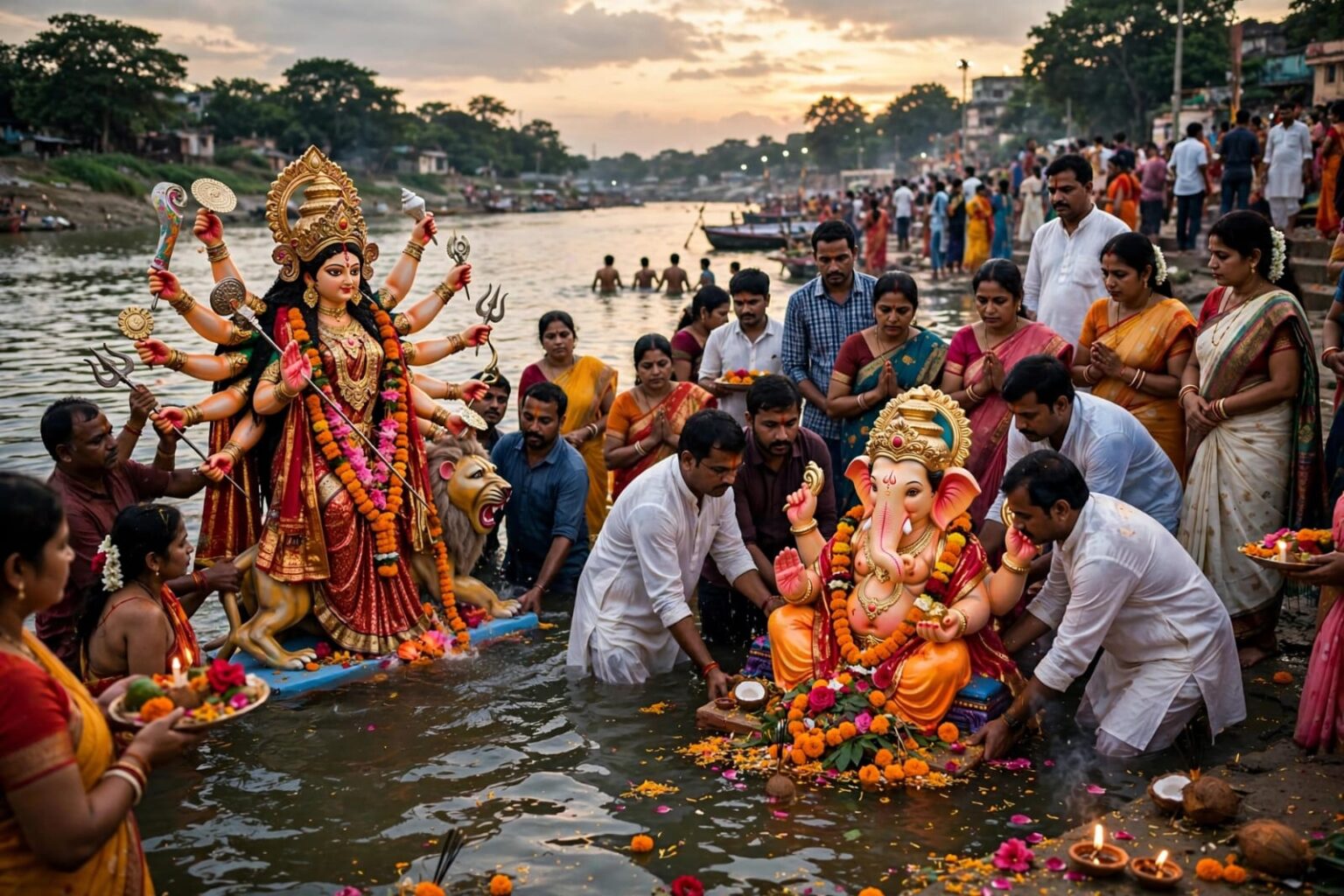

India’s grand festival season—featuring major celebrations like Ganesh Chaturthi and Durga Puja—has historically carried a heavy environmental toll due to the traditional water immersion (visarjan) of large idols made of Plaster of Paris (PoP) and painted with toxic heavy metals (lead, mercury, cadmium). These materials severely damaged water bodies, causing oxygen depletion, water turbidity, and aquatic life loss.
Environment Pulse Desk: With the monsoon clouds wearing thin and the air crisp with its initial whiff of autumn, two of India’s biggest festivals arrive in immediate succession — Ganesh Chaturthi and Durga Puja. Both end the same way—they involve carrying lakhs of exquisitely sculpted idols through a city, down to a river or lake or sea and lowering them into water in an event called visarjan. It is one of the most beautifully orchestrated traditions in this country — drums, colour, tears and joy mixed together. For decades, however, this annual ritual also quietly carried a steep environmental price tag – and only in the last fifteen-odd years has that started to change for real.
Getting too comfortable for too long was the problem no one spoke about
Historically, idols made out of river clay, straw and bamboo — biodegradable material that dissolves back into the earth without too much trouble. Eventually at some point, as the festivals got bigger and taller and more grandiose, Plaster of Paris came in to replace it because it’s cheaper and it holds fine detail and dries faster. The catch is that PoP decomposes in water only after prolonged periods. It simply languishes at the bottom of lakes and rivers for months, even years. To that you add the synthetic paints used to animate idols — many with lead, mercury, chromium and cadmium — and what you have is a slow poisoning of the same water bodies being worshipped.
Similar trend, the researchers monitoring rivers like the Hooghly and several lakes in Maharashtra and Karnataka found from their water quality tests after every immersion season that dissolved oxygen went down, turbidity soared and heavy metals entered aquatic life. Fish kills following big immersion days came to be a grim, regular news item in some cities. It simply could not go on, and slowly but surely the courts, pollution boards and communities themselves began to fight back.
Ganesh Chaturthi’s Quiet Green Revolution
Ganesh Chaturthi, huge in Maharashtra, was the first festival under real pressure to change — Vijay told me this happened partly due to the large-scale Ganpati idols that Mumbai is known for and partly because lakes (Powai and Vihar specifically) couldn’t take any more damage from these trucks year-on-year. The reply was rather exhaustive. Popular clay Ganesha idols, or shadu maati murtis, have made a roaring return thanks to eco-friendly artisans and the support of celebrities. Today, so many housing societies hold “eco-Ganpati” competitions and urge families to bring home smaller Ganesh idols of biodegradable natural clay that can be immersed in a bucket at home rather than taken out to a lake at all.
Cities have spent millions on giant inflatable tanks — enormous mobile swimming pools erected solely for the purpose of making sure idols never make contact with a natural water body in the first place. Dozens of such tanks have come up in Pune, Mumbai and elsewhere during the festival where municipal workers segregate flowers and decorations, safely dispose of PoP idols, even recycling idol clay for gardens. In recent years, Nagpur has gone a step ahead and virtually wiped out direct immersions in the natural lakes. It isn’t a perfect system — enforcement remains patchy, and many larger pandals still favour PoP for the finer detailing it permits in their community shapes — but the direction of change is clear.
The Same Story: How it goes in Durga Puja
Durga Puja, with its heartland in Kolkata, but reaching far and wide across West Bengal, Odisha, Assam and beyond, has had a startlingly similar trajectory — only wrapped up in local accoutrement. In 2020, the Central Pollution Control Board came out with guidelines that gave formal shape to the movement: idols made of natural clay, only biodegradable colours, no single-use plastic and thermocol, immersion zones and proper clean-up post-immersion.
In West Bengal, there has been a sincere and real transition toward lead-free, natural colour and several thousands of idols are now painted with these cleaner colours than what was being done 10 or even two decades ago. Some of the civic bodies in Kolkata, for example, have even been resourceful with logistics — using cranes to quickly lift immersed structures from the river before any toxic elements can leach into the water; on the other hand a few community pujas have begun dissolving idols within their own pandals instead (using jets of water or fire hoses for this liquidisation), thereby completely circumventing having to process them by taking them all the way to the river. The ritual is still revered – just under cover.
Even artificial ponds, as can be seen here — like Maharashtra did with Ganpati. Dozens of such temporary immersion ponds are created in Delhi during Durga Puja and Doljatra which lies right next to diwali while similar facilities exist in Jamshedpur, Gorakhpur and parts of Odisha. Then there is an increasing custom at the household level of soaking idols in tubs at home and watering potted plants with that water — a small act, but one multiplied across thousands of homes.
What’s Changing Beyond the Idols
Both festivals, in fact, are becoming our speakers to a lot wider environmental messages other than cleaner immersions. Over a period of time, several Durga Puja pandals have constructed their whole concepts around climate change or biodiversity and even sustainable living, allowing the festival to become an informal classroom for millions. Ganpati mandals are also starting similar trends (some of the zero-waste decorations using only recycled materials has received prizes.)
The Work That’s Still Left
This doesn’t mean that the problem is even partially solved. There is a limit to how much volume they can accommodate in these artificial ponds and even in smaller towns where the civic infrastructure is weak, old ways are entrenched just because clay idols cost money and take time to create. In many high-budget pandals and pandals-turned-tourist-attractions, it is aesthetic preference that still sways favour to PoP and its sharp detailing. And testing water quality post-festive season is still not uniform across all states.
That said, the course of the past decade is not questionably obvious: an unquestioned ritual — idol goes in, festival done — has turned into a thing communities think about, plan around and in increasing measures attempt to do better each year. The devotion hasn’t changed one bit; it’s just the how that is being quietly rewritten with lumpen clay and artificial ponds, one at a time.


