

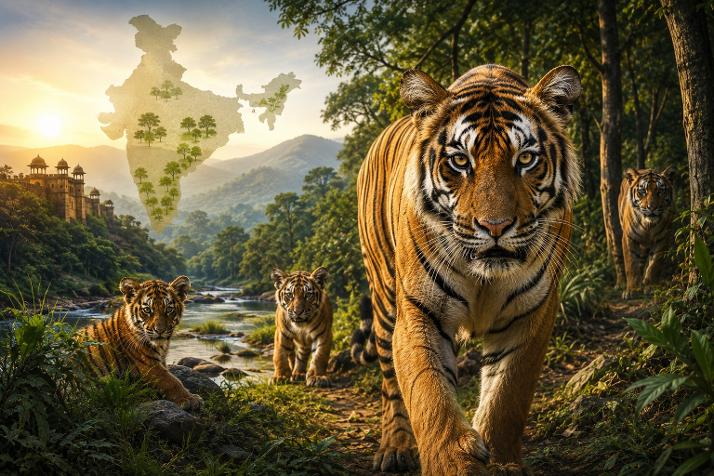

For a country that came close to losing its tiger population, the turnaround is genuinely remarkable
Make sure that tiger`s habitats stay connected and climate-resilient
Environment Pulse desk
India boasts being the World’s Tiger Capital India has always cherished its prized wild cats. Every year on July 29, the world marks International Tiger Day. A date that remains etched in memory for the 2010 St. Petersburg Tiger Summit, where leaders from 13 tiger-range countries set an ambitious goal: double the global wild tiger population by 2022. The 3,200 tigers surviving in the wild baffled all. That target was actually hit, and then some — recent estimates put the global count at around 5,711 tigers, a rise of roughly 78% since 2010. India’s share of that story is enormous. The country is now home to nearly 70% of all wild tigers on the planet, making it, without much competition, the most important place on Earth for this species’ survival.
A national symbol with deep roots The tiger has been embossed on old coins, royal seals, and temple carvings that showcase the majesty of one of India’s greatest symbols. That history is part of why the government named the Royal Bengal Tiger India’s national animal back in 1972, and why tiger conservation here has never been purely a wildlife issue. By saving the wild cat, India aims to nurture the forest ecosystems — the rivers, the soil, the pollinators, even the local climate. Millions to this date, depend on those forests for their livelihoods. From crisis to comeback Its not always been a very happy story when it comes to the tiger. Recent stories show that the tiger population has just doubled since 2006, according to the most recent All India Tiger Estimation in 2022, which counted 3,682 tigers. It also included, for the first time, a nationwide count of ungulates — the prey species tigers depend on. The machinery behind the numbers This stunning reality is not accidental. Project Tiger has been a very important initiative of the government which has been running for decades now. Its still run by the Ministry of Environment, Forest and Climate Change.
It oversees 58 tiger reserves spread across 18 states, covering about 84,500 square kilometres — roughly 2.56% of India’s entire landmass. Overseeing all of this is the National Tiger Conservation Authority, set up after a 2006 overhaul of the Wildlife Protection Act — reforms that came out of a Tiger Task Force formed to fix what wasn’t working in the country’s conservation approach.
The same reforms also created the Wildlife Crime Control Bureau. The NTCA, chaired by the environment minister and staffed with MPs, officials, and outside experts, signs off on conservation plans for every reserve and keeps tabs on how well they’re actually being run — not just on paper. Each reserve, by design, has a heavily protected core area plus a buffer zone where conservation and local livelihoods have to coexist, and wildlife corridors link reserves together so tiger populations don’t become isolated islands. Technology has changed the game Counting tigers used to be guesswork. Now it’s closer to a data science operation. A system called M-STrIPES uses GPS and remote sensing for field monitoring, while AI tools do a lot of the heavy lifting — one, called CaTRAT, automatically sorts camera trap images by species, and another, ExtractCompare, identifies individual tigers by their stripe patterns, much like a fingerprint. The camera trap survey behind the 2022 count actually holds a Guinness World Record as the largest of its kind ever conducted. There’s also a separate evaluation system that grades how well individual reserves are managed — by 2022, 51 reserves had been assessed, 12 of them rated “Excellent,” with an average score of 78%.
Looking beyond India’s borders India isn’t doing this in isolation. It works with Nepal and Bhutan on cross-border conservation, with Myanmar on curbing timber trafficking, and with Russia on camera trap data and big cat research more broadly. It’s also built partnerships with countries like Botswana, South Africa, Kenya, Namibia, Cambodia and Guatemala, and even has bilateral cooperation with China on tiger conservation specifically. As early as 2024 India established what is now called as the International Big Cat Alliance, a coalition that brings together 95 countries and organizations working across seven big cat species — tigers, lions, leopards, snow leopards, cheetahs, jaguars and pumas. With such interest in India, the headquarter in India leads charge.
The collective resolve drives the Global Tiger Forum, the only intergovernmental body focused solely on tigers, bringing together 13 tiger-range nations from Bangladesh to Vietnam. What’s next For those on the lifelong tiger trail, the challenge has gone beyond counting tigers — it’s making sure their habitats stay connected and climate-resilient. This is being ensure through continued investment in monitoring technology, better-trained frontline forest staff, and international knowledge-sharing. For a country that came close to losing its tiger population entirely a few decades ago, the turnaround is genuinely remarkable – though most conservationists would say the work is far from finished.
Also Read: Lucknow’s Kukrail Night Safari: Setting a New Standard for Urban Eco-Tourism