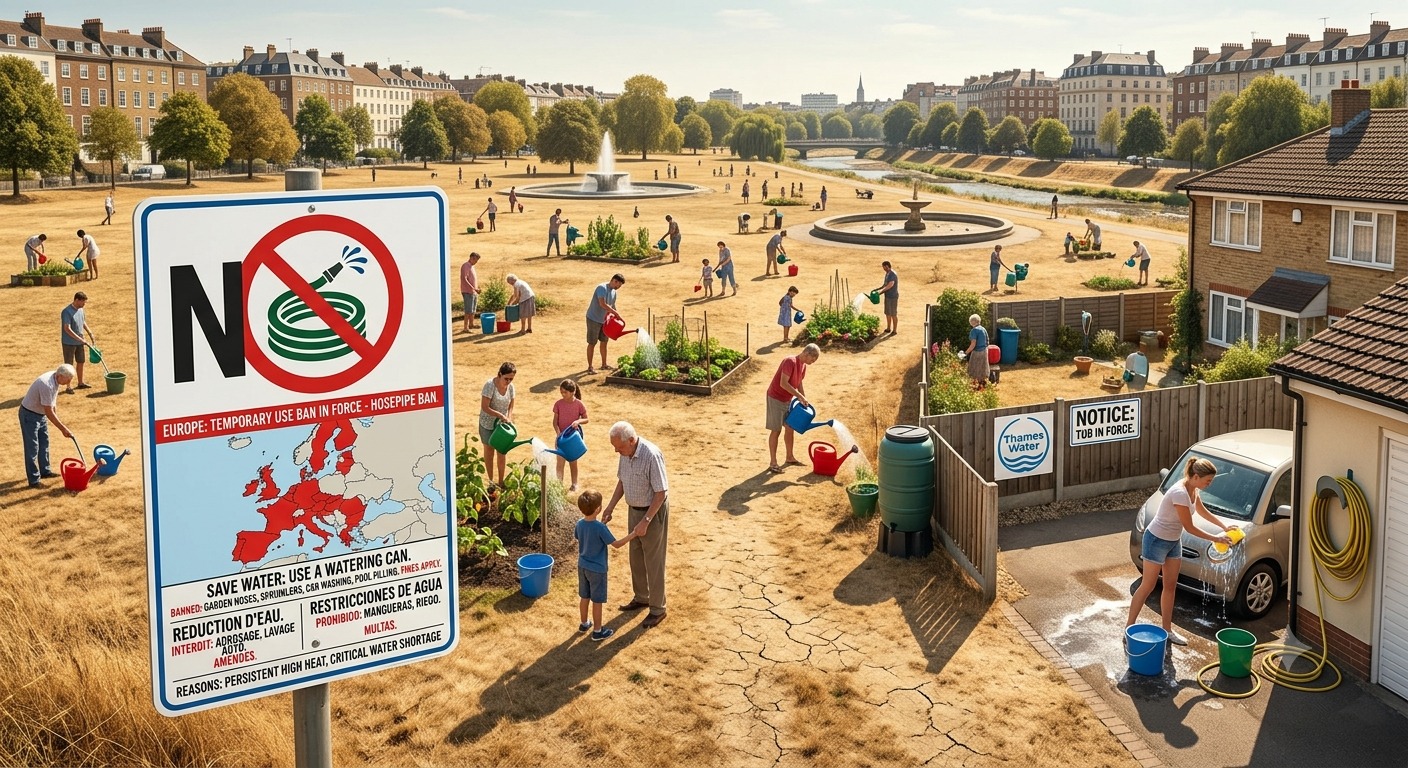
By the end of summer, an official drought has been declared across approximately 71% of England’s land area, affecting around 30 million people. Companies such as Thames Water and South East Water have implemented Temporary Use Bans (TUBs), prohibiting the use of hosepipes for gardening, car washing, and filling pools.
Environment Pulse Desk: It’s late summer in England, and across the country, gardens are turning brown. In households from London to Lancashire, people are watching their lawns wilt, learning to love their weeds, and becoming oddly intimate with their watering cans.
Welcome to the hosepipe ban era—a reality that’s now affecting around 30 million people across more than half of England. And it’s showing no signs of letting up anytime soon.
When Half the Country Runs Dry
By late August 2026, the numbers told a stark story. The Environment Agency classified roughly 71% of England by land area as being in official drought conditions. Let that sink in for a moment: nearly three-quarters of the country.
It’s not some localised dry spell that’ll sort itself out with the next decent downpour. This is the result of a relentless combination: successive heatwaves that have baked the ground hard, rainfall so low it’s barely worth mentioning, and reservoirs that have quietly dropped to worryingly low levels.
“The summer has been brutally dry,” one meteorologist might say. For the rest of us living through it? It feels like the weather’s forgotten how to rain.
What You Can’t Do Anymore
The restrictions creeping into daily life are becoming familiar now. Water companies across the country—Thames Water in London and the Thames Valley, South East Water, Anglian Water, Affinity Water, and others stretching as far as parts of west Wales—have all imposed what they’re officially calling Temporary Use Bans (TUBs).
It’s a rather dry acronym for what’s essentially a nationwide inconvenience.
Forget watering your garden with a hosepipe. Say goodbye to casually spraying down the patio or washing the car with a hose. Paddling pools? Swimming pools? Not happening. Even window cleaning with a hosepipe is off the table. The hosepipe, it turns out, is the thirsty villain in this story.
But before anyone panics too much: you can still have a drink, cook a meal, or take a shower. The ban doesn’t touch the essentials of life. It’s the extras—the habits we barely thought about before water became precious—that have to go.
And there’s a workaround for the truly devoted gardener: a watering can. Low-tech, slightly annoying, but perfectly legal. Some people are also collecting rainwater in buckets and butt, pretending they’re channelling their inner pioneer.
A Continent in Crisis
This isn’t just an English problem, though it’s hitting hard here. Travel across Europe and you’ll find the same story playing out at continental scale.
The Danube, one of the world’s great rivers, has dropped to historic lows. Shipping traffic is grinding to a halt. Nuclear power plants in Hungary and Romania are having to reduce output because there’s not enough water to cool them. Spain and France are wrestling with severe soil moisture deficits, watching their crops struggle and their wildfire risk climb. It’s a cascading crisis that nobody quite planned for.
Scientists are pointing the finger at climate change. Not as some distant future threat, but as something happening right now. Extreme dry conditions are becoming more frequent, more intense. The pattern we’re living through—the kind that would have been rare a generation ago—is now part of the weather we can expect.
The July That Wasn’t
July 2026 will be remembered, if it’s remembered at all, as unusually dry. In some parts of England, the rainfall was a fraction—an actual fraction—of what normally falls. It’s the kind of statistic that sounds abstract until you realise your water company is meeting weekly to figure out how to ration water for millions of people.
Reservoir levels across the country are sitting well below where they should be at this time of year. River flows are alarmingly low. Groundwater sources, which usually provide a reliable backup, are feeling the pressure too. Everything that keeps the taps flowing is stressed.
What Happens Next?
The National Drought Group—yes, that’s a real thing, meeting every week now—is working through scenarios. Water companies are sending out the same message on repeat: fix those leaky taps, take shorter showers, stop using water for non-essential things.
But here’s the uncomfortable truth being quietly discussed in official circles: recovery won’t come from a few months of conservation efforts. It will require something far more significant: proper, sustained rainfall through autumn and winter. The kind of wet, grey British weather that everyone complains about would, right now, feel like a blessing.
Without it, the bans won’t just continue. They’ll probably get stricter. Other parts of the country might join in. What’s currently an inconvenience could become a real hardship.
Living With Less
For now, millions of English people are adjusting. Gardeners are learning to let nature take its course (or rather, to not take its usual course). Car owners are getting used to a bit of dust. Patio cleaners are discovering that paths can look rustic.
It’s a small sacrifice, most people agree. But it’s also a peculiarly modern form of anxiety—the realisation that something as basic as water, something that’s always flowed from the tap, can’t be taken for granted anymore.
If you want to know whether your specific address is under a hosepipe ban, most water companies now have online trackers. Chances are, unless you’re in the far north or far west, you probably are.
For now, the advice is simple: conserve, adapt, and hope that autumn brings the rain Britain’s parched earth desperately needs. Because right now, more than half of England is banking on it.
Also Read: Natural Disasters Spark Renewed Scrutiny of Hill Station Construction in India