


How Solar Power Is Changing Life in Rural India
It has significantly transformed the face of the villages
Environment Pulse desk
Uninterrupted electricity supply has long remained a dream for many villages in India. This has been due to power outages, weak grid connections, or a complete lack of connectivity. Consequently, people have long relied on kerosene lamps and diesel generators—options that are not only expensive but also polluting and somewhat hazardous. Solar energy is now transforming this situation, reshaping the landscape of these villages.
New age electricity for a greener future
As villages evolve, they are now on the road to a new kind of renaissance. In the new day and age, it is new solar power sources like Rooftop panels, home solar systems, and mini-grids that are helping rural folk see brighter times. That means lights that stay on, phones that charge, fans that run, and evenings that no longer end the moment the sun goes down.
In what can be called a boon, solar power is far more economical than what the grid offers. From the local demand and proper upkeep lens, this is a win – win. For families, that translates into real savings and better quality of daily life.
A lifeline for farmers
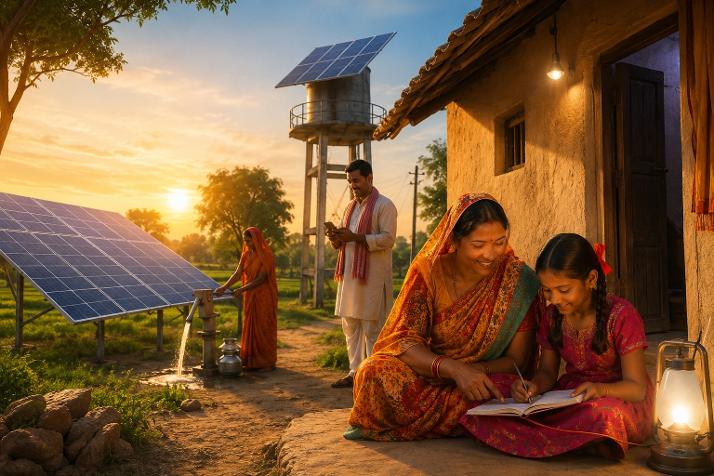
Agriculture runs on water, and water pumps run on power — which is exactly where solar has made one of its biggest differences. Through schemes like PM-KUSUM, farmers are swapping out diesel pumps for solar ones, irrigating during daylight hours when the sun’s doing the work anyway. That cuts fuel costs, often to nothing, and gives farmers more control over their water use and, in turn, their yields. Some can even sell surplus electricity back to the grid or lease out barren land for solar installations — turning what used to be unused land into a source of income.
Better classrooms, better learning
Kids studying by kerosene lamp is a familiar image in rural India, and not a great one — dim light, health risks, and shortened study hours. Solar lighting cuts down the depended on conventional electricity sources. Building futures, schools get reliable power which in turn helps fans, computers, and projectors run seamlessly. This is good for both comfort and learning quality. Students in school now don’t have to suffer from the perils of poor infrastructure.
Keeping clinics running
Health centres in rural areas often struggle with the same erratic power supply — which is a much bigger problem when it means spoiled vaccines or diagnostic machines that won’t turn on. Greater emphasis on solar power has had a reasonably positive impact on cold chains, powering basic medical equipment, and making sure light is available during emergencies. It may not be too upmarket, but it’s the kind of infrastructure improvement that saves lives.
New jobs, and a real shift for women
Installing and maintaining solar systems creates local jobs, and productive uses of solar power — mills, dryers, cold storage — are helping small rural businesses get off the ground. For homemakers (women) the tangible benefits are very visible. They spend lesser time and energy on gathering fuel. There is lesser time spent on manual labour as well. This in turn means more time for school, work, or running a small enterprise. With a boost to greater gender equity there are real-time gains in income, skills, and confidence among women in these communities.
Cleaner air, less noise, better health
Moving away from kerosene and diesel isn’t just about cost — it’s about the air people breathe indoors and the pollution communities are exposed to daily. Study suggests that with lesser smoke there are chances of fewer respiratory problems. It is also believed that regulated diesel generators active can bring down noise pollution, cleaner atmosphere. It’s a smaller, but no less important, part of the story.
The policy pushes behind it all
Two government programs are doing much of the heavy lifting here. PM-KUSUM focuses on solar-powered agriculture — pumps, decentralized plants, and letting farmers generate and sell their own power. PM Surya Ghar Muft Bijli Yojana targets households directly, aiming to give a large number of homes free electricity (up to a certain usage limit) through rooftop solar subsidies. Together with earlier rural electrification efforts, they’re steadily expanding both access and what people can actually do with that access.
Some villages have gone all-in on rooftop solar and seen their electricity bills drop to virtually nothing — in some cases even generating more power than they use and feeding the surplus back into the grid.
The bigger picture
None of this happens without real challenges — upfront costs, maintenance needs, storage for nighttime use, and making sure the benefits reach everyone equally, not just those who can afford to get started first. But where it’s working, the impact is hard to miss. Solar power is helping rural India move away from energy scarcity and toward something more self-sufficient — better-lit homes, functioning schools and clinics, stronger farms, new income streams, and cleaner air to breathe. It’s not a single fix, but it’s a foundation a lot of other progress can be built on
Also Read: India’s efforts towards tiger conservation are praiseworthy at the international level