

Across the country, there are many people who support this project, while a large number oppose it.
Both sides have their own arguments; the project has become a case of development versus the environment.
Environment Pulse desk
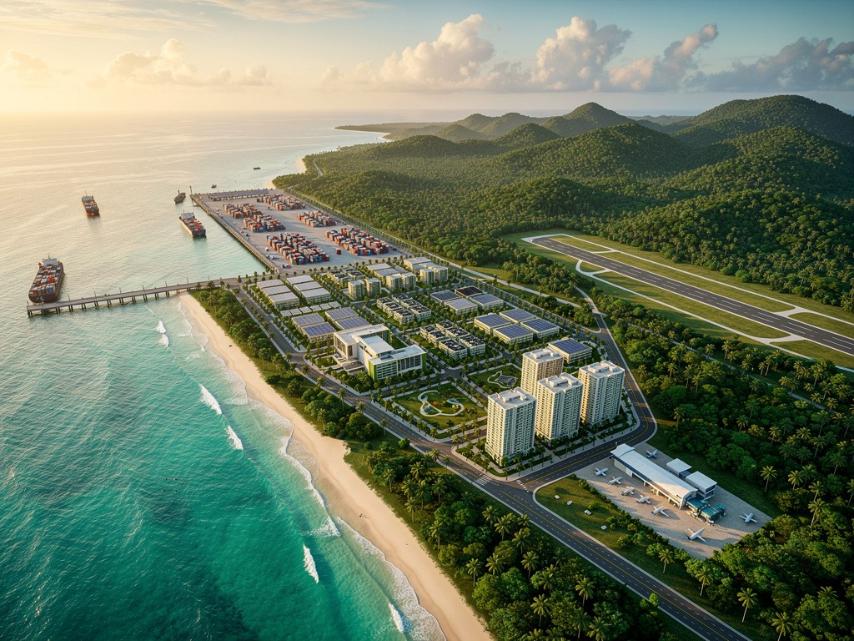
There have been fervent pleas and rallying cries around what is now popular as the widely known The Great Nicobar Project. It happens to be one of the very few infrastructure projects that have raised alarm bells. As per estimates — a sweeping ₹81,000-crore ($8.5–10 billion) plan conceived by NITI Aayog eyes turning the remote, southernmost island of the Andaman and Nicobar chain into a major strategic and commercial hub.
While ambition drives this blueprint. The core remains an International Container Transshipment Terminal at Galathea Bay which will handle millions of containers annually, a dual-use airport serving both civilian and military purposes, a 450 MVA power plant running on gas and solar energy, an entire township, tourism resorts, and connecting infrastructure like expressways and desalination plants.
Once live it would develop about 166 square kilometres — roughly a fifth of the island — over a span of three decades. Strategically its proximity to the Strait of Malacca, one of the world’s busiest shipping corridors, makes it a crucial point. Once this turns real, India will no longer have to depend on foreign ports such as Colombo and Singapore. This will also boost employment, strengthen India’s defence footprint in the Indo-Pacific to counter Chinese presence, and support broader initiatives like Sagarmala and Act East.
While those spearheading the initiative cannot stop boasting of the positives, those who hae started upping the ante are rather terse in their observations. The plan has run into a wall of resistance from environmentalists, tribal rights advocates, scientists, opposition leaders, and international experts alike.
Experts who are raising doubts on the intent warn that any major changes could have a massive impact on India’s last untouched, biodiversity-rich ecosystems.
A closer look at the finer points shows that Great Nicobar is home to dense rainforest with unusually high levels of endemic species, along with coral reefs and other fragile habitats. Government estimates show close to 9.64 lakh trees will be required to cut down to clear over 130 square kilometres of forest. Naysayers point out that number may fall short of the real toll, given how thick the island’s forest cover actually is.
Galathea Bay itself is both a nesting ground for the endangered leatherback turtle and a protected Ramsar wetland; dredging and coastal construction there could wreck coral reefs, disrupt marine food chains, and threaten species found nowhere else, including the Nicobar megapode, the Nicobar macaque, saltwater crocodiles, and various native birds and reptiles.
Understandably experts underline that gravity of the situation compounds, given its proximity to seismically volatile zone . Life here was majorly affected during the 2004 tsunami — meaning large-scale deforestation and mangrove clearance could hve an adverse impact on natural buffers against future disasters.
The Shompen — a semi-nomadic, hunter-gatherer tribe classified as Particularly Vulnerable, numbering only a few hundred people could very well lose their resting place with sweeping changes in Nicobar. At this scale — hundreds of thousands of people over the coming decades — raises fears of disease exposure for a community with little immunity to outside illnesses, as well as the erosion of their culture and loss of the land they forage on.
Few years back, in February 2024, a group of 39 genocide scholars from around the world wrote to President Droupadi Murmu, warning that even a scaled-down version of the project could prove fatal for the Shompen and might meet the international legal definition of genocide.
The Nicobarese community, too, faces displacement from ancestral villages — some of which were already damaged in the 2004 tsunami. Local tribal councils have since withdrawn their no-objection certificates, saying they were never properly consulted or asked for informed consent.
There are also serious questions being raised about how the project has been approved and pushed through. Critics say the environmental clearances, coastal zone approvals, and forest diversion permissions were based on weak impact assessments, altered maps — including changes to how coral reefs were mapped — and biodiversity studies that didn’t account for seasonal variation.
The government and project supporters, for their part, argue that mitigation steps — like wildlife corridors, relocating corals, offering alternative tribal reserves, and limiting access to sensitive zones — can manage these risks, and that the strategic and economic stakes justify moving forward.
At its core, the fight over Great Nicobar is a clash between two different visions of progress: near-term economic and geopolitical gain versus the irreversible loss of a unique ecosystem and the survival of some of the world’s most vulnerable indigenous communities.
Also Read: आज के कुछ समय पहले किसी ने सोचा भी नहीं था कि यहां इतनी गर्मी पड़ेगी