


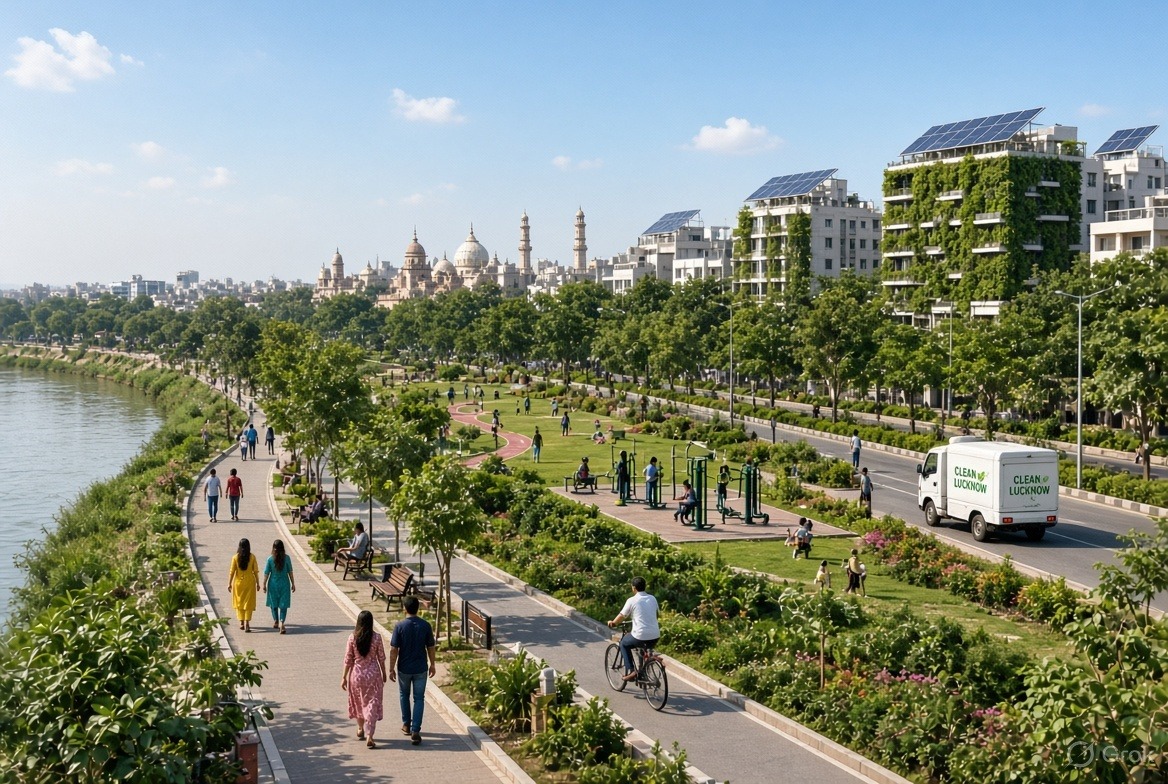

Lucknow is quietly transforming its urban landscape through a combination of large-scale green spaces, cleaner public transport, solar adoption, and waste-to-wonder projects. Ranked top in Swachh Vayu Survekshan 2026 among million-plus cities, the city is expanding its green cover via Miyawaki forests, vertical gardens, and a 19-kilometre blue-green Gomti corridor. Additionally, robust rooftop solar installations under the PM Surya Ghar scheme and mandatory rainwater harvesting are steering the city toward sustainable urban development.
Environment Pulse Desk: Six in the morning, and Janeshwar Mishra Park is already awake. Walkers loop the paths in twos and threes, a few joggers cut past the lake, and somewhere near the open-air gym a group of retirees is working through a stretching routine they’ve clearly done a hundred times before. Nothing about the scene looks engineered or ceremonial. It just looks like a city going about its morning. But scratch beneath that ordinariness and you find a fairly deliberate story: Lucknow, a city more often associated with nawabi kebabs and old-world charm than climate policy, has spent the last several years quietly rewiring how it breathes, moves, and grows.
This isn’t a single grand gesture — no one park or solar rooftop tells the whole story. It’s closer to a layering effect, the kind of change that shows up less in headlines and more in the texture of daily life: a shaded stretch of road that wasn’t shaded two years ago, an electric van humming past instead of grinding through gears, a neighbour proudly mentioning that their power bill has dropped since the panels went up.
Parks That Do More Than Look Pretty
Start with the parks, because they’re the most visible evidence that something has shifted. Janeshwar Mishra Park, sprawling across roughly 376 acres, is often cited as one of Asia’s larger urban parks, and its lakes and rainwater-fed water systems aren’t just scenic — they’re functional infrastructure dressed up as leisure space. Along the Gomti, riverfront stretches and biodiversity parks give residents a chance to walk among genuinely local flora and fauna without needing to leave city limits.
The ambitions don’t stop at what already exists. The Lucknow Development Authority has been pushing forward on an eclectic mix of additions: an interactive aviary planned for the Gomti Bio-Diversity Park, hundreds of open-air gyms distributed across the city’s parks, an “Insectopedia” feature tucked into Eco-Garden, and a five-senses themed park coming up in CG City complete with jogging tracks, sports arenas, a water body, and even a green-roofed library. A roughly Rs 150 crore initiative is meanwhile aimed at overhauling about fifty existing parks — adding play areas, proper tracks, seating, lighting, and toilets, along with noticeably denser landscaping. Newer spots like Harmony Park are experimenting with a mix of fitness zones, music, and art made from recycled material, which says something about the direction the city’s park-planning imagination is headed.
Then there’s the smaller, less photogenic stuff that may matter just as much: Miyawaki-style mini-forests and so-called “oxygen parks” are being planted in whatever pockets of space the city can spare, part of a broader push under the Green Lucknow Mission 2030 that also includes ten dedicated urban forests. These aren’t grand destinations — they’re the kind of green patch you might not consciously register but that quietly cools the block it sits on and gives kids somewhere to play that isn’t a parking lot. Vertical gardens along roads and junctions do similar work at an even smaller scale, softening hard edges that would otherwise just radiate heat back into traffic.
Longer term, there’s a vision — still unfolding — for nearly 19 kilometres of the Gomti riverfront to be transformed into a continuous blue-green corridor: city forests, wellness parks, eco-trails, botanical gardens, yoga zones, and promenades strung together. Alongside that sits the conservation of urban lakes like Motijheel, adding accessible water features back into a landscape that’s spent decades treating its rivers and lakes as afterthoughts.
Cleaner Air, Quieter Streets
None of this exists in isolation from the air people are actually breathing. Lucknow topped the Swachh Vayu Survekshan 2026 rankings among million-plus cities, a result that reflects a fairly unglamorous mix of interventions — mechanized street sweeping using electric machines, road restoration to cut down on dust, and tens of thousands of new plantings layered on top of the Miyawaki forest push. One ward even ranked first nationally in its category, suggesting the improvements aren’t just concentrated in a few showcase zones but are reaching down to the mohalla level.
The municipal fleet tells its own version of the story. Electric and CNG vehicles now handle much of the city’s waste collection and public transport, and door-to-door collection has been extended to cover the large majority of households. Former dumping grounds have been converted into actual parks — Rashtra Prerna Sthal, for instance, now stands where waste once piled up, replanted with a substantial number of trees. Some sites have gone further, turning old debris and recycled material into public art under a “waste-to-wonder” concept, which is either a clever bit of civic branding or a genuinely useful way to make cleanup feel less like punishment and more like renewal — possibly both. Home composting campaigns round out the picture, nudging residents to deal with organic waste at the source rather than sending it downstream.
Solar Roofs and Underground Rain
Perhaps the most quietly significant shift, though, is happening on rooftops. Lucknow has emerged as one of the leading districts under the PM Surya Ghar rooftop solar scheme, crossing well over 100,000 installations by mid-2026, with new panels going up even in the city’s older, denser neighbourhoods. The appeal here is straightforward — lower electricity bills, less reliance on the grid, and some dent in the urban heat island effect that comes from acres of unshaded rooftop.
Underground, or rather beneath the surface, rainwater harvesting has become mandatory for larger plots, with the Lucknow Development Authority enforcing the requirement at the map-approval stage. Thousands of approvals have incorporated these systems since 2019, though — as with most infrastructure mandates — maintenance in existing high-rises remains a work in progress rather than a solved problem. Parks are increasingly designed with sponge-like drainage built in, meant to recharge groundwater rather than just funnel rain into overwhelmed storm drains.
The Unfinished Middle
It would be dishonest to frame this as a finished project. Lucknow’s built fabric is dense in a way that limits how many large new parks can realistically appear, groundwater stress hasn’t gone away, and young plantations plus harvesting systems both need the kind of ongoing maintenance that’s easy to promise and harder to sustain year after year. Some of this is aspiration running ahead of execution — plans for hundreds of kilometres of new footpaths and cycle tracks exist on paper well before they exist under anyone’s feet.
But the direction is fairly unmistakable. What’s notable isn’t any single park or policy — it’s the sense that greening has stopped being a special project handed down from the top and has started becoming, in fits and starts, part of how the city just operates: the walk to work, the bill that comes each month, the van that collects the trash, the patch of shade that wasn’t there before. Cities rarely transform all at once. Lucknow’s version seems to be arriving one rooftop, one park, one electric van at a time.



Thanks a lot.