


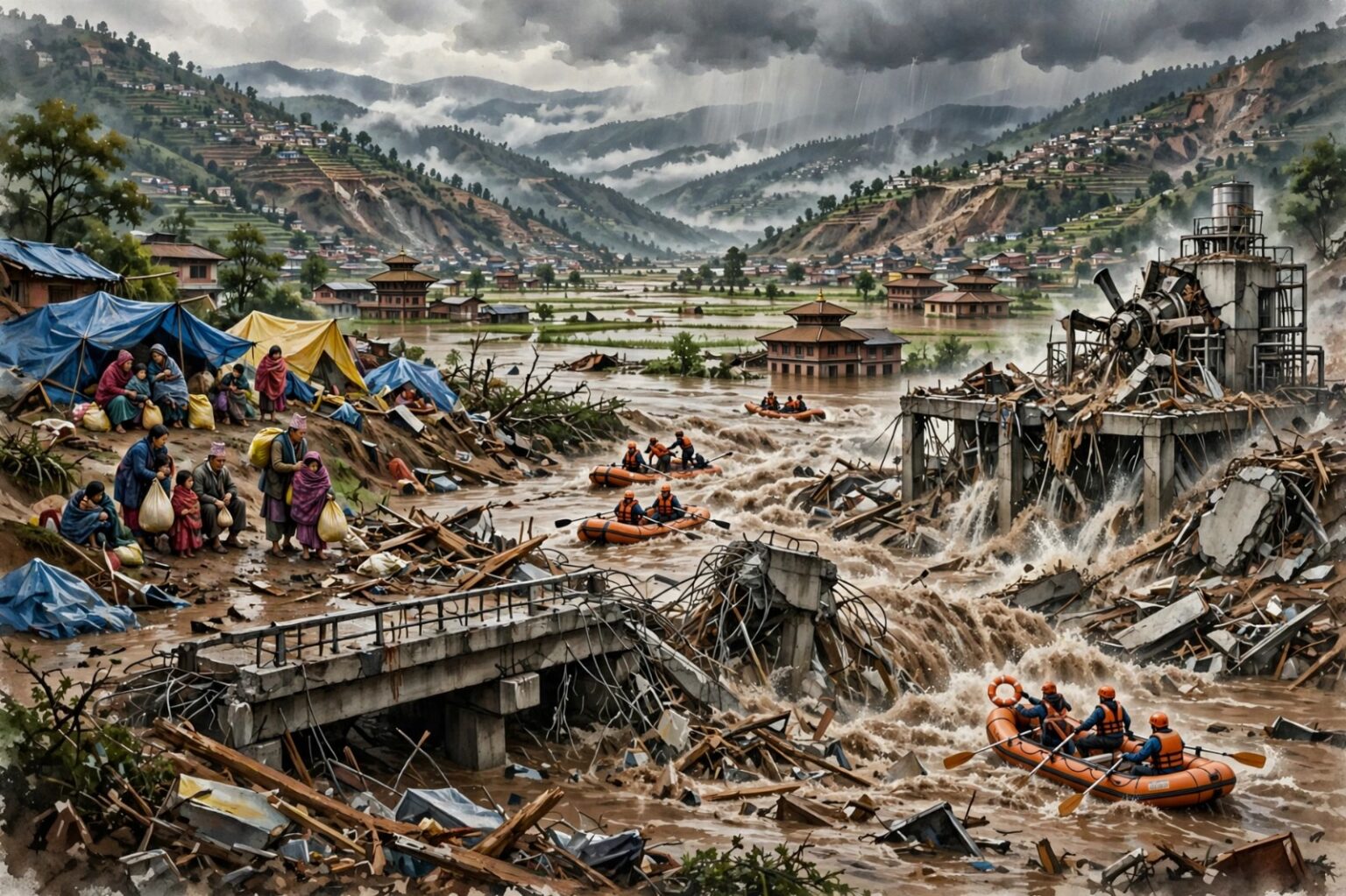

Nepal faces escalating climate risks as extreme weather events like the floods of 2024 and 2026 supercede traditional hazards like earthquakes and landslides. Driven by melting Himalayan glaciers (which lost 65% more ice between 2011–2020 compared to the previous decade) and intense monsoon patterns, these disasters have heavily impacted human life and infrastructure. The September 2024 floods killed over 200 people and caused 17 billion Nepalese Rupees in damages, while the catastrophic glacier-triggered flash floods along the Bhote Koshi-Trishuli corridor in August 2026 resulted in 1,455 deaths, over 5,200 missing individuals, and up to $2.7 billion in overall economic and physical damages. Critical trade routes, 10.6% of the nation’s energy capacity, and local communities were severely disrupted, prompting the World Bank to provide $170 million in emergency aid while urging long-term climate-resilient planning away from high-risk river corridors.
Environment Pulse Desk: Nepal is most widely recognized for earthquake and landslide hazards, however, the floods of 2024 and 2026 are examples of how hazardous heavy rain is becoming. Extreme rainfall events have had a severe impact upon human life, infrastructure and the economy.
The country lies within a geographic area with heavy rainfall from the monsoon season; glaciers are melting; and many people depend upon the use of rivers for transportation, trade and the generation of electricity. According to the International Centre for Integrated Mountain Development (ICIMOD), the amount of glacial ice lost in the Himalayas during the years 2011-2020 was 65 percent greater than what was lost during the prior ten-year period.
September 2024: Floods across the country
Heavy rains that fell over much of Nepal during late September 2024 caused widespread flooding and landslide activity. During the period of September 28th and 29th, the Kathmandu Valley experienced rainfall amounts from 240 mm to 322.2 mm. At Tribhuvan International Airport (TIA), there were records of 239.7 mm of rain within 24 hours. This was significantly higher than TIA’s previous daily rainfall record of 177 mm, which had occurred in 2002.
In total there were over 200 deaths, approximately 150 injuries and around 30 people uncounted for. There were also about 13,000 rescues.
The first week of flooding damaged 25 bridges, 37 highways, and 11 hydroelectric power plants. Early reports estimated that the flooding caused over 17 billion Nepalese Rupees (approx. $127 million USD) worth of damage. Many areas lost access to electricity, clean drinking water, schools, and homes due to the flooding. Communities were more vulnerable to the effects of the flooding because they had built on flood plains without proper planning or consideration for community development.
August 2026: Flash floods along the Bhote Koshi-Trishuli corridor
On August 26, 2026, a glacier-triggered mass movement at the Nepalese-Chinese boundary caused a rapid increase in water volume (flash flood) and mudflow (debris flow) into both the Bhote Koshi and Trishuli rivers. Settlements and public works projects throughout the Rasuwa, Nuwakot, and Dhading districts suffered extensive damage. According to the World Bank, this was one of the worst floods that Nepal had experienced for several decades.
Early in October, the Disaster Management Authorities of Nepal reported that 1,455 persons had died as a result of the disaster. In addition to those confirmed dead, there were 5,285 individuals who remained unaccounted for. Furthermore, 13,795 other individuals were able to be rescued. This means that many thousands of families will continue to experience the uncertainty of whether or not their missing family members are alive or deceased, whether they can receive some form of financial assistance (e.g., compensation, insurance claims) or if they will ever obtain official documentation confirming the death of their loved ones.
The World Bank estimates that the direct cost of damage to physical infrastructure was approximately US$1.66 billion. In contrast, the Government-led damage assessment estimated that the total cost of physical damage was roughly US$1.81 billion and that the overall effect (which includes the cost of lost production) would be about US$2.7 billion.
Trade and transport routes cut off
Flooding caused significant disruption to vital trading and transport networks. Over half (55 km out of 82 km) of the Galchhi-Rasuwagadhi highway corridor suffered damage, while approximately 40 km of it was completely washed away. A total of 37 motorable bridges and 68 suspension bridges have been either destroyed or damaged, thus isolating communities, markets, and border trade.
In terms of the most significant level of directly caused damage, Rasuwa was the worst affected, with Nuwakot being the next most affected area. The loss of roads and bridges makes transporting items more difficult, will slow down the process of rebuilding, and has made it harder for mountain communities to obtain basic service.
Hydropower and electricity hit
Energy infrastructure suffered a severe impact. Twelve hydropower plants and one solar plant were impacted; additionally, damage to transmission lines prevented more generation from being delivered. According to the World Bank, approximately 430.7 megawatts of generating and transmitting capacity were affected, which equates to roughly 10.6 percent of Nepal’s total installed hydropower and solar capacity for the 2026 fiscal year.
The damage illustrates that many of the energy projects developed along river valleys that are prone to flooding and landslides will be at risk. Also, power outages can lead to disruption of industrial operations, exports and overall economic activity.
Climate change and fragile infrastructure
The Himalayan region faces increasing challenges due to the effects of climate change, the melting of glaciers, excessive rainfall, and the instability of the land. In 2023, the International Centre for Integrated Mountain Development (ICIMOD) stated that glaciers located within the Hindu Kush Himalaya lost ice at a rate of 65 percent higher during 2011-2020 as compared to the previous decade. Although the loss of glacier mass alone cannot be used to account for any particular flooding event, it represents a significant factor contributing to the changing risk landscape of the area.
Experts and development agencies have pointed out how the pattern of settlements as well as infrastructure development affect vulnerability. When roads, bridges, power plants and houses are located within a narrow river corridor, then one extreme weather event will disrupt everything in the area.
Recovery is about much more than simply putting back what we lost. To build better, we must assess our risk again, find safer places to put up buildings and infrastructure, develop better ways to warn people when emergencies happen and make sure that we can get around and have power, water and other essentials even if things go wrong.
New financing for recovery
The World Bank has provided up to US $170 million in emergency aid to help Nepal address its short-term needs and begin repairing severely damaged infrastructure. In addition, the World Bank is urging Nepal to plan for long term disaster preparedness, including developing resilient systems so they are less susceptible to damage caused by future natural catastrophes, as opposed to rebuilding in high risk areas.
The overall point is that the financial impact of a flood does not stop after the waters recede. Families must continue to deal with the insecurity of their situation, community members will lose access to market places and other essential services, and the damaged infrastructure can negatively affect people’s ability to earn a living for months, even years.
Reducing future losses requires a strategy that includes climate adaptation, emergency preparedness, safe development planning, and adequate recovery funding. The August 2026 event demonstrates how an individual catastrophic occurrence can have widespread consequences across many aspects of society including; energy supply, commerce, and the overall economy.
Also Read: Decoding Environment from the Green Lens