


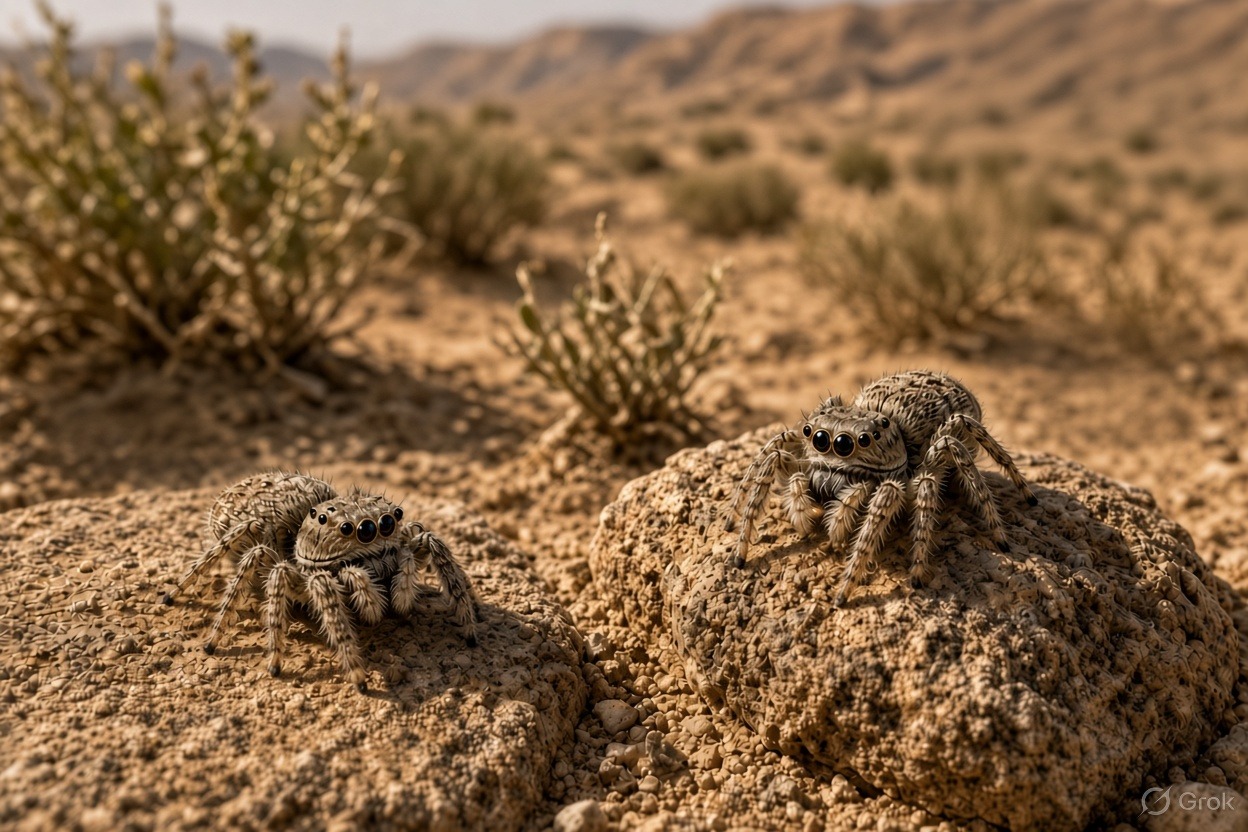

Scientists have discovered two new species of jumping spiders in India—Mogrus shushka, found in the arid landscapes of Rajasthan and Gujarat, and Mogrus pune, located within an urban biodiversity park in Maharashtra. Published in the European Journal of Taxonomy, the research also documented the first description of the male Mogrus rajasthanensis, recorded the first Indian occurrence of Mogrus larisae, and noted the discovery of Langelurillus udaipurensis near Udaipur. Together, these findings highlight the ecological richness of less-studied habitats like deserts and urban green spaces, emphasizing the importance of ongoing field research in uncovering India’s hidden biodiversity.
Environment Pulse Desk: Scientists have described two new species of jumping spider that had never been documented before in India; one is found on the arid lands of Rajasthan and Gujarat and the other is located within a urban bio-diversity park in Maharashtra.
The study that was reported on by the European Journal of Taxonomy contains the findings of a research project regarding the family Salticidae. Salticidae are commonly called “jumping spiders.” These spiders have very good vision and are small enough to leap onto their food rather than using web traps.
The new species are named Mogrus shushka and Mogrus pune.
Mogrus shushka has been recorded in the open, dry environments of Rajasthan and Gujarat. The holotype reference specimen of this species is from the Nimaaj area close to Chhatrasagar and other records have been documented in the Desert National Park. The name for this species derives from the Sanskrit word ‘shushka’ which means ‘dry’ as a reflection on the arid, barren landscapes of the Thar Desert area in which it occurs. Researchers have observed this species occurring in sparsely vegetated areas and therefore appear to be able to survive under such environmental conditions.
The Mogrus Pune species on the other hand, was found in a biodiverse park located within a heavily populated urban area. The finding of a unique species residing within a managed green area demonstrates that even very small protected areas may be able to support unique wildlife. Both of these spider species illustrate how adaptable the genus is, as there are many different types of habitats that members of this genus inhabit including harsh deserts and urban parks.
The study was conducted by a group including Rishikesh Tripathi. In addition to identifying the new species, the study added several valuable pieces of information to the scientific literature. The study provided the initial description of the male of Mogrus rajasthanensis, which had previously been described based on female specimens collected at Mt. Abu. The diagnosis for Mogrus rajasthanensis was completed using additional material obtained from Jaisalmer. Additionally, the team reported the first occurrence of Mogrus larisae in India. Mogrus larisae has been documented in Central Asia and some parts of the Middle East; however, the presence of Mogrus larisae in the Desert National Park provides evidence that there may be connections between the Thar Desert and the larger arid region spanning Africa and Asia.
Jumping spiders are some of the most visual arthropods. Their 8 eyes allow them to see almost 360 degrees around, and hydraulic pressure in their legs enables them to jump with great precision. These spiders eat small insects and thus are a type of biological pest control. Identifying each species of jumping spider can be difficult because most of the identifying features of these spiders are subtle and require close observation through microscopy to examine genitalia, body proportions, and color patterns.
Rajasthan has proven to be a good area for researchers. Researchers have also found a new species of jumping spider called Langelurillus udaipurensis in the rocky areas of Sajjangarh Wildlife Sanctuary near Udaipur. Scientists believe these findings demonstrate the importance of doing long-term field studies in India’s arid and semi-arid environments. These environments are less studied compared to India’s forests.
The findings have another implications for all of us – new species are being found in areas we may think have been extensively studied or modified by humans. Continued studies of deserts, rocky mountains, and city parks will continue to increase our knowledge of India’s spiders, their evolutionary history, and how best to protect these unique predators.
Also Read: Hidden Waters: Two Blind Fishes Beneath Assam and a New Seahorse Off Tamil Nadu


