


Lucknow generates between 700 and 780 million litres of sewage daily (MLD), but treatment capacity often lags significantly behind (around 450 MLD or less). This leaves at least 280 MLD of untreated sewage—flowing through major drains like Sarkata Nala and Haider Canal—to empty directly into the river, causing dissolved oxygen levels to plummet and faecal coliform counts to surge.
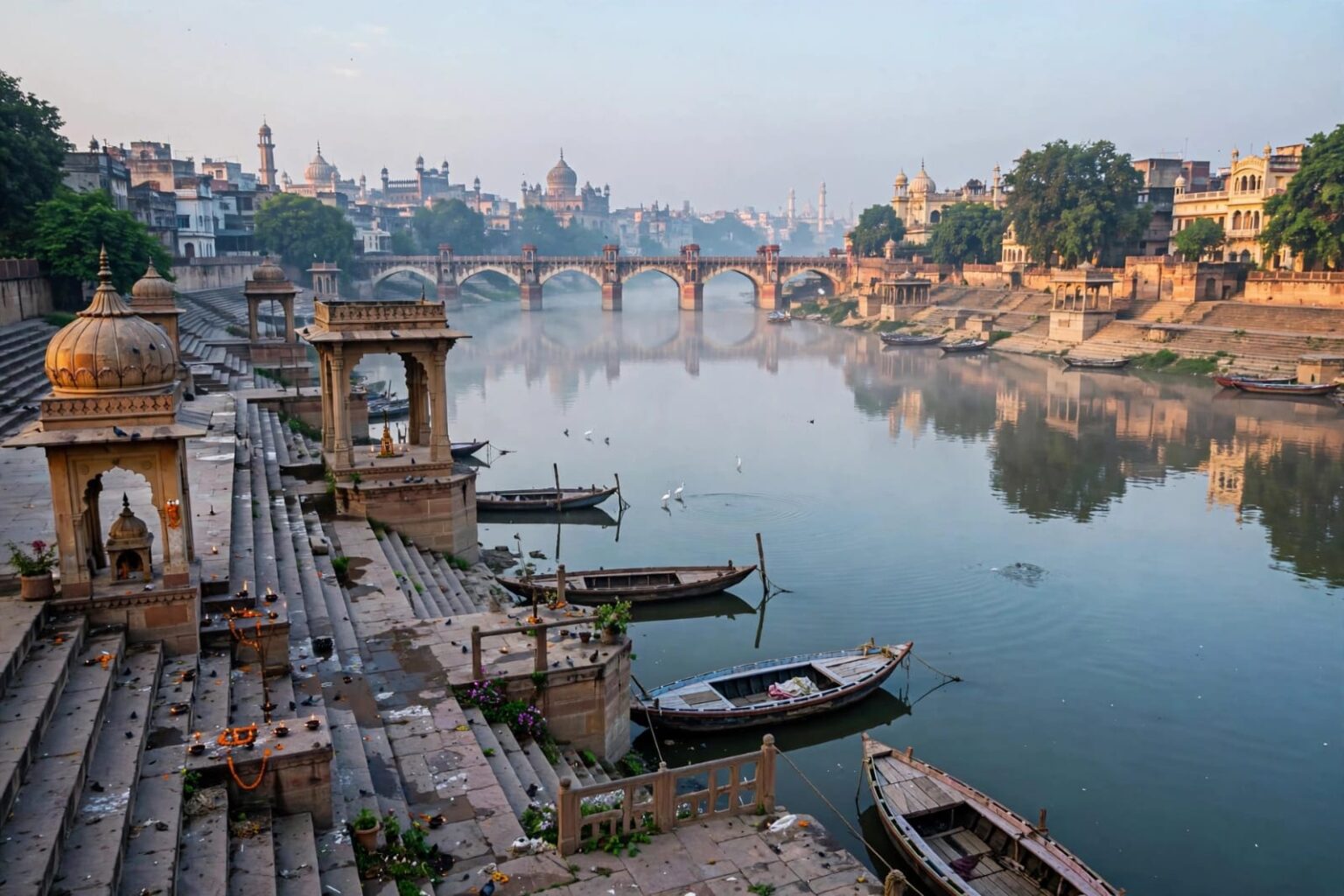
Environment Pulse Desk: Drive along the Gomti Riverfront in Lucknow on a pleasant evening, and it’s easy to be fooled. The walkways are landscaped, the embankments look neat, and families come out for their evening strolls along water that, from a distance, seems calm and manageable. But get closer, or better yet, look at what’s actually flowing beneath that placid surface, and a very different picture emerges — one of a river that has been pushed to the edge of ecological collapse, despite two decades and thousands of crores spent trying to save it.
The Gomti isn’t just another river running through a big city. For Lucknow, it’s practically identity — culturally, historically, and functionally, since the city draws hundreds of millions of litres from it every single day just to keep taps running. And yet, this same river has quietly turned into something closer to a slow-moving drain in its urban stretch, choking under the weight of sewage, silt, and decades of short-term fixes.
The Sewage Problem That Refuses to Go Away
The numbers tell an uncomfortable story. Lucknow generates somewhere between 700 and 780 million litres of sewage every day, but the city’s treatment capacity simply hasn’t kept pace — often functioning well below what’s needed, sometimes around 450 MLD or less when plants are actually running properly. That leaves a staggering gap, with estimates suggesting 280 MLD or more of untreated sewage flowing directly into the river through dozens of drains. Names like Sarkata Nala and Haider Canal come up repeatedly in reports as major, uninterrupted sources of pollution.
The consequences show up in the water itself. Dissolved oxygen levels in the Lucknow stretch routinely fall below what’s needed for aquatic life to survive. Faecal coliform counts run into the tens of thousands, far past safe thresholds. Add heavy metals, pharmaceutical residues, and industrial runoff into the mix, and you get a river that’s inhospitable to most of what once lived in it. Water hyacinth has taken full advantage of all those nutrients, spreading aggressively and further choking whatever flow remains. On top of that, roughly 10 metric tonnes of solid waste — plastic, construction debris, garbage from settlements along the banks — reportedly ends up in the river daily in some stretches.
Even where sewage treatment plants exist, they’re frequently operating below capacity or breaking down entirely, and stormwater drains often mix freely with sewage lines, defeating the purpose of treatment infrastructure altogether. Building more plants, experts point out, means very little if the interception system around them remains leaky and inconsistent.
A River Running Out of Water, Not Just Clean Water
Pollution is only half the story. The Gomti has also been steadily losing the very water that once sustained it. Being a groundwater- and rainfall-fed river, its health depends heavily on aquifers feeding it during dry months. But groundwater extraction across the basin has been so aggressive — with water tables dropping as much as 30 metres in parts, and around half a metre to a metre every year in Lucknow alone — that the river’s connection to its underground water source has effectively been severed in many places. Flow levels have dropped by an estimated 40%, and in some areas closer to 60%, over the last four decades.
This hydrological disconnection is worsened by the disappearance of wetlands and ponds that once fed the system. Lucknow’s stretch alone is believed to have had around 1,344 such water bodies, many now encroached upon, silted over, or simply abandoned. Zoom out further to the Gomti’s 26-odd tributaries — rivers like the Behta, Sai, Kukrail, Reht, and Nagwan — and the pattern repeats: encroachment, stagnant water, floodplain farming, invasive vegetation, and seasonal drying, all starving the main river of the water it needs to dilute pollution and sustain itself.
A Riverbed Buried Under Its Own History
Perhaps the most physically telling sign of neglect lies beneath the water — quite literally. Around 1.5 metres of silt and sludge have built up on the Gomti’s riverbed over decades, a mix of sewage residue, urban runoff, eroded soil, and dumped waste. Clearing it properly would require an operation on the scale of 8,000 to 10,000 truckloads, and the last major desilting effort dates back to 2001. That layer isn’t just sitting there passively; it blocks natural water replenishment, traps pollutants, and gives invasive plant life an ideal breeding ground.
When “Beautification” Isn’t the Same as Restoration
The Gomti Riverfront project, approved around 2015 with a budget of roughly ₹657 crore, was meant to be a turning point. Instead, its legacy is more complicated. By channelizing over eight kilometres of the river using concrete diaphragm walls, the project shrank the natural floodplain from around 450 metres wide to just 240 metres. What had once been a multi-habitat ecosystem became a rigid, constrained channel — one with reduced habitat diversity, limited groundwater recharge potential, and a weaker natural baseflow.
Ironically, some studies suggest the river’s Water Pollution Index actually rose after the riverfront’s construction, since the visual cleanup of the banks did nothing to address the upstream sewage still pouring in unchecked. The river may look tidier, but the walls and embankments leave it little room to interact naturally with its floodplain — something rivers depend on to stay ecologically alive.
A City Growing Faster Than Its River Can Handle
Layered on top of all this is the more familiar story of urban India: unregulated growth eating into floodplains and wetlands, fragmented governance across multiple agencies with overlapping mandates, and enforcement that struggles to keep up with both dumping and encroachment. A study by the National Botanical Research Institute found that 36% of the riparian zone along the Gomti is under high or very high ecological stress, with native vegetation declining and invasive species taking over. Species that once served as indicators of the river’s health — like the Indian River Dolphin — have vanished entirely from its urban stretches.
What Real Recovery Would Actually Take
Experts are fairly consistent on what’s needed, even if implementing it has proven far harder than diagnosing it: complete sewage interception and treatment, restoration of tributaries, wetlands, and the thousands of ponds that once supported the basin, tighter groundwater regulation, serious desilting work, encroachment removal, and coordinated action across the entire river basin — not just cosmetic fixes within Lucknow’s city limits.
Until those root causes are addressed together, rather than piecemeal, the Gomti is likely to remain what it has slowly become: a river that looks better on its banks than it does in its water — proof that beautification and genuine ecological recovery are not always the same thing.
Also Read: India Widens Carbon Market Net, Brings 208 More Industrial Units Under Emission Targets