


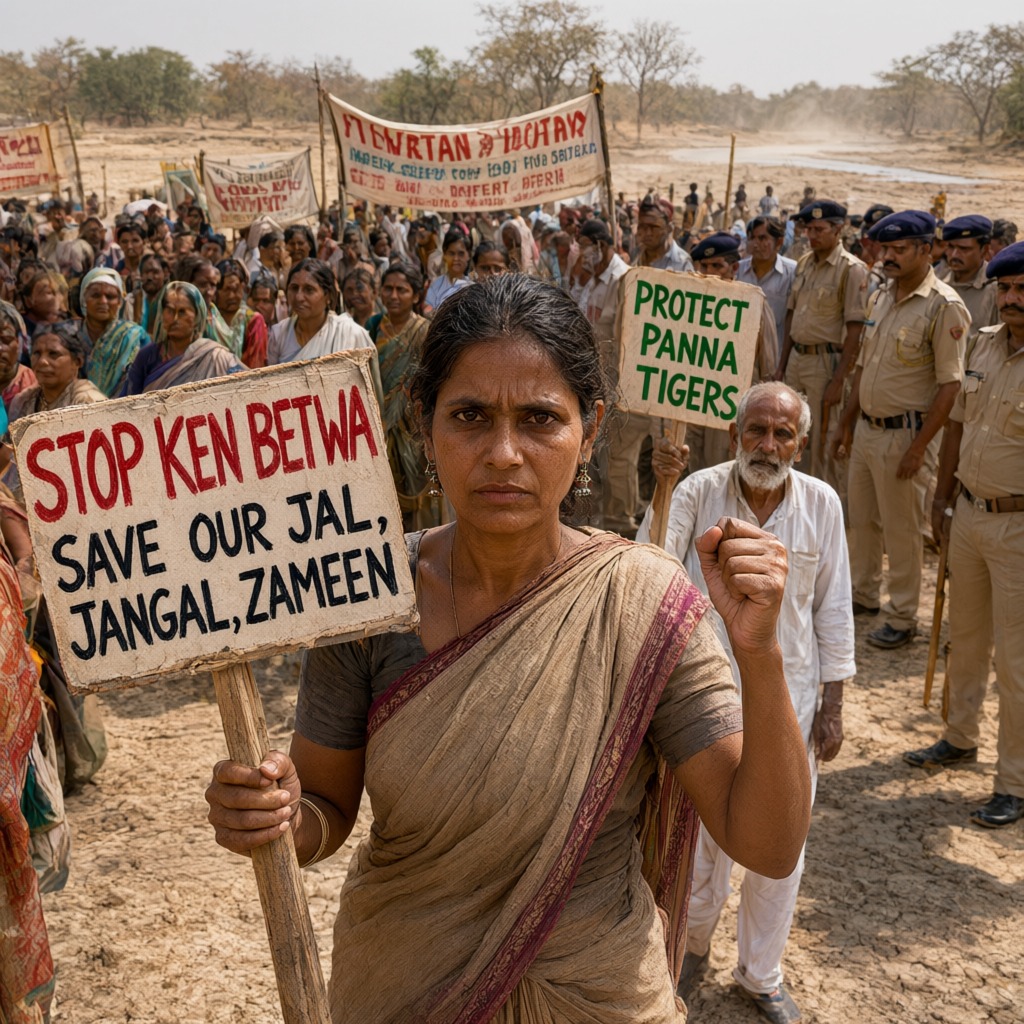

Inside the Bundelkhand Protests Against Ken-Betwa
Funeral pyres, hunger strikes, and a march that never reached Delhi
Environment Pulse desk
There’s a particular kind of grief that doesn’t show up in engineering reports or government press releases — the grief of watching the land your grandparents farmed disappear under a reservoir you never asked for. That’s the grief driving thousands of tribal families in Madhya Pradesh’s Bundelkhand region to the streets, the riverbanks, and in some cases, to lying down on mock funeral pyres in protest.
At the centre of it all is the Ken-Betwa Link Project — India’s first attempt at physically linking two rivers on this scale, and a project the government has staked considerable political capital on. On paper, the idea sounds almost elegant: the Ken River, flowing through a stretch which has plenty of water, gets dammed at a site called Daudhan, and its “extra” water is funnelled through a 221-kilometre canal — tunnel included — into the Betwa basin, where water is chronically short.
The cost boils down to something to the tune of ₹44,000 to ₹44,605 crore. Understandably the returns include irrigation for roughly 1.06 million hectares, drinking water for around 6.2 million people, and a modest amount of hydropower and solar generation. The Prime Minister inaugurated it in December 2024, and construction has been moving forward since.
But scratch beneath those numbers, and a much messier, more human story emerges.
The people the dam is displacing
Government figures put the number of families set to be displaced at around 7,193, spread across 14 villages in Chhatarpur and eight in Panna district. Earlier estimates were murkier and often higher — somewhere between 5,200 and 7,000-plus families across roughly 22 villages, with 8 to 10 of those villages facing complete submergence. Most of the people affected belong to Gond, Kol, and other tribal communities — communities for whom land isn’t simply an economic input, but something closer to identity itself.
That distinction matters enormously to understanding why these protests have been so sustained and so emotionally charged. For these families, the forest isn’t just a place to farm — it’s where they collect tendu leaves and other forest produce that supplement their income, it’s tied to their cultural practices, and for many, it carries a spiritual weight that no cheque can replace. So when the government’s rehabilitation package arrives as a lump sum of cash, many protesters see it as fundamentally missing the point. What they’re demanding instead is “land for land” and “village for village” — meaning relocation to comparable habitats where community structures can survive intact, rather than scattered families trying to rebuild individually with a payout.
There are other sticking points too. Protestors have voice concerns. There call is simple. They want every adult in a household counted as an individual beneficiary under the ₹12.5 lakh compensation package. They do not want the family to be counted as a single unit. They’re pushing to revise the eligibility cut-off date, which currently sits at February 2024 or earlier, arguing it excludes people who should qualify. Some are asking for the package to be raised to ₹25 lakh.
Allegations of a broken process
This is where things get genuinely troubling. Protesters allege the entire compensation process, which is supposed to operate under India’s land acquisition and rehabilitation law, has been riddled with irregularities. There are claims that actual, long-term residents were left off compensation lists while people who’d moved away years ago — or who never lived there at all — somehow made the cut. Traditionally Gram Sabha records are meant to document free, informed community consent, have reportedly looked suspiciously identical across different villages, raising obvious questions about whether real consultation happened at all. Protesters underline they have often been undervalued, delayed, or only partially disbursed. Some reports go further, alleging discrepancies running into hundreds of crores of rupees. Similar patterns have surfaced around related state irrigation projects — Majhgaon and Runjh — where compensation packages started as low as ₹5 lakh before later being revised upward.
Funeral pyres, hunger strikes, and a march that never reached Delhi
What makes this movement striking is just how symbolically loaded the protest tactics have been. There’s the “Chita Andolan” — women lying down on what look like funeral pyres, a deliberate and visceral way of framing displacement as a kind of death. There’s “mitti andolan,” built around soil itself as a symbol of what’s being lost. There’s “jal satyagraha,” protesters standing in water to make their point. Some have staged symbolic hangings with nooses. Activist Amit Bhatnagar of the Jai Kisan Sangathan went on a hunger strike that stretched somewhere between 14 and 18 days. At one point, protesters attempted to march toward Delhi, though they were intercepted before getting far. More recently, villagers have turned to “chulha bandh” — refusing to even light their kitchen fires, a quiet but pointed form of resistance.
Protestors have been upping the ante since April 2026. The recent inflection point came in July near Kupi village along the Barana stream, drawing hundreds of participants, many of them tribal women.
Around July 19, police moved in and cleared the site. Around 150 protesters were removed from the area. Authorities said rising water levels near a nearby bridge was a safety concern; protesters countered that the crackdown was timed to bury emerging revelations. Fresh orders were passed for verification, and enhanced compensation packages for the related state projects.
The tiger in the room
There’s also an ecological dimension that critics argue hasn’t been given nearly enough weight. The project cuts directly through the Panna Tiger Reserve — a site with genuine conservation significance, having successfully reintroduced tigers after they went locally extinct around 2009. Submergence threatens thousands of hectares of core tiger habitat, fragments the corridors tigers need to move through, and puts breeding zones at risk. Downstream, the Ken Gharial Sanctuary and its endangered crocodilians face their own set of threats, along with vultures and other wildlife dependent on the landscape. Estimates of tree loss vary wildly depending on the source — tens of thousands of trees already marked or felled for dam construction, with older, broader assessments suggesting the number could eventually run into the lakhs across the wider project landscape.
Beyond the immediate habitat loss, environmentalists have raised a more fundamental question: does the Ken actually have the reliable water surplus the whole project depends on? Climate change, upstream demand, and hydrological data that critics say is outdated all complicate that assumption. Expert panels have questioned the clearances granted, the project’s viability, and whether large inter-basin transfers like this one are even the right approach.
Where things stand
The government’s position remains consistent: this is a project that will finally bring water security to one of India’s most drought-prone regions, backed by a special rehabilitation package, environmental assessments, and an Integrated Landscape Management Plan overseen partly by the Greater Panna Landscape Council. Officials have ordered fresh surveys, disputed the scale and composition of the protests — suggesting many demonstrators are actually affected by other, unrelated projects — and rejected allegations that Gram Sabha records were fabricated.
What’s left is a standoff that captures a tension playing out across much of rural India: the pull between large infrastructure promising regional prosperity, and the lived reality of communities who stand to lose everything that infrastructure doesn’t count — their forests, their rivers, their ancestral ground, and a critical tiger habitat that took over a decade to rebuild. The project keeps moving forward. So, for now, does the resistance to it.
Also Read: अमेरिका के तीनों तटों पर, 84% वेटलैंड धीरे-धीरे डूब रहे हैं