


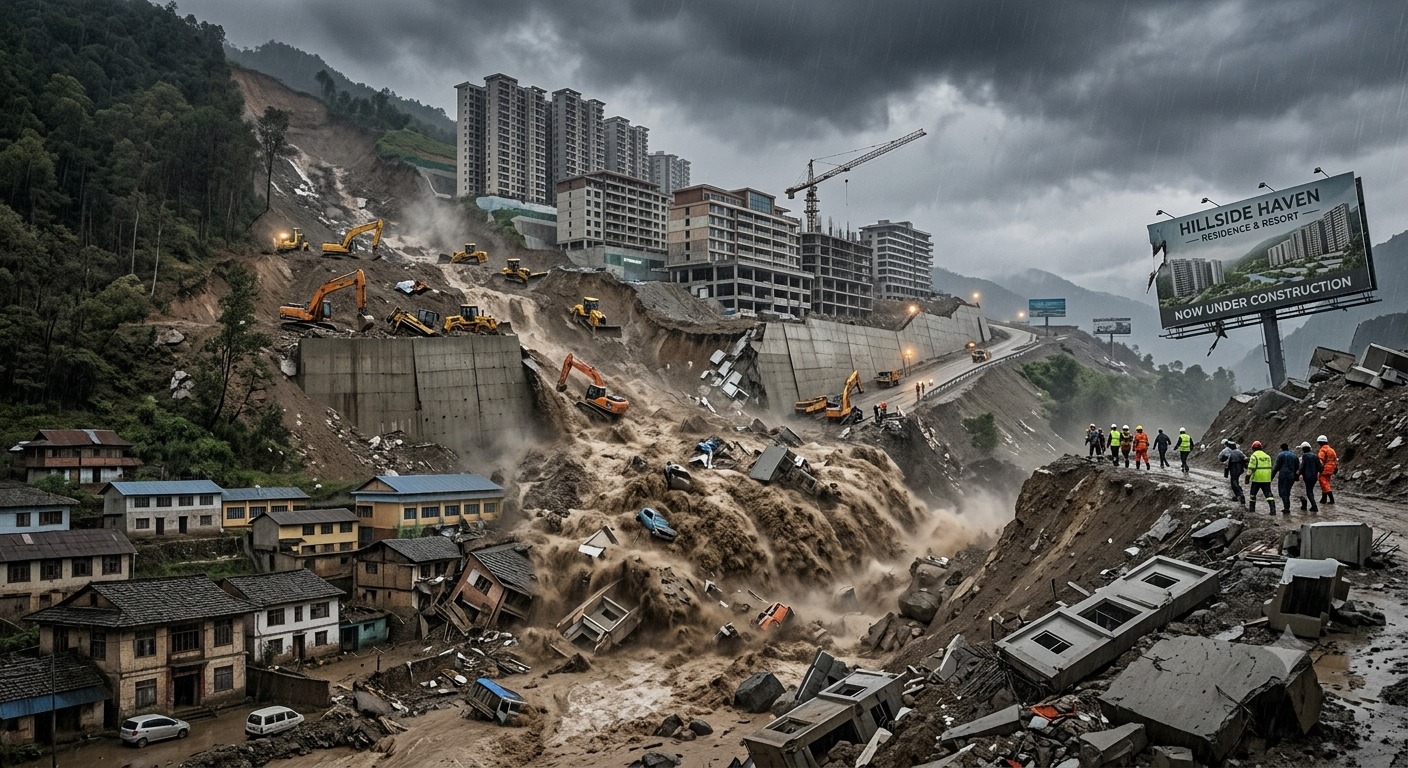

Serious questions have been raised regarding the large-scale development and construction of fossil fuel-based projects in India’s mountainous states (such as Uttarakhand, Himachal Pradesh, and Jharkhand).
Environment Pulse Desk: Recent natural disasters across neighbouring Himalayan regions have reignited a contentious debate over large-scale infrastructure development in India’s hill stations, as critics and experts warn that widespread construction projects are amplifying risks in one of the world’s most geologically fragile mountain systems. Heavy tunnel projects, road-widening initiatives, and hydropower schemes on tectonically unstable slopes are drawing sharp criticism from environmental groups, scientists, and local communities, who argue that development is outpacing safety measures in states including Uttarakhand, Himachal Pradesh, Sikkim, and parts of the Northeast.
THE CRISIS
The Himalayas rank among the world’s youngest and most tectonically active mountain ranges. This geological youth creates inherent vulnerability: steep slopes, active seismic zones, accelerating glacial retreat, and intense monsoon precipitation combine to create persistent threats of landslides, flash floods, and debris flows. When these natural hazards collide with large-scale human intervention, the consequences escalate rapidly. Recent disasters have claimed lives, destroyed critical infrastructure, severed road and bridge connectivity, and displaced communities—events that have prompted Indian authorities and scientific bodies to conduct comprehensive reviews of ongoing and planned projects.
CONCERNS MOUNT
Environmental advocates and geologists point to a consistent pattern of inadequate oversight. Projects, they contend, often proceed with: Insufficient geological assessments failing to account for subsurface instability Inadequate slope stabilisation measures before and during construction Limited evaluation of climate-change impacts on rainfall intensity and glacial dynamics Minimal involvement of local communities in risk assessment and decision-making Tunnel blasting and large-scale excavation present particular risks. These operations can destabilise hillsides already weakened by natural processes. Hydropower developments, though aligned with renewable energy objectives, frequently involve extensive river diversions, reservoir creation, and associated road networks that alter natural drainage patterns and increase susceptibility to landslides. “The cumulative impact of these projects has not been adequately assessed,” experts argue, pointing to visible environmental scars and the recurrence of disaster zones in areas of heavy development.
THE DEVELOPMENT ARGUMENT
Supporters of infrastructure expansion emphasise competing priorities. Improved connectivity, they note, is essential for remote mountain communities. Tourism infrastructure generates economic opportunity. Clean hydropower contributes to national renewable energy targets. They contend that modern engineering techniques, rigorous environmental clearances, and advanced monitoring systems can effectively mitigate geological risks. Government agencies have highlighted ongoing efforts to strengthen building codes, conduct detailed geological surveys before project approval, and incorporate disaster-resilient design principles into new construction.
EXPERTS WEIGH IN
Geologists and disaster management specialists recommend a more cautious development paradigm, emphasising: Priority slope-stability studies before any construction approval Restricted development in identified high-risk geological zones Enhanced early-warning systems integrated with community alert networks Mandatory consultation with affected local populations Sustainable alternatives, including smaller-scale projects and nature-based solutions (riverbank stabilisation, reforestation)
THE LARGER PICTURE
Climate patterns are becoming increasingly extreme across the region, with unpredictable weather intensifying existing geological hazards. Simultaneously, pressure for rapid development persists. This tension—between progress and safety—defines the central challenge facing Indian Himalayan regions. The latest disasters underscore a sobering reality: the region’s geological fragility cannot be subordinated to development timelines if long-term community resilience and environmental stability are to be achieved.
OUTLOOK
As debates continue at state and central government levels, the path forward remains contested. Environmental and scientific voices advocate for a precautionary stance prioritising stability studies and community welfare. Development proponents argue that properly engineered infrastructure can coexist with geological realities. What remains clear is that the Himalayas’ unique vulnerability—born of its youth, active tectonics, and climate sensitivity—demands that any future construction proceed with rigorous scientific oversight, transparent community engagement, and a genuine commitment to prioritising safety over rapid expansion. The region’s disasters, tragic as they are, may ultimately prove valuable if they catalyse the institutional reforms and policy shifts necessary to protect both mountain communities and the integrity of Asia’s greatest mountain system.