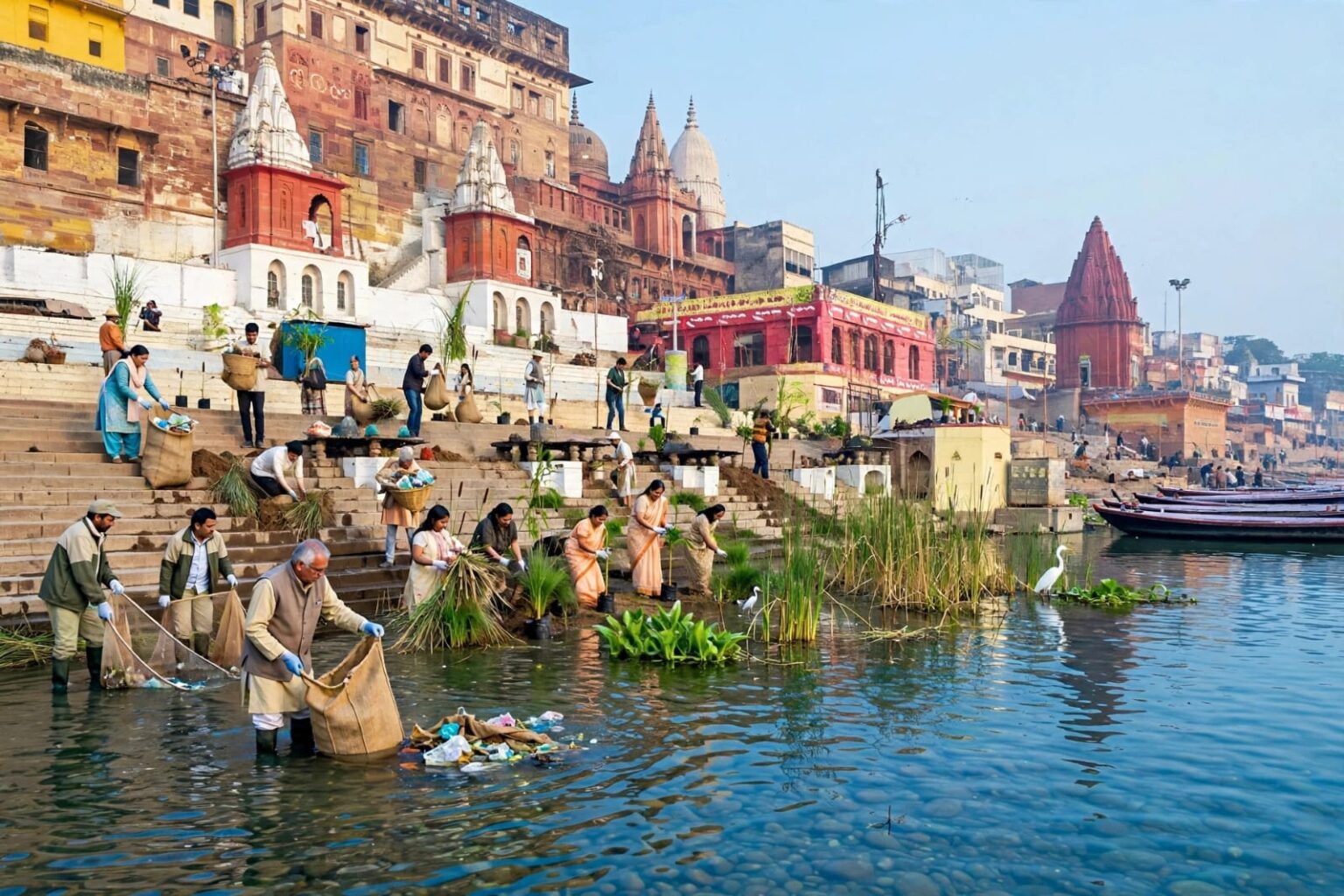

Launched in 2014–15 with a multi-billion-rupee budget, the Namami Gange programme has driven measurable improvements in the health of the Ganga River by expanding sewage treatment capacity, upgrading industrial regulations, and introducing performance-based plant maintenance. Recent data shows that water quality indicators—such as dissolved oxygen and pH levels—now meet bathing standards across most of the river’s main stretch, supported by rebounding wildlife populations like the Gangetic river dolphin. However, significant challenges remain, including localized urban sewage pollution in Uttar Pradesh, insufficient environmental river flow due to dams and water diversion, and bacterial spikes during major religious festivals, meaning the river is meaningfully better but not yet fully “clean.”
Environment Pulse Desk: For most of India’s modern history, cleaning the Ganga has felt like an impossible promise—one made and broken by successive governments since the 1980s.
So it’s worth asking, honestly, where things stand in 2026 after more than a decade of the Namami Gange programme: has the river actually gotten cleaner, or is this just another chapter in a long story of good intentions and incomplete results?
The answer, based on the data, is somewhere in between—closer to “meaningfully better” than “finally clean.” A History of Trying and Falling Short India’s first serious crack at this problem was the Ganga Action Plan, launched in 1985 and followed by a second phase in the ’90s.
The strategy was straightforward: build sewage treatment plants along the river’s major towns. And to be fair, capacity did grow—by the early 2010s, India had built out roughly 1,500 to 1,600 million litres per day of treatment capacity.
But the plants themselves were often the problem. Many ran under capacity, upkeep was inconsistent, and the sheer volume of sewage pouring in from India’s swelling cities simply outran what the infrastructure could handle. Add uncontrolled industrial pollution—tanneries in Kanpur were a particular offender—and it’s not hard to see why water quality stayed poor for so long.
Pollution monitors kept finding the same story: oxygen levels too low to sustain aquatic life, bacteria counts too high for the water to be considered safe even for bathing. What Namami Gange Changed Launched in 2014–15, Namami Gange was pitched as something different: not a patchwork of local fixes, but a basin-wide effort spanning five states—Uttarakhand, Uttar Pradesh, Bihar, Jharkhand, and West Bengal—and touching everything from sewage infrastructure to industrial regulation to reforestation along the banks.
The money behind it has been substantial. By mid-2026, the government had sanctioned more than 520 projects worth over ₹43,000 crore, with somewhere around 345 to 360 of those already completed. A new financing model—tying payments for treatment plants to actual performance rather than just construction—was meant to solve the maintenance problem that plagued earlier efforts.
The Numbers Tell a Genuinely Better Story
This is where the picture gets interesting. Government water quality data from January through August of 2025 showed that, for the first time, oxygen levels and pH met bathing-water standards at every monitored point along the river’s main stretch. Organic pollution levels also came within acceptable limits across the entire river in Uttarakhand, Bihar, Jharkhand, and West Bengal. The one holdout is Uttar Pradesh, where pollution near Kanpur, Raebareli, and stretches of Mirzapur–Ghazipur is still a problem—though even there it’s become more localized rather than widespread. State-level classifications back this up. Uttarakhand no longer has any of its worst-rated polluted stretches. Jharkhand has gone seven straight years without a single polluted stretch. West Bengal has moved into better pollution categories. Industrial pollution loads have roughly halved since 2017.
And treatment capacity itself has grown two to three times over compared to before 2014, now sitting somewhere between 3,800 and 4,260 million litres a day. There are ecological signs too, and they’re arguably the most compelling evidence of real change.
A nationwide dolphin survey counted around 6,300 Gangetic river dolphins—roughly double what estimates suggested a decade or more ago. Otters, turtles, gharials, and various fish species are turning up more often in cleaner stretches, and biological surveys from 2024–25 rated water quality as “good” to “moderate” at many sites. What Hasn’t Been Fixed None of this means the job is done.
Untreated or partially treated sewage still flows into the river from crowded urban stretches of Uttar Pradesh. Some treatment plants underperform or don’t run at full capacity. And the harder-to-control sources of pollution—farm runoff, solid waste, residual industrial discharge—haven’t gone away.
There’s also the matter of environmental flow: upstream hydropower dams and water diversion for farming and drinking supply make it difficult to guarantee the river has enough water moving through it to sustain itself naturally. Bacterial contamination still spikes during major religious festivals or dry spells, and despite the improvements, the water is nowhere close to being safe to drink without treatment.
Rural sanitation, too, lags well behind what’s been achieved in cities. So, Cleansed or Not? The honest answer is that Namami Gange has done something earlier programmes didn’t: it’s bent the river’s trajectory from getting steadily worse to genuinely, measurably improving. That’s not nothing—water quality trends have moved in the right direction for consecutive years now, pollution categories have improved across several states, and wildlife is coming back in places it had disappeared from.
But “cleaner” and “clean” are different claims, and the Ganga right now is the former, not the latter. Pollution hotspots persist, treatment coverage still has gaps, and the everyday pressures of a fast-growing population living along its banks haven’t let up. What happens from here depends less on new announcements and more on the unglamorous work of keeping existing plants running properly, enforcing industrial rules consistently, and treating the river as a long-term commitment rather than a finished project.
Also Read: बढ़ते तापमान और बिजली की मांग से निपटने के लिए असम ने कूलिंग एक्शन प्लान लॉन्च किया