
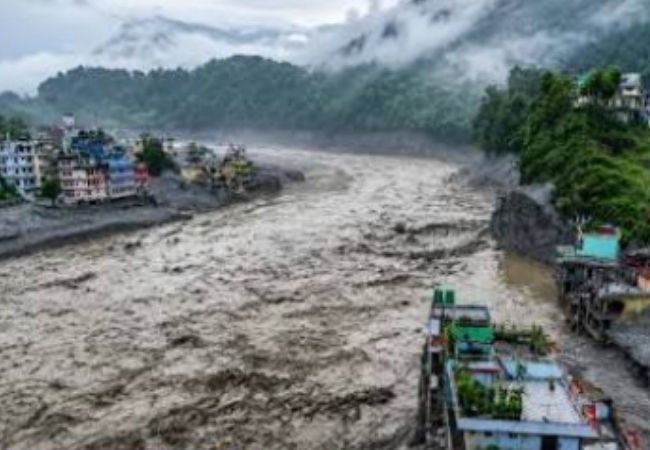


The issue of climate justice has once again come to the fore following the devastating floods in Nepal’s Bhote Koshi river valley. Nepal’s Foreign Minister has held three major nations—the US, China, and India—accountable for this catastrophic disaster. According to him, these three countries are primarily responsible for greenhouse gas emissions; therefore, it is their legal and moral obligation to compensate Nepal for the massive losses incurred. The Foreign Minister further stated that carbon emissions from the US, China, and India are causing Nepal’s glaciers to melt. He warned that if this trend of melting glaciers continues, the entire civilization of South Asia—not just Nepal—will face grave peril. Meanwhile, Nepal’s Prime Minister Balen Shah is set to raise this issue at the international level during the upcoming United Nations General Assembly meeting. He will also seek compensation for Nepal under the ‘Loss and Damage’ fund. This severe disaster has caused Nepal losses amounting to approximately five billion US dollars, which is nearly 10 percent of the country’s GDP.
There is merit in the Nepali Foreign Minister’s argument. The US, China, and European nations are major contributors to global pollution. China alone accounts for 33.1 percent of the world’s carbon emissions, while the US share is 11.7 percent and India’s is 8.0 percent. Together, these three nations are responsible for more than half (53 percent) of global carbon emissions. While Nepal includes India in this group, it is worth noting that a US citizen emits seven times more carbon than an Indian citizen.
One need only look at the US in this context; President Donald Trump announced the country’s withdrawal from the Paris Agreement—an accord designed to tackle the challenges posed by climate change—on the very day he was sworn in for his second term. Trump is unwilling to accept any form of social or legal responsibility—let alone moral responsibility. As for China, it too seeks to absolve itself of accountability by shifting the burden onto Western nations, particularly the United States; China maintains that it will pay compensation only after the US does so.
In this context, India has never shied away from its responsibilities, nor is it doing so now. Consequently, whenever this issue is raised at the UN, the debate must highlight India’s efforts to reduce global carbon emissions. India has consistently advocated for climate justice, always championing the voices of nations that are blameless yet unfairly bear the brunt of actions taken by major polluters. India and Prime Minister Narendra Modi played a pivotal role in establishing the ‘Loss and Damage Fund’ designed to assist affected nations. While the issue had been raised at previous COP summits, the actual formation of the fund at COP-27 in Egypt garnered international acclaim for the efforts of India and Prime Minister Modi. Smaller nations acknowledged India’s significant leadership role. Nepal’s Prime Minister Balen Shah intends to raise this issue at the UN and demand compensation for Nepal from this very ‘Loss and Damage Fund.’
India has always stood for climate justice, frequently criticizing the injustices faced by smaller and poorer nations at COP summits while advocating for aid to these countries. Following the natural disaster in Nepal, Prime Minister Narendra Modi not only pledged all possible assistance during a call with his Nepalese counterpart but also ensured that Indian Army personnel worked alongside the Nepalese Army to safely evacuate stranded individuals—an effort that has earned global praise.
Now that this issue has resurfaced on the international stage in the wake of the Nepal disaster, wealthy nations must reflect and ensure they do not evade this critical matter. Rather, they must acknowledge their responsibility. Beyond adopting effective measures to curb pollution, they should also provide compensation to impoverished nations that are suffering undue harm. As for India, it stands in solidarity with Nepal while pursuing its own goal of achieving net-zero emissions by 2070.
The crucial lesson to be drawn from this disaster is that we must control pollution at all costs through every possible effort—whether institutional or individual. This is the need of the hour; after all, curbing pollution is not the government’s responsibility alone.
In fact, the Himalayas are known as the “Third Pole” because they hold the largest reserve of ice outside the two polar regions. Rivers such as the Trishuli, Gandak, and Kosi originate here and flow into the Ganges in India. This region gives rise to the world’s largest river system, upon which a population of nearly two billion people across several countries depends, either directly or indirectly. Any disruption to this system would undoubtedly imperil the civilization of all South Asia. Such disruption can only be halted if the Himalayas are shielded from the adverse effects of climate change. If we continue to increase pollution and the Earth keeps warming as a result, the ensuing devastation will be unprecedented—something beyond our current imagination. We must, therefore, learn from this disaster.
(Akhilesh Mayank is a journalist and novelist who writes on environmental issues.)