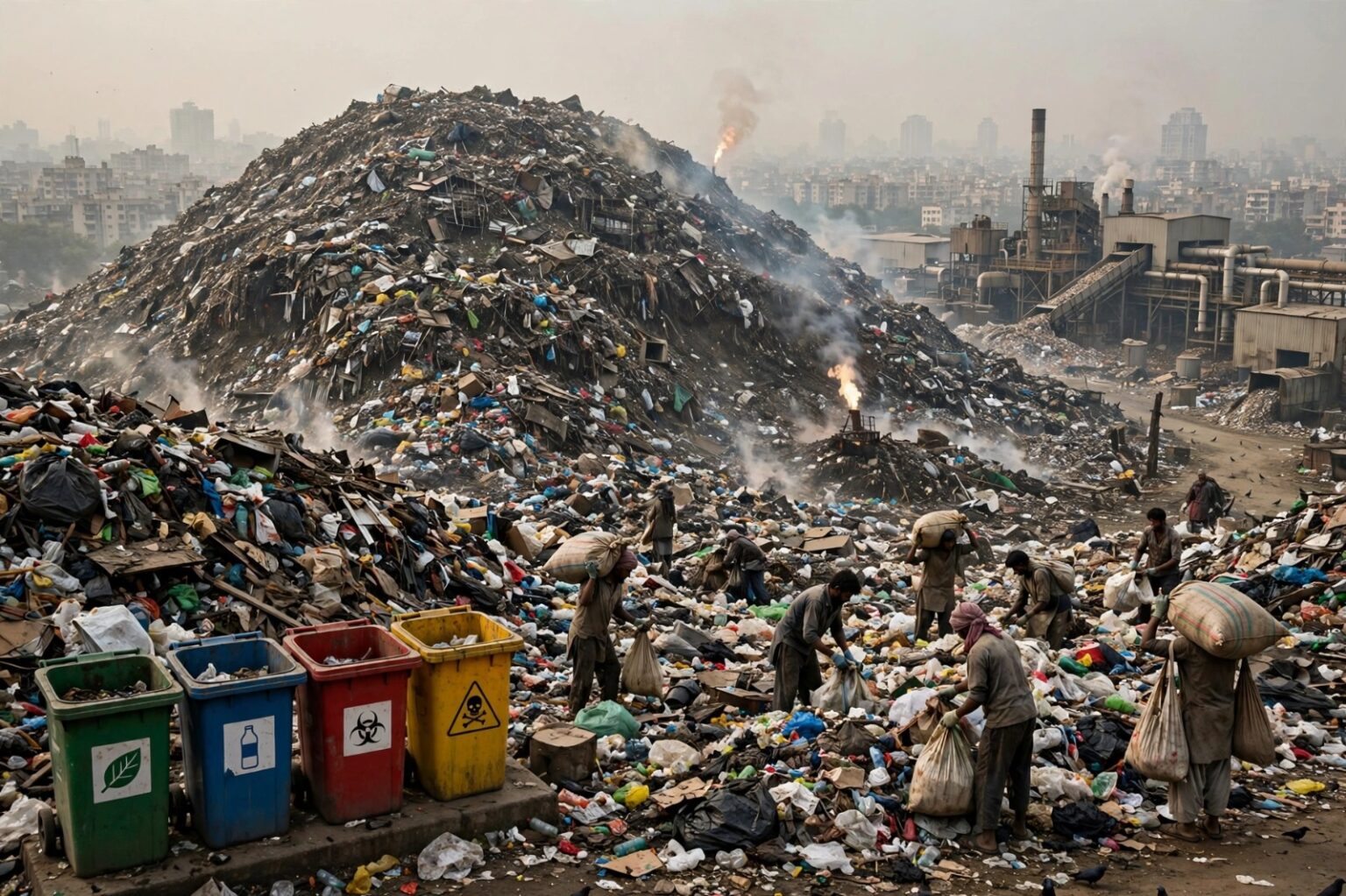
India generates approximately 170,000 tonnes of daily waste, and while collection rates have improved under the Swachh Bharat Mission, a significant portion still escapes proper processing. Bolstered by the Solid Waste Management Rules, 2026, which introduce strict four-way household segregation and the “Polluter Pays Principle,” cities are ramping up processing capacity and clearing dumpsites to curb surging methane emissions and environmental strain.
Environment Pulse Desk: he cities and towns of India discard approximately 170 thousand metric tons of waste daily. On an annual basis this is about 62 million metric tons based upon official statistics; however, many experts estimate that if the rate of urban growth continues, the amount of waste generated will reach 165 million metric tons per year by 2030.
The Institute for Governance and Sustainable Development and Gateway Research published a report in 2026 stating that on average there are 170,000 tonnes of waste collected each day. However, of those 170,000 tonnes, only 104,000 tonnes are properly processed. Under the Swachh Bharat Mission – Urban program, collection rates have significantly increased, with more than 90% of all generated waste being collected. Despite the increase in collection, approximately 40% of the collected waste never makes it to a proper processing site. This waste either gets dumped in open areas or simply disappears without any documentation. Because 40-60% of the waste we produce consists of food and organic matter, this also contributes to India’s methane issues. Methane produced from waste is India’s third most significant source of methane.
A slightly more positive story is told by the government’s own statistics. The Ministry of Housing and Urban Affairs estimates that urban areas within India produce approximately 1.62-1.66 lakh tonnes per day. Processing capacity has grown significantly since 2014 when only 16 percent of this waste was processed, today more than 80 percent of this waste is processed. There are more than 7,700 processing facilities operational such as; material recovery facilities (MRFs), compost facilities (composters), bio-methanation facilities (bio-methane) and waste-to-energy (WTE) facilities. Several states and cities claim to have achieved nearly 100 percent processing capacity.
The Solid Waste Management Rules, 2026, were implemented in April. These rules are the first major update to the 2016 Solid Waste Management Rules. The 2026 rules provide more strict guidelines on how households must manage their waste. Households will now need to separate their waste into four different categories: wet waste (organic matter), dry waste (paper, plastic, glass), sanitary waste (diapers, napkins), and special-care waste (hazardous materials). Additionally, the 2026 rules define what constitutes a “bulk generator.” A bulk generator includes any individual, business, organization, etc., that generates 100 kilograms or more of solid waste per day. Also included under this definition are entities that exceed specific thresholds related to size and/or water consumption. A bulk generator has specific obligations as well as penalties if they fail to meet these obligations. Finally, there is now a single online portal where all data concerning solid waste management can be tracked. This portal is used by local governments and businesses to help ensure compliance with the 2026 rules. The “Polluter Pays Principle” is incorporated within these new rules. Therefore, whoever creates solid waste is ultimately responsible for its proper disposal.
There are many examples of how this is working in other cities. The best example would be Indore where there has been a great deal of success at separating waste from the beginning of the process and at processing it as well. Also, other cities have begun to increase the number of homes that they collect waste from on a daily basis (door-to-door), encourage residents to compost in their own yards or community gardens, and develop waste-to-energy facilities and bio-CNG plants. Furthermore, many of these same cities have started to clean-up older dumpsites at a faster pace, which allows them to use the space again and reduces methane emissions.
Still, plenty is left to fix:
Most municipal budgets go to collection and sweeping, not processing.
Informal waste workers aren’t properly brought into the system.
Segregation isn’t enforced consistently.
Smaller towns lack basic infrastructure.
The segregation gap is the most important factor. If there is mixed waste entering a facility, then treating the waste will be harder and more costly.
Experts believe we need to start by doing a better job of separating our trash when we throw it away; increasing our ability to process and clean up existing landfills; and using a circular model to view waste as a raw material. If we can accomplish these three goals, we can greatly reduce the amount of methane gas released into the atmosphere. How India chooses to handle trash as its cities grow—from simply picking up and throwing it away to processing and reusing it—will ultimately determine both the health of the environment and the quality of life in its cities.
Also Read: Rivers Are Quietly Running Out of Oxygen, and Freshwater Life Is Paying the Price