


A Personal Look at the Father of the Green Revolution
Warm Centenary Tribute vs. Unaddressed Trade-offs
Environment Pulse Desk
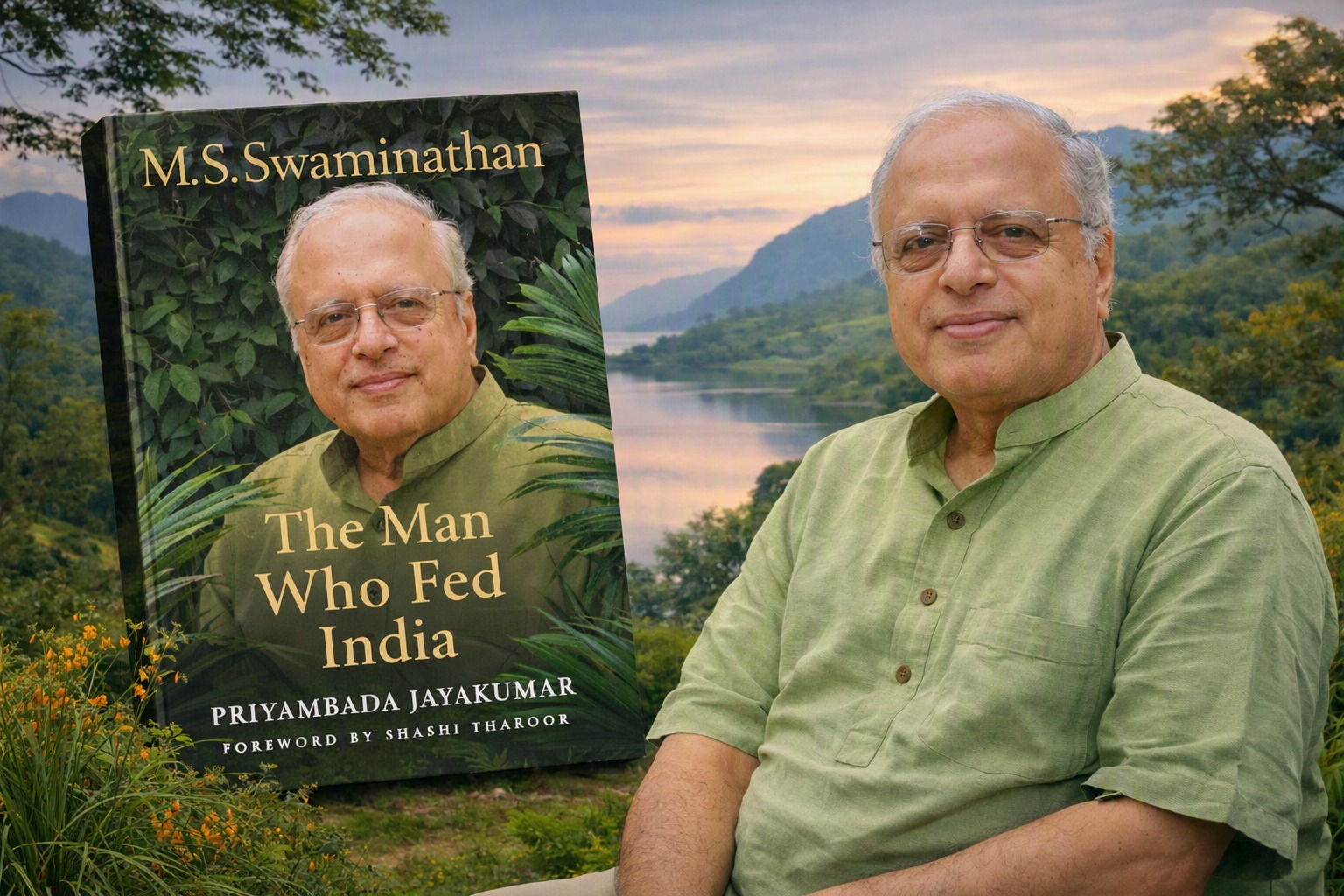
M.S. Swaminathan: The Man Who Fed India by Priyambada Jayakumar (HarperCollins India, September 2025, roughly 324 pages) is the biggest book to come out on Swaminathan recently, and probably the most talked-about one right now.
It was published to mark his birth centenary — he was born on 7 August 1925 and passed away in 2023 — and the author is a historian who’s also related to him (a niece). That family connection shows up in the writing: she had access most biographers wouldn’t, and she’s clearly trying to show the man behind the Green Revolution headlines rather than just rehashing the science and policy. It reads as a book meant for ordinary readers, not agricultural historians, and it leans hard into the personal stories.
What’s actually in it
The book starts with his childhood in Kumbakonam, Tamil Nadu, and how growing up around agriculture, combined with witnessing the Bengal Famine of 1943, pushed him to drop his original plan of becoming a doctor and go into agricultural science instead. From there it follows him through his education — including his time at IARI and abroad — his return to India, his collaboration with Norman Borlaug on high-yield wheat, and the political backing from people like Lal Bahadur Shastri and C. Subramaniam that actually made the Green Revolution happen on the ground. It also covers India’s move from a food-scarce nation to one that could largely feed itself.
The later chapters move beyond the Green Revolution story and into the rest of his life — his conservation work, the institutions he built, his advocacy for farmers (including the Swaminathan Commission), and less obvious sides of him: as a feminist, a lifelong Gandhian, and someone who worked quietly behind the scenes diplomatically. It also touches on how his thinking evolved later in life toward sustainability, biodiversity, and what he called an “evergreen revolution,” along with some course-correcting on environmental issues he’d been less cautious about earlier.
How it’s been received
Most reviewers seem to agree it’s a warm, respectful, easy-to-read tribute that manages to fit a genuinely huge life into a fairly compact book, and that it does a good job of humanizing someone who’s often reduced to a textbook name.
The praise mostly centers on how it captures his conviction and his collaborative relationships — with both scientists and farmers — and how well it ties his individual story to India’s bigger transformation from scarcity to food security. For anyone who doesn’t already know much about him, it’s being recommended as a solid starting point.
The criticism is fairly consistent too. Some reviewers feel parts of it read more like a eulogy or a list of awards and honors than a real biography — a bit too polished, a bit too admiring. There are also a few factual slip-ups early on (Kumbakonam gets placed in Kerala at one point, which it isn’t). And the book has been called out for not really digging into the messier or more controversial parts of his legacy: the long-term environmental and social costs of Green Revolution farming (water overuse, heavy fertilizer dependence, the narrowing focus on a few crops), his genuinely mixed feelings about GM crops, the institutional pushback he faced, and just the harder, less flattering parts of his personal and professional life that don’t make it much past the early chapters.
Bottom line
Most people reviewing it seem to land in the same place: it’s a solid, affectionate centenary tribute that does justice to how much impact Swaminathan had, while also being the kind of concise, admiring biography that naturally skips over some of the harder questions. It’s easy to find, including on Amazon, and it’s had a few high-profile launch events, with people like Shashi Tharoor showing up to discuss it.
If what you actually want is a more critical, academic look at the Green Revolution itself — its ecological trade-offs, the technical details — this book probably isn’t that, and you’d be better off pairing it with some of the older specialist literature on the subject.
Also Read: वैज्ञानिक खदान बंदी में SECL ने कायम की मिसाल, कोल इंडिया की 67% खदानों को बंद कर देश में बनी नंबर-1