


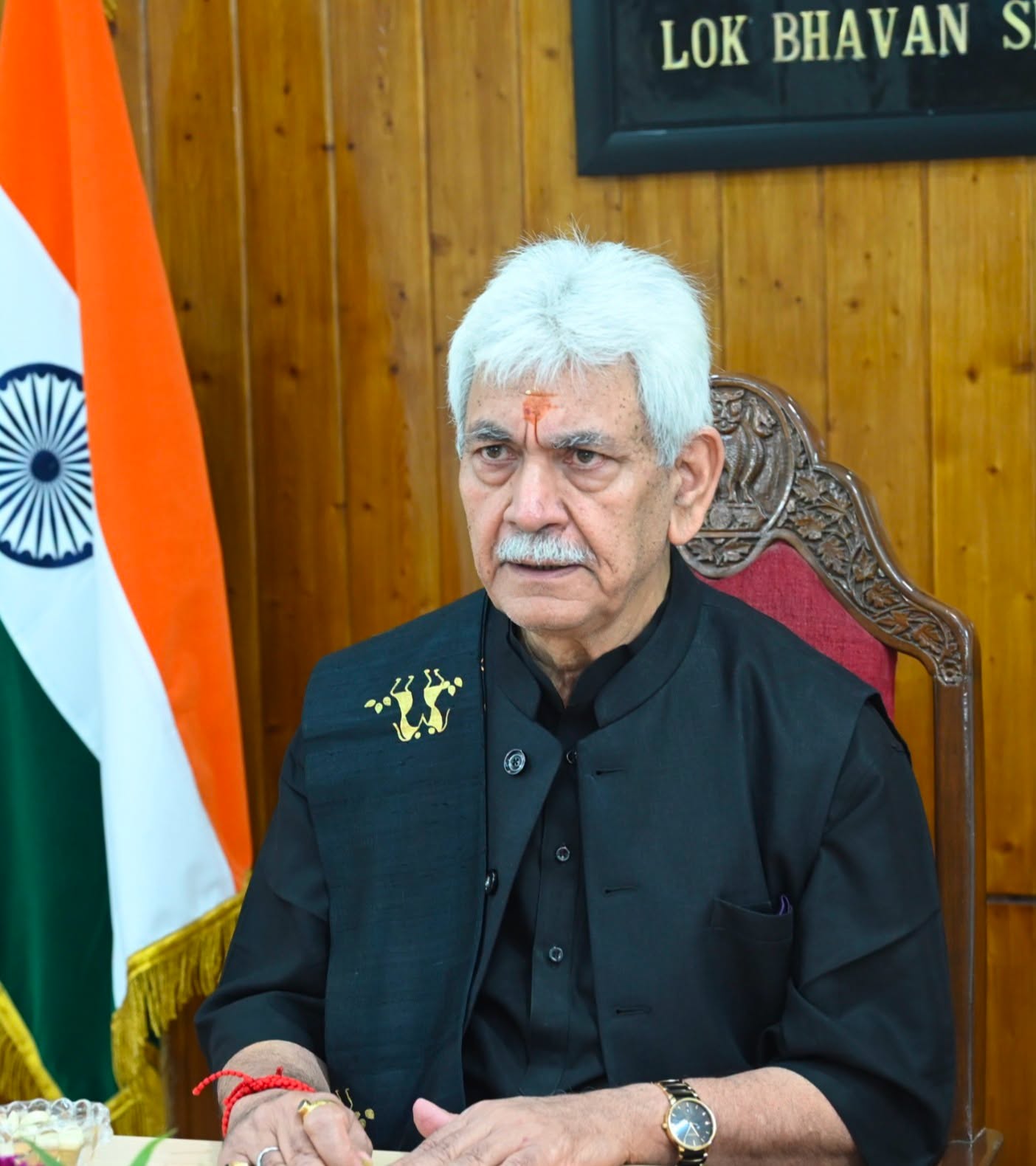

A press conference on climate issues in the Himalayan region
Sinha underlined some sobering numbers.
Environment Pulse desk
Srinagar: Joining the growing tribe of people who are gunning for climate resilience, addressing a press conference on climate issues in the Himalayan region, Lieutenant Governor Manoj Sinha didn’t hold back punches about how urgent the situation has become. He made a strong case for letting nature itself do a lot of the heavy lifting.
Speaking at length on the matter at the Islamic University of Science and Technology’s conference on “Strengthening Climate Resilience and Livelihoods in the Himalayan Region through Nature-based Solutions,” Sinha underlined some sobering numbers.
He said between January and August last year, the Himalayas saw a natural disaster almost every single day. Referring to regional issues, he was of the view that in Jammu and Kashmir alone, flash floods and cloudbursts tore through public infrastructure — roads washed out, water supply schemes disrupted, with power feeders damaged.
Instead of framing this as purely a disaster-management problem, Sinha pushed back against what he called a false choice between development and conservation. His argument: nature is infrastructure, we just don’t always think of it that way.
“For example, constructing a watershed is also an effective flood-control system,” he said. “It is infrastructure that also serves as a water purification system and forms the basis of an irrigation system.” He extended the metaphor further — a wetland, he said, works like a giant natural reservoir, soaking up excess monsoon water and releasing it slowly through the dry months. A thickly forested mountain slope, meanwhile, acts like a wall holding the whole mountainside together, protecting villages below from collapse. “When we destroy these natural systems, we are playing with the future,” he said. “But when we conserve and restore these natural systems, we are investing in a bright future.”
He called on scientists and domain experts to stop treating nature-based solutions as an afterthought in development planning and instead put them front and centre.
Sinha urged the learned to adapt modern tools. Focus on learning remote sensing, geospatial mapping, AI — to actually track things like glacier retreat, spring flow, soil health, and forest cover. Farmers, shepherds, orchard owners, tribal communities — these are the people who’ve lived alongside these rivers, mountains, and forests for generations, and their knowledge deserves a seat at the table, not a footnote. Annual budget reviews, he suggested, should track whether forests and ecosystems are actually getting richer or poorer, so there’s real accountability for environmental wealth, not just economic growth.
Sinha also had a message for academia: universities, he said, need to treat nature-based solutions as a genuinely multidisciplinary subject — spanning ecology, hydrology, engineering, economics, disaster management, and traditional knowledge all at once.
He looked back at the Green Jammu Kashmir Drive launched in 2020, which pushed forest cover up to nearly 55 percent, as proof that sustainable living isn’t just an ideal — it’s achievable.
The conference drew a notable crowd, including Justice Sanjeev Kumar, Acting Chief Justice of the High Court of Jammu Kashmir and Ladakh; IUST Vice Chancellor Prof Shakil A Romshoo; Registrar Prof Shamim Ahmad Shah; conference convener Prof Javed Hussain Mir; along with scientists, senior officials, faculty, and students.