


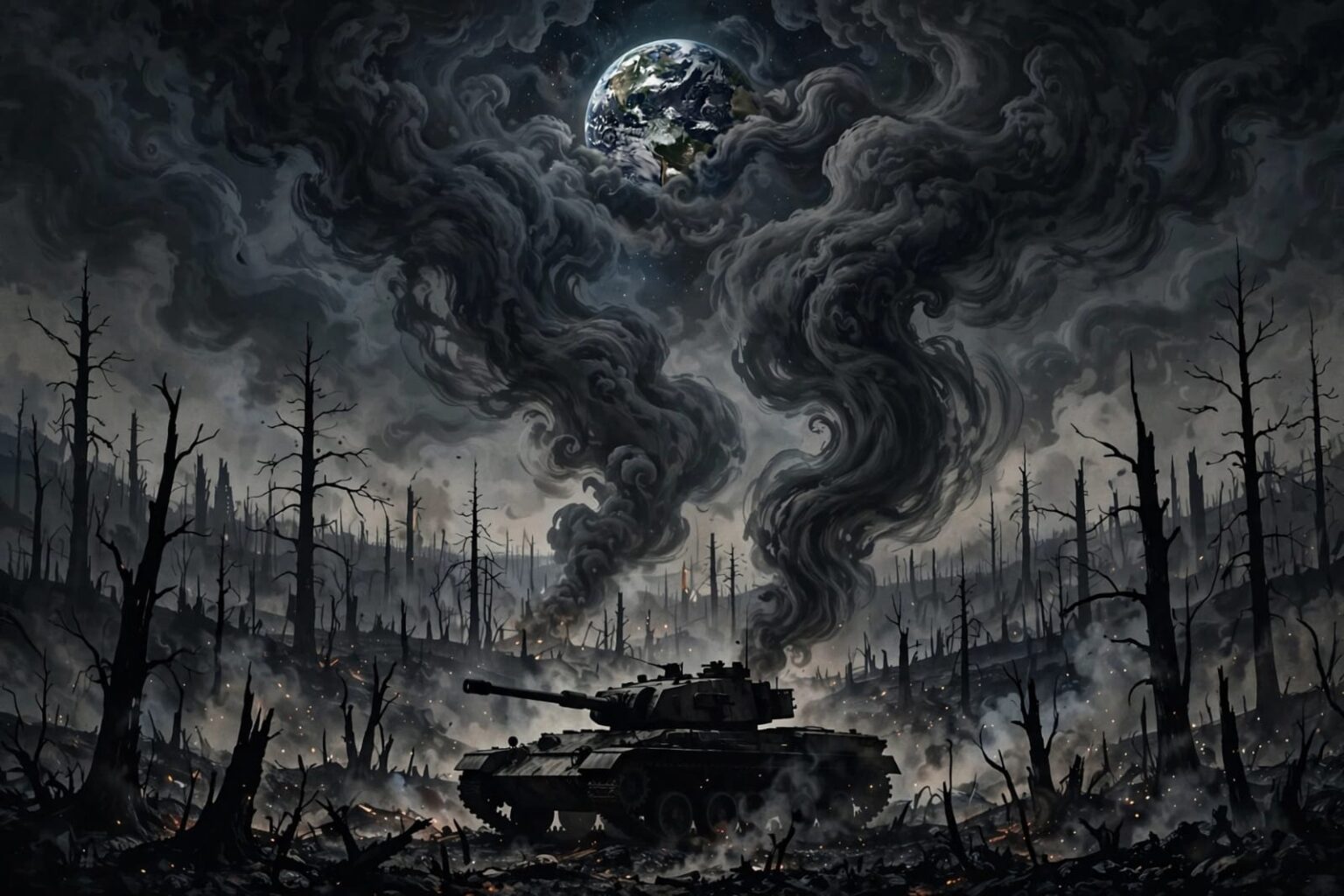

This comprehensive analysis highlights the massive yet largely unreported carbon footprint of global military conflicts, which contribute an estimated 5.5 percent of global greenhouse gas emissions—surpassing the combined emissions of global aviation and shipping. Armed forces are among the world’s largest fossil fuel consumers, yet military emissions remain exempt from mandatory United Nations reporting due to historical loopholes. Case studies, such as the first two years of the Russia-Ukraine war, reveal staggering emissions driven by direct fuel combustion, landscape destruction, massive fires, and carbon-intensive post-war reconstruction. Furthermore, climate change and conflict operate in a destructive feedback loop where resource scarcity and environmental degradation act as threat multipliers for instability. The article emphasizes that achieving global climate targets is impossible while large-scale conflicts persist, calling for mandatory UNFCCC military reporting, the classification of environmental destruction as a war crime, and increased investments in military sustainability and green energy.
Environment Pulse Desk: When we count climate emissions, we count cars, factories, and power plants. We almost never count tanks, jets, and burning oil depots. That omission is now costing the planet.
- War is a massive, unreported emitter
Militaries are among the world’s biggest fossil fuel consumers, but they are exempt from mandatory UN reporting.
– Estimate: Global militaries contribute 5.5% of global greenhouse gas emissions — more than aviation and shipping combined. If the world’s militaries were a country, it would be the 4th largest emitter after US, China and India.
– A single F-16 fighter jet burns ∼3,500 litres of jet fuel per hour. A B-52 bomber: 12,000 litres/hour.
– An M1 Abrams tank gets 0.6 km per litre. Moving an armoured division is like moving a small city.
Wars in Ukraine, Gaza, Sudan and Yemen are not just humanitarian crises — they are climate events.
- Case Study: Ukraine
According to a study by the Initiative on GHG Accounting of War:
– In first 2 years of Russia-Ukraine war: ∼175 million tonnes of CO2e emitted — equivalent to annual emissions of a country like Netherlands.
– Breakdown: 30% from military fuel, 25% from fires, destruction of forests and energy infrastructure, 20% from reconstruction — cement and steel for rebuilding cities like Mariupol will emit more than the war itself.
– Nord Stream pipeline sabotage alone leaked ∼500,000 tonnes of methane — 84x more potent than CO2 over 20 years.
- How conflict accelerates climate change — 5 channels
- a) Direct combustion: Missiles, jets, tanks, warships. A military operation is 24/7 diesel.
- b) Landscape burning: Forests in Ukraine (over 3 million acres), oil fields in Syria, croplands in Sudan. These fires release stored carbon and kill the carbon sink itself.
- c) Destruction of green infrastructure: Dams blown up (Kakhovka dam 2023), water treatment plants destroyed → methane from stagnant water, loss of hydropower.
- d) The rebuild trap: Post-war reconstruction is ultra carbon-intensive. UN estimates rebuilding Gaza will generate 60 million tonnes of CO2 — mostly cement.
- e) Diversion of money and focus: In 2023, global military spending crossed $2.4 trillion for first time. Every dollar spent on a missile is a dollar not spent on solar panels. COP negotiations stall because security concerns override climate commitments.
- The vicious loop — Climate change also fuels conflict
It works both ways.
– Resource scarcity: Lake Chad shrank 90% since 1960s → competition between farmers and herders → recruitment ground for Boko Haram.
– Syria: 2006-2010 worst drought in 900 years destroyed 75% farms → 1.5 million people moved to cities → social unrest that preceded civil war.
– Arctic: Melting ice opens new shipping routes and oil reserves → US, Russia, China military competition increases → more emissions in a pristine sink.
The Pentagon calls climate change a “threat multiplier.”
- Why this is not in climate accounting
Under Kyoto Protocol (1997), at US insistence, military emissions were made voluntary to report. That loophole continues. Most countries report only peacetime fuel purchases, not wartime consumption or emissions on foreign soil.
Result: We are undercounting global emissions by at least 5-7%.
- What can be done?
- Make military emissions mandatory in UNFCCC reporting from COP30 onwards.
- Include conflict emissions in ceasefire deals — e.g., Ukraine’s climate damage registry.
- Green the military: US Army target — 50% cut by 2030 via hybrid vehicles, biofuels. Indian armed forces exploring solar microgrids in border posts.
- Protect carbon sinks as war crime: Burning forests/oil fields should be counted as environmental war crime under Geneva Conventions.
Bottom line
We cannot achieve the 1.5°C target while fighting wars at this scale. A single year of major conflict can wipe out years of renewable energy gains. In UP terms: The entire annual solar generation from the 8.76 lakh rooftop plants you just installed — about 482 crore units — offsets less than half of what the Ukraine war emits in one year.
Climate action without peace is accounting without honesty.
Also Read: Story: We Talk About Lungs When We Talk About Climate — It’s Time To Talk About The Heart


