


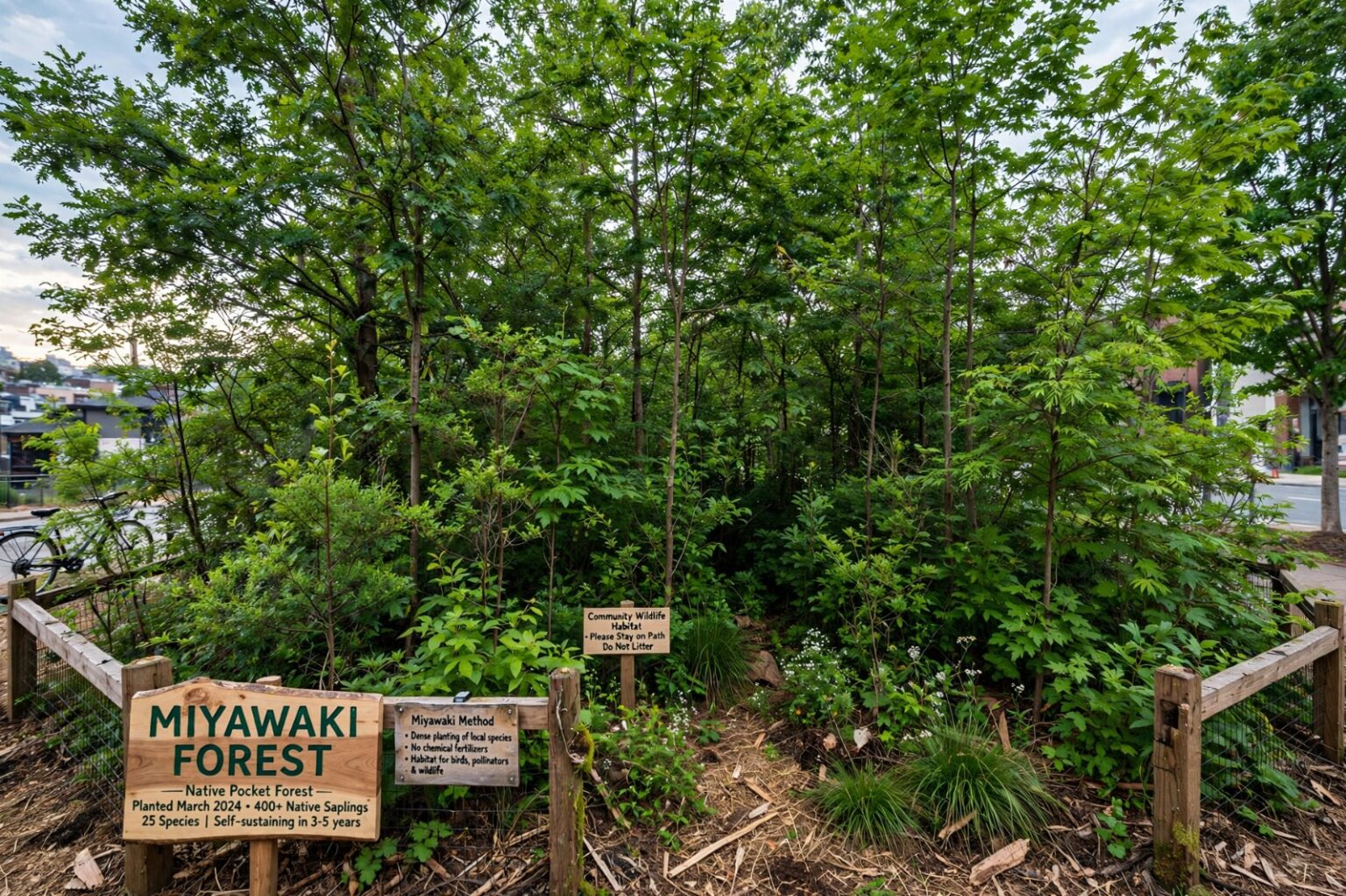

To combat severe air pollution and rising AQI levels, Lucknow is rapidly expanding urban green cover through the Japanese Miyawaki afforestation method. Spearheaded by local research institutions and the Lucknow Municipal Corporation, this technique involves planting native tree species at high densities—three to four saplings per square meter—allowing mini-forests to become self-sustaining and mature in just two to three years instead of decades.
Environment Pulse Desk: The monsoon rains have just cleared from Lucknow, leaving the air thick with dust and vehicle exhaust. Residents scroll through air quality apps, watching the numbers climb into the “unhealthy” red zone.
Children with asthma stay indoors. Morning joggers retreat to their homes. Yet in small pockets scattered across the city—in Aliganj, Rasulpur Kayasth, and along the Kukrail River—something quietly powerful is taking root.
Dense clusters of saplings, packed three or four to every square meter, are growing faster than any forest in nature. These are Miyawaki forests, and they may just be Lucknow’s answer to one of its most pressing environmental crises.
The capital of Uttar Pradesh has long battled an invisible enemy. Rising vehicular emissions, construction dust, and industrial activity have pushed the city’s Air Quality Index into dangerous territory for months every year.
Traditional tree-planting—the kind that adds one or two saplings every few meters—moves too slowly. The city needed something different. Something faster. Something that could turn a patch of unused land into a thriving ecosystem in just two or three years instead of decades.
That something arrived from Japan, courtesy of botanist Akira Miyawaki, who pioneered a radical afforestation technique that challenges everything conventional forestry assumed.
The Science of Speed
Walk past a Miyawaki forest site in Lucknow, and you might miss it at first glance. These are not the sprawling green spaces you’d expect. They’re compact—sometimes just a few hundred square meters—but unmistakably alive. The difference is density. Where a traditional plantation might place a single sapling every few meters, the Miyawaki method packs 3 to 4 saplings into every square meter, creating a multi-layered ecosystem that mirrors how forests naturally grow.
The technique is deceptively simple, yet ecologically sophisticated. Native species are selected based on local ecology—in Lucknow, that means neem, jamun, arjun, peepal, and banyan for the canopy; guava and kachnar for the mid-story; and medicinal plants like tulsi, aloe vera, and giloy for the understory.
This staggered planting creates a dense, stratified structure that grows extraordinarily fast. Unlike monoculture plantations that take decades to mature, Miyawaki forests become self-sustaining in just two to three years.
They achieve 30 times greater density than conventional plantations and sequester carbon at rates that dwarf traditional forest schemes. “The beauty of this method,” explains a botanist familiar with Lucknow’s projects, “is that nature does most of the work after the initial phase.
You’re not fighting against the forest; you’re helping it be what it wants to be.” Lucknow Goes Green The city’s embrace of Miyawaki forests has been steady and strategic. In the early 2020s, research institutions led the way.
The National Botanical Research Institute (NBRI) in Aliganj created test sites. The CSIR-Indian Institute of Toxicology Research (IITR) established a compact Miyawaki forest on just 100 square meters of its Kanpur Road campus, packing 1,000 diverse plants—sandalwood, amla, mango, and medicinal herbs—into a space smaller than a tennis court.
The success of these pilot projects caught official attention. The Lucknow Municipal Corporation scaled up dramatically. In Rasulpur Kayasth, four Miyawaki forests, each spanning about 11,200 square meters, received 44,800 plants.
But the most impressive project is the Atal Harit Upvan in Aurangabad Jagir—a sprawling 60,700-square-meter expanse planted with over 2.12 lakh saplings, positioned as a major urban green hub.
Smaller forests were deliberately placed in high-pollution neighborhoods. In Sector-D and Sector-O of Aliganj, in Katha Park, forests of 1,000 square meters—each containing 3,500 plants—rise from areas where the AQI regularly spikes dangerously high.
The logic is direct: plant oxygen-producing, pollution-absorbing forest where the air is worst. Looking forward, Lucknow’s vision is even more ambitious.
A new section of Miyawaki planting is planned within the Gomti Biodiversity Park. The proposed Urmila Forest—a 24-acre restoration project along the Kukrail River near Paper Mill Colony—will use native species to restore riverside ecology.
These projects align with the Uttar Pradesh Urban Green Policy, approved in 2025, which prioritizes Miyawaki mini-forests at the city level and champions the Upvan Scheme for urban afforestation across the state.
How Leaves Fight Pollution
The impact of these forests on air quality operates through elegant biological mechanisms. The dense, multi-layered canopy and high leaf surface area act as natural filters. Particulate matter—the PM2.5 and PM10 that choke the lungs of city residents—gets trapped on leaves and bark. Gaseous pollutants like nitrogen dioxide and sulfur dioxide are absorbed directly through plant stomata, processed by the tree’s metabolism.
Studies indicate that dense Miyawaki stands can achieve up to 30 times better dust and noise reduction compared with conventional plantations covering the same area. The oxygen production is equally significant. As photosynthesis rates surge in these densely-planted ecosystems, they become what officials call “oxygen banks,” creating pockets of fresher air in neighborhoods smothered by traffic fumes.
A mature Miyawaki forest functions as a localized carbon sink, absorbing CO₂ at rates claiming to be 30 times greater than monoculture plantations—a capacity that helps offset emissions from nearby vehicles and urban activity. Beyond pollution-fighting, these forests reshape their immediate environment.
Through shade and evapotranspiration, they can lower local surface and air temperatures by 0.5 to 5 degrees Celsius or more, combating the urban heat island effect that amplifies summer misery and secondary ozone formation. Dense root systems improve soil structure, enhancing water infiltration and groundwater recharge.
Biodiversity flourishes. Birds, insects, butterflies, and small mammals colonize these new ecosystems, creating ecological corridors in a fragmented urban landscape. The thick vegetation provides noise reduction, and the forests themselves become accessible green spaces that quietly improve mental well-being and foster community connection.
The Long Game
The challenge is scale. Individual Miyawaki forests, for all their ecological intensity, remain localized. A 1,000-square-meter forest is a pocket-sized solution to a city-wide problem. Early plantations have not yet triggered city-wide temperature or pollution reductions.
Their power lies in accumulation and maturation. Long-term success depends on careful species selection, proper soil preparation, diligent initial maintenance, and protection from encroachment. The city must continue implementing the Urban Green Policy, integrate these mini-forests into larger biodiversity projects, and encourage community participation. Rigorous monitoring of air quality parameters, carbon stock assessments, and biodiversity surveys will be essential to quantify benefits and refine the approach.
A Living Solution
Miyawaki forests represent something rare in urban environmental work: a practical, science-based solution tailored to a city’s actual constraints. By packing high ecological value into limited urban space, they expand green cover, filter pollutants, sequester carbon, cool microclimates, and restore biodiversity simultaneously.
As more sites mature and ambitious projects like the Urmila Forest come online, their cumulative contribution will grow. Lucknow’s experience suggests that even in a sprawling, heavily polluted city, change is possible—not through grand, slow-moving solutions, but through dense, fast-growing forests that turn empty plots into living engines of environmental recovery. One compact forest at a time, one native sapling at a time, Lucknow is building a greener, cleaner future.
Also Read: 2025 में भी बढ़ती रही ग्रीनहाउस गैसों की सांद्रता, अगस्त 2026 तक बदलाव के संकेत नहीं