


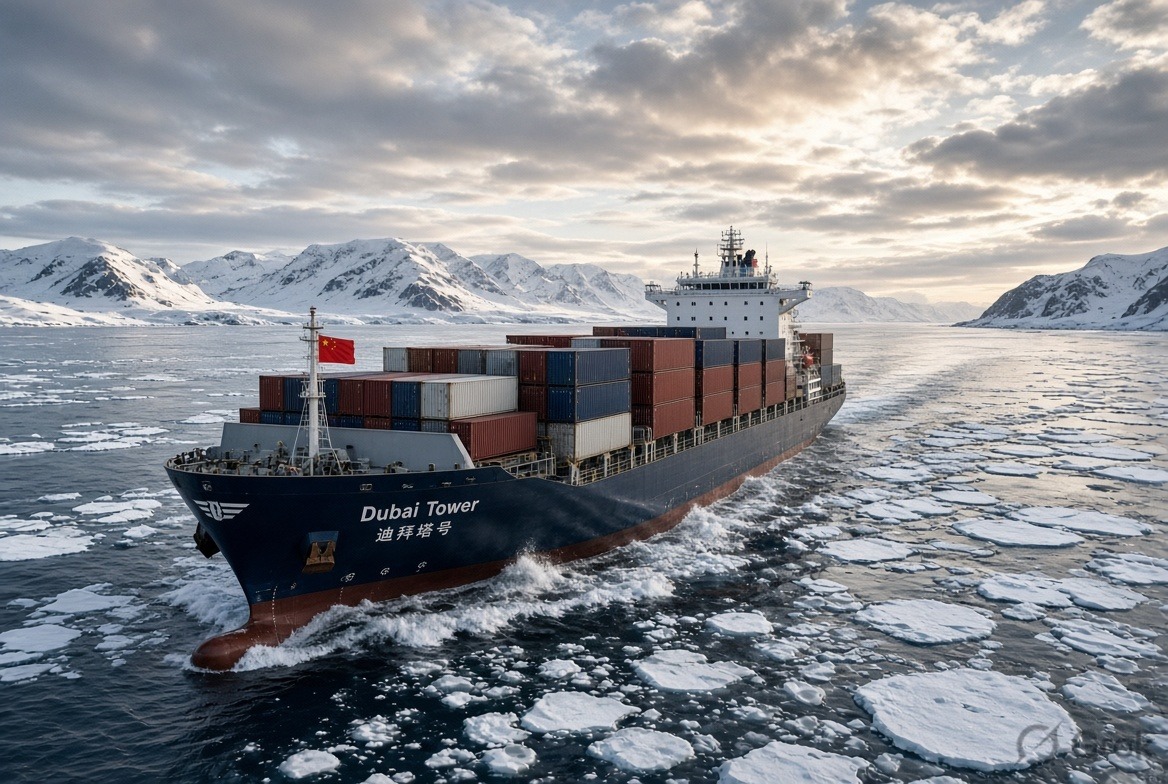

A Chinese cargo vessel, the Dubai Tower, has launched a regular commercial trade service along the Northern Sea Route, utilizing melting Arctic ice to reduce the Asia-Europe journey time to about three weeks. Operated by Sea Legend, the “China-Europe Arctic Express” bypasses volatile Middle Eastern chokepoints and saves time and fuel during the summer window, though it faces severe environmental criticisms, geopolitical scrutiny, and seasonal ice limitations.
Environment Pulse Desk: Melting Arctic sea ice has cleared the way for a new chapter in global shipping: a Chinese cargo vessel is pioneering what is being billed as the first regular commercial trade service along the Northern Sea Route, cutting weeks off the traditional journey between Asia and Europe.
A New Kind of Voyage The container ship Dubai Tower, operated by Chinese shipping company Sea Legend, set sail from a Chinese port in the Ningbo-Zhoushan or Qingdao area in mid-to-late August 2026.
Its cargo holds are packed with electric vehicles, batteries, renewable energy equipment, and other high-value goods bound for a British port such as Felixstowe or Teesport. The roughly three-week voyage along Russia’s Arctic coastline marks the opening run of Sea Legend’s new China-Europe Arctic Express service, which the company plans to operate about eight times this year during the short summer sailing window.
Why It Matters
The appeal of the route lies in simple geography. The Northern Sea Route — which China has folded into its broader “Polar Silk Road,” sometimes called the “Ice Silk Road” — can shave up to two weeks off a typical Asia-Europe crossing. A journey that might take around 40 days via the Suez Canal could be completed in 20 to 25 days along Russia’s northern coast, depending on ice and weather conditions. Beyond speed, the route offers shippers a way to sidestep some of the world’s more volatile waters, including chokepoints in the Middle East and the Red Sea, where security concerns have disrupted conventional shipping lanes in recent years.
Operators also see potential savings on fuel and operating costs, at least during the narrow summer months when the ice retreats far enough for standard merchant vessels — rather than heavy icebreakers — to make the passage. From Experiment to Schedule This summer’s voyages represent a shift from testing to routine operation.
Sea Legend and other Chinese shipping firms ran trial transits as recently as 2025, but this year several companies are moving toward scheduled service, with plans reportedly in place for dozens of Arctic transits involving container ships, bulk carriers, and multipurpose vessels. Russian icebreaker escorts and permits remain a key part of making the passages possible along the country’s northern coastline.
Not Without Risk
Despite the promise, the route comes with real limitations. It is open for only a few months a year, typically from midsummer to early autumn, and conditions can shift quickly — unpredictable ice movement and harsh weather still require specialized vessels or icebreaker support. Environmental advocates have also raised alarms about the potential for pollution and ecological disruption in one of the planet’s most fragile regions. And the geopolitics are not lost on observers: expanded use of the route deepens cooperation between China and Russia, feeding Western concerns about strategic competition in the Arctic.
Some major international shipping lines have already said they will avoid the Northern Sea Route altogether on environmental grounds.
Into the Future
As the Dubai Tower nears its European arrival this week, shipping analysts are watching closely to see whether the service can prove reliable enough to expand in future seasons. Sea Legend executives have said they hope to extend the sailing window using ships built to higher ice-class standards, which can better withstand Arctic conditions.
For now, the route remains a niche option rather than a wholesale replacement for established southern shipping lanes. But its emergence — made possible only by a warming polar climate — points to a subtle but real shift underway in the patterns of global maritime trade.
Also Read: Wildfires Scorch France, Spain, and Northern Algeria Amid Prolonged Heatwaves