


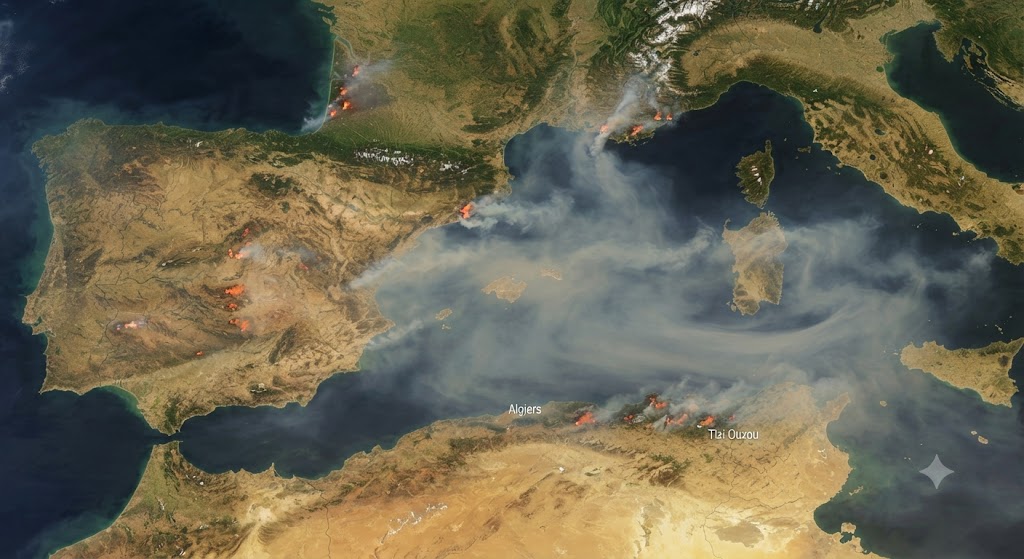

France, Spain, and northern Algeria are experiencing one of their most devastating wildfire seasons, driven by prolonged heatwaves and dry vegetation following a wet winter. The fires have forced hundreds of thousands of evacuations, caused dozens of fatalities, and destroyed vast forest areas. France and Spain are recording historic destruction with extensive deployments of firefighters and EU aid, while northern Algeria has suffered deadly blazes prompting national mourning and military intervention. Researchers attribute this extreme fire weather to ongoing climate change.
Environment Pulse Desk: Europe and North Africa are living through one of the harshest wildfire seasons in recent memory. A summer of relentless heatwaves, following a wetter-than-usual winter that left forests thick with vegetation, has turned that greenery into tinder.
The result: fast-moving fires across France, Spain, and northern Algeria that have killed dozens of people, pushed hundreds of thousands out of their homes, and burned through vast stretches of forest and countryside.
France is having its worst wildfire year in over a decade The Gironde region in southwestern France, known for its Bordeaux vineyards and the sprawling Landes forest, has taken the heaviest hit.
Nearly 100,000 hectares have burned nationwide so far this year, making 2026 the most destructive wildfire season France has recorded since 2012. More than a quarter of a million people have been evacuated from Gironde alone, including thousands pulled from tourist areas near Lacanau in a single sweep, with ash reportedly drifting onto nearby beaches. Local authorities suspended public gatherings in the area as a precaution.
Roughly 5,000 firefighters have been on the ground battling the blazes, joined by aircraft sent from other EU countries to reinforce France’s own water-bomber fleet. What’s made this fire season particularly punishing is how unpredictable the fires have been — some have grown intense enough to generate their own storm clouds and lightning, adding a whole new layer of danger and unpredictability to the firefighting effort.
Spain is facing one of its most damaging seasons in years Spain hasn’t fared any better. It’s currently on track for its third-worst wildfire year since record-keeping began in 2012. Fires have swept through central Spain — the areas around Ávila, Madrid, Toledo, Guadalajara, and Castellón — with one blaze merging into what’s now considered the largest single wildfire in the country’s modern history.
The toll has been especially tragic in Almería province, where a fire killed at least 14 people. Combined, France and Spain have seen more than 300,000 people displaced. A fourth heatwave hit both countries in late July, pushing temperatures to around 40°C in France and even higher once it reached Spain — a fresh blow just as crews were starting to gain ground.
Aid organizations warned at the time that the situation remained precarious, with relief teams working nonstop to house and support displaced families. Algeria’s heatwave has turned deadly On the other side of the Mediterranean, a brutal heatwave swept across northern Algeria and set off a wave of fires that killed at least 12 people in late August. The hardest-hit areas were in the east and along the coast — provinces like Béjaïa, Tizi-Ouzou, and Jijel.
Over a thousand separate fires broke out during the heat spell, destroying pine and oak forest and forcing residents out of nearby towns. The scale of the losses led the government to declare a period of national mourning and call in military support to help contain the damage. Why this is happening Climate researchers studying the fires say the pattern is becoming familiar: an unusually wet winter and spring produce lush vegetation, and then extended, intense heat dries that vegetation into ready fuel.
Add long stretches of drought and repeated heatwaves — France alone declared four separate heatwaves this summer — and you get conditions ripe for exactly this kind of fire behavior. Scientists studying the connection to climate change say this kind of extreme fire weather is becoming significantly more likely as the planet warms.
Where things stand now
Firefighting crews, military units, and EU emergency resources are still deployed across all three countries. Some fires have eased as weather conditions shifted, but authorities are keeping a close watch for new outbreaks and are urging people to stay cautious, especially as more heat is expected in the weeks ahead.
Also Read: एंटीबायोटिक प्रतिरोधी बैक्टीरिया से लेकर जंगल की आग तक, भारतीय पारिस्थितिकी तंत्र पर बढ़ते खतरे