

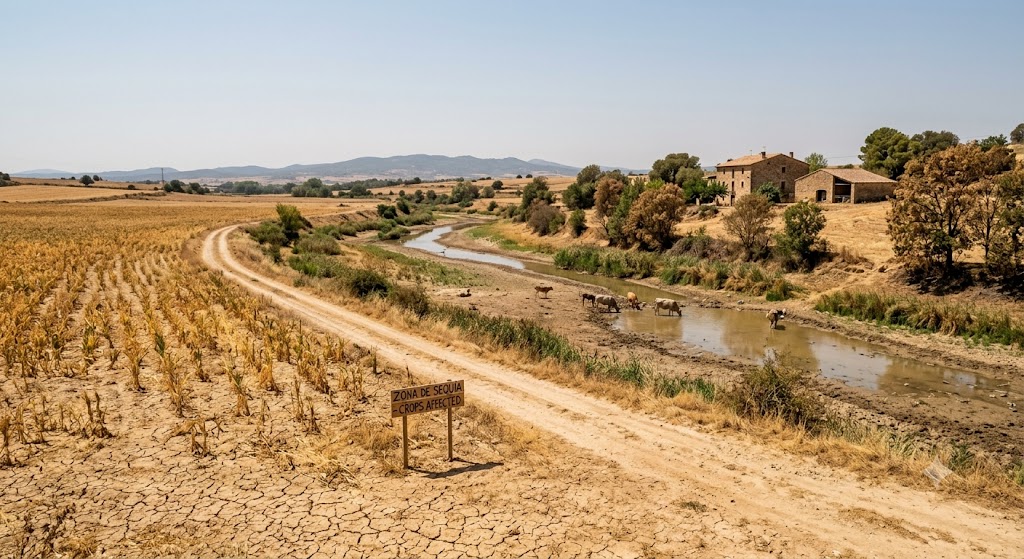

According to a warning from the European Environment Agency (EEA), cultivating traditional crops in Europe is becoming increasingly difficult due to rising temperatures, prolonged droughts, and water scarcity. This problem is no longer confined to Southern Europe; severe droughts and water crises are now being observed in countries such as Ukraine, Hungary, Britain, and Finland as well.
Environment Pulse Desk: Europe’s agricultural landscape could undergo major changes as rising temperatures, prolonged droughts and growing water shortages make it increasingly difficult to cultivate some traditional crops.
The warning comes from the European Environment Agency (EEA), which says climate change is already placing significant pressure on farming across the continent. While drought has long been associated with southern Europe, increasingly dry conditions in countries such as Ukraine and Hungary show that the problem is spreading beyond the Mediterranean region.
EEA Executive Director Leena Ylä-Mononen has warned that some crops may eventually become impossible to grow in the driest parts of southern Europe. She said expanding irrigation cannot provide a permanent solution because water resources themselves are under increasing pressure. Some agricultural land currently used for food production could become unsuitable for cultivation if current climate trends continue.
This summer, according to Ylä-Mononen, has provided a clear indication of the scale of the challenge facing European countries. The effects of drought and extreme heat are extending well beyond agriculture. Low water levels are affecting rivers and transport systems, while energy infrastructure and other essential services are also facing additional pressure. For farmers, adverse weather can delay harvesting, reduce crop yields and create uncertainty over food supplies in the months ahead.
Drought Spreads Across the Continent The EEA has highlighted severe drought conditions in Ukraine and Hungary, alongside unusually dry weather in parts of the United Kingdom and Finland. Northern Europe could potentially benefit from warmer conditions by gaining opportunities to grow some crops that currently require milder climates.
However, experts caution that these gains may not compensate for agricultural losses caused by drought, flooding and other extreme weather events. The European Union’s Joint Research Centre has reported drought conditions across roughly half of the EU and the United Kingdom. Low river flows and deteriorating soil and water conditions are already creating difficulties for agriculture.
An EEA assessment published in March found that four major weather-related hazards account for around 80% of agricultural losses in the European Union. Drought is responsible for the largest share at 54%, followed by heavy rainfall at 21%, frost at 16% and hail at 9%. Ylä-Mononen has stressed that climate adaptation needs to be treated as a long-term priority rather than an issue addressed only when funding is available.
She said decisions on agricultural infrastructure and investment need to consider climate risks over the next 10, 20 and even 50 years. The financial challenge is substantial. The EEA estimates that adapting Europe’s transport, energy and agricultural systems to climate change could require between €53 billion and €137 billion every year by 2050. The eventual cost will depend largely on how much global temperatures rise compared with pre-industrial levels.
The agency’s findings suggest that without sustained investment in adaptation, climate change could alter where and how food is produced across Europe. For farmers and policymakers, the challenge is no longer simply coping with occasional extreme weather, but preparing agricultural systems for a fundamentally different climate.
Also Read: Parched: Inside England’s Drought Crisis as 30 Million Face the Hosepipe Ban