


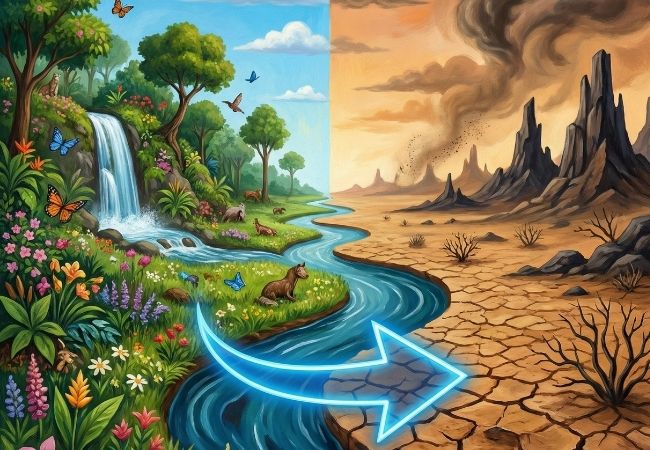

Climate-themed music emerged alongside the early environmental movement in the 1960s and 70s with classics like Joni Mitchell’s “Big Yellow Taxi” and Marvin Gaye’s “Mercy Mercy Me,” later expanding into global pop culture through Michael Jackson’s “Earth Song.”
Environment Pulse Desk: Music has always found ways to carry social and political messages, and the climate crisis is no exception. From folk anthems of the 1970s to today’s pop, hip-hop, and experimental soundscapes, artists have used melody, lyrics, and performance to spotlight environmental destruction, push for action, and forge an emotional connection to the natural world. These songs do more than entertain — they turn abstract science into something felt, amplify the voices of activists, raise money for causes, and help shift how culture thinks about sustainability.
As extreme weather and biodiversity loss keep intensifying, climate-themed music keeps evolving right alongside it, serving as both protest and a source of hope.
Where It All Began
The modern wave of environmental music can be traced back to the late 1960s and early ’70s, right as the environmental movement itself was taking shape. Joni Mitchell’s 1970 classic “Big Yellow Taxi” remains one of the genre’s most enduring entries. Beneath its deceptively cheerful melody sits a pointed critique of overdevelopment and environmental loss — a warning, inspired partly by Rachel Carson’s Silent Spring and a trip to Hawaii, about how easily people take nature for granted until it’s gone.
Decades later, its central message still resonates as a caution against short-sighted growth. Marvin Gaye brought a different kind of urgency to the topic with “Mercy Mercy Me (The Ecology),” from his landmark 1971 album What’s Going On.
Nestled among songs about war, racism, and inequality, Gaye mourned the state of the planet’s air, oceans, and wildlife — pairing a lush, soulful arrangement with a genuinely bleak account of ecological damage, which made the song both beautiful and deeply unsettling at once.
Around the same time, Neil Young offered his own fragile, almost sci-fi-inflected meditation on humanity’s relationship with nature in “After the Gold Rush,” while Cat Stevens (later known as Yusuf) questioned the cost of progress in “Where Do the Children Play?”
These songs emerged alongside the first Earth Day, as public concern over pollution and dwindling resources was just starting to take hold.
Decades later, Michael Jackson expanded the emotional register even further with “Earth Song” (1995), combining gospel-scale intensity with a sweeping plea on behalf of the planet and its creatures — a message made all the more dramatic through its accompanying music video and live performances.
A New Generation of Climate Voices
In recent years, climate messaging has found its way into nearly every genre imaginable. Billie Eilish’s “All the Good Girls Go to Hell” (2019) leans on religious and apocalyptic imagery to grapple with wildfires and climate inaction, capturing a sense of anxiety common to her generation.
Anohni’s “4 Degrees” (2016) takes a starker approach, confronting the scale of biodiversity loss the world faces under just a few more degrees of warming, with a haunting, repetitive refrain that implicates the listener directly.
Childish Gambino’s “Feels Like Summer” (2018) takes a subtler route, using warm, soulful production to evoke rising temperatures and a quiet sense of unease. Some of the most far-reaching efforts have come through collaboration and celebrity power. Lil Dicky’s 2019 song “Earth” brought together an enormous roster of artists — including Ariana Grande, Justin Bieber, and Snoop Dogg — to tackle the climate crisis with humor, while also raising substantial money for environmental causes.
The band The 1975 took a more direct route, featuring a recorded speech from young activist Greta Thunberg set against sparse piano, blurring the line between music and activism entirely. Metal acts like Gojira have long tackled environmental themes with real intensity, and folk, indie, and hip-hop artists continue to carry the tradition forward in their own ways.
Beyond the Lyrics
Artists aren’t limiting their climate advocacy to songwriting anymore. Coldplay, Billie Eilish, and others have restructured their touring around carbon-neutral or low-impact practices, sustainable merchandise, and fan engagement campaigns. In 2025, Eilish’s tour helped raise millions of dollars for climate and food-security causes. Some projects have gone even further, incorporating field recordings from real ecosystems directly into songs and routing royalties toward Indigenous-led conservation efforts.
Others have turned to sonification — transforming raw climate data like temperature records or ice-melt measurements into haunting musical compositions that let listeners feel the science rather than just read it off a chart. What Music Can — and Can’t — Do Climate-themed music succeeds in making complicated, often overwhelming issues feel accessible and emotionally real.
A strong chorus or striking video can reach people who’d never sit through a scientific report. Benefit concerts, curated Earth Day playlists, and artist-led campaigns have raised real money and rallied real petitions. Research suggests that when artists people trust speak up, it can actually push fans toward concrete action — contacting representatives, backing local policy efforts, and more.
There’s also a communal element: singing the same songs at protests or festivals helps reinforce a shared sense of identity around environmental values. That said, the impact has real limits. Not every climate-themed song becomes a hit, and raised awareness doesn’t automatically lead to policy change or lasting behavioral shifts.
Critics have also pointed out that celebrity environmentalism can come across as performative when it isn’t backed by deeper, systemic advocacy. Even streaming itself carries a real energy cost — though many would argue the cultural conversation it sparks, especially when artists push for broader change, outweighs that footprint. Still, what makes music unique is its ability to reach people in a way pure facts and figures can’t. Reports and data inform the mind, but songs reach the heart. Whether it’s Mitchell’s wry take on lost paradise, Gaye’s sorrowful beauty, Eilish’s generational urgency, or entirely new data-driven soundscapes, these songs keep the climate crisis alive in the cultural conversation — a persistent reminder that the environment isn’t just a backdrop to human life, but the very foundation it depends on.
As the crisis deepens, climate music seems likely to grow only more urgent and more inventive — blending protest with genuine hope, global perspectives with deeply personal stories, and traditional songwriting with emerging technology. In doing so, it carries forward one of art’s oldest jobs: pushing us to protect what’s left before it’s gone for good.
Also Read: How Green Technology Is Reshaping the Fight Against Climate Change