


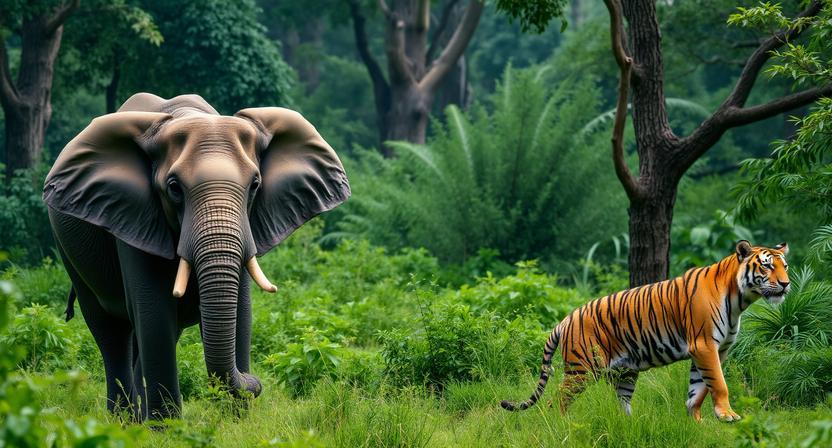

Two cases illustrate the scale of human-wildlife conflict problem with particular force: the surge of elephant conflict in Chhattisgarh, and the growing number of tigers now found living outside India’s designated reserves. Together, they reveal how success in wildlife recovery is now colliding with the hard ceiling of ecological and social carrying capacity.
Environment Pulse desk
Rising human-wildlife conflict along forest corridors and village fringes has become one of India’s most urgent conservation challenges. Two cases illustrate the scale of the problem with particular force: the surge of elephant conflict in Chhattisgarh, and the growing number of tigers now found living outside India’s designated reserves. Together, they reveal how success in wildlife recovery is now colliding with the hard ceiling of ecological and social carrying capacity.
Elephants in Chhattisgarh: A Disproportionate Toll
Chhattisgarh hosts only a modest elephant population, yet it has become one of the country’s worst hotspots for conflict. The state’s elephant metapopulation is estimated at just 250 to 300 animals, a figure inflated in recent years by herds migrating in from neighbouring Odisha and Jharkhand as their own habitats have degraded. Despite accounting for roughly one percent of India’s total elephant population, Chhattisgarh recorded 303 human deaths linked to elephant encounters between 2019 and 2024 — about 15 percent of the national toll.
The long-term picture is equally stark. Over a 23-year period through 2023, the state logged 828 recorded conflict incidents, resulting in 737 human deaths and 91 injuries. Forest divisions such as Jashpur, Dharamjaigarh, Surajpur and Korba consistently rank among the highest-risk zones, and fatalities have continued into 2026, with deaths reported across Surajpur, Raigarh, Korba and Balrampur. Many victims are villagers going about ordinary rural life — herding cattle, gathering forest produce, or walking to fields in the low light of dawn or dusk, when elephants are most active and least visible.
Crop damage compounds the human toll. Studies from the Surguja circle alone documented hundreds of raiding incidents affecting staple crops including sugarcane, rice, maize and wheat, deepening economic hardship in already vulnerable farming communities. But the conflict cuts both ways: elephants themselves are dying in large numbers. Illegal electric fencing and unsafe power lines are now a leading cause of elephant mortality, alongside drowning and train strikes. In just a 26-month stretch ending in early 2026, the state recorded 38 elephant deaths, 14 of them from electrocution.
Wildlife experts point to a familiar set of underlying causes: fragmented habitat, expanding agriculture, dwindling natural forage, and the breakdown of traditional migratory corridors. Notably, research suggests that larger, more contiguous forest patches see lower conflict rates, while paradoxically some high-conflict villages sit amid substantial forest cover but very little cultivated land — pushing hungry elephants into closer, more frequent contact with people. In response, grassroots initiatives like Hathi Mitra Dals, or “elephant friend” community teams, have taken on a frontline monitoring role, tracking herd movements and issuing early warnings to nearby villages. Forest departments are also beginning to deploy thermal drones and AI-assisted monitoring systems to strengthen real-time alerts, though coverage remains patchy.
Tigers Beyond the Reserves: The Cost of Recovery
If Chhattisgarh’s elephant crisis stems from population pressure on marginal habitat, India’s tiger story is, paradoxically, a case of conservation succeeding almost too well in confined spaces. The 2022 national tiger census put the country’s population at 3,682 — more than 70 percent of the world’s wild tigers. Yet scientists now estimate that 30 to 40 percent of these animals, well over 1,100 individuals, live outside formally notified tiger reserves. This dispersal is largely a consequence of several flagship reserves reaching or exceeding their ecological carrying capacity.
Reserves such as Bandhavgarh, Corbett, Rajaji, Ranthambore, Tadoba and other parts of the central Indian tiger landscape are under mounting pressure. As core habitats fill up, territorial conflict among tigers has intensified, and younger, weaker or subordinate animals are increasingly forced out into buffer zones, agricultural mosaics and multi-use forest lands. Bandhavgarh alone records more than 2,000 cattle kill annually — a telling sign of tigers ranging deep into human-occupied edges of the landscape. Comparable patterns are emerging in Madhya Pradesh, Maharashtra, Uttarakhand and Uttar Pradesh.
The human cost has grown alongside this dispersal. Tiger attacks caused hundreds of deaths between 2020 and 2024, with certain states seeing sharp spikes. Livestock losses are fuelling local resentment, occasionally provoking retaliatory poisoning or electrocution of tigers by affected communities. Adding further complexity, tigers have been found taking shelter in sugarcane fields and other tall-crop agricultural land, which offer dense cover similar to forest understorey — effectively erasing the boundary between wild habitat and farmland.
To address this, the Ministry of Environment, Forest and Climate Change has launched the “Tigers Outside Tiger Reserves” (TOTR) initiative. The programme aims to track dispersing tigers, extend protective measures into forest divisions beyond official reserve boundaries, reduce conflict through community engagement, restore degraded habitat, strengthen anti-poaching efforts, and manage the knock-on displacement of leopards and other predators into human settlements as competition for space intensifies.
Common Threads and the Road Ahead
Across both crises, the underlying drivers overlap significantly. Linear infrastructure — roads, railway lines and power transmission corridors — along with mining, agricultural expansion and urban sprawl, have fractured once-continuous wildlife corridors. Shifting rainfall and water availability linked to climate change are pushing animals to range further in search of resources. And in many landscapes, it is not just ecological capacity being tested, but social carrying capacity — the willingness of local communities to continue tolerating wildlife presence, particularly when compensation for losses is slow or seen as inadequate.
Where implemented consistently, tools such as early-warning systems, solar and bee fencing, organised crop-guarding, and habitat restoration have shown real promise in reducing conflict. But such measures remain unevenly distributed, and many known elephant corridors still lack formal legal protection, leaving them exposed to further encroachment and development.
Conservationists are largely united on one point: the answer is not to cap wildlife numbers but to expand usable habitat, secure and legally protect corridors, improve landscape-level planning, and deepen genuine partnership with the communities who share these spaces. India’s wildlife recovery over the past few decades has been a genuine success story. But the current wave of conflict — spilling out of parks and into farmland, villages and forest fringes — is a clear signal that protected areas alone cannot indefinitely absorb growing populations of large, wide-ranging animals.
As elephants continue moving across northern Chhattisgarh and tigers push beyond the limits of crowded reserves, the defining conservation challenge of the coming years will not be protecting wildlife within parks, but learning to share an increasingly fragmented countryside with them.
(AI image)