


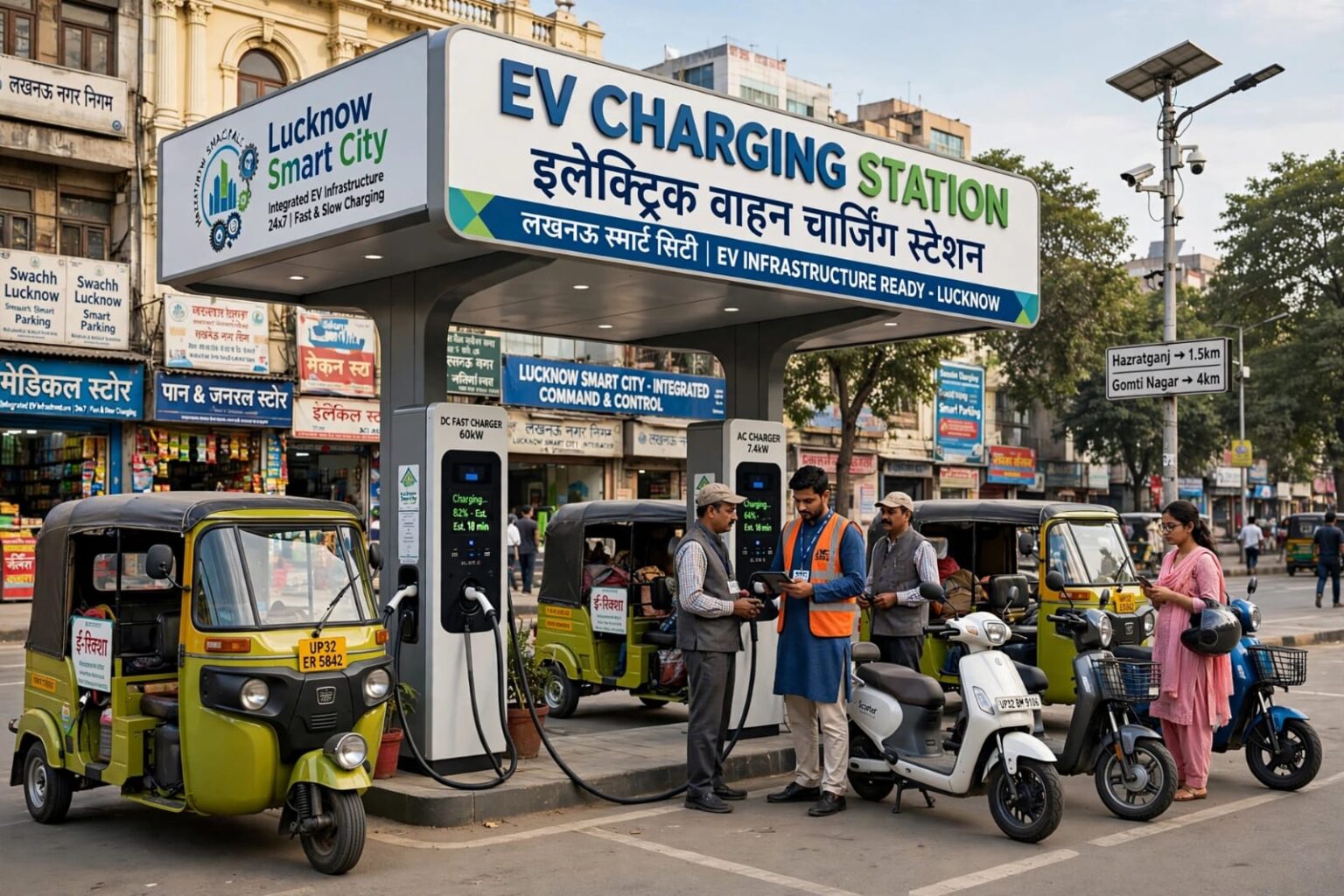

While Lucknow is emerging as a prominent electric vehicle (EV) market in Uttar Pradesh with growing registrations of two-wheelers, three-wheelers, and e-buses, the city still faces a severe shortage of charging infrastructure. Public chargers remain sparse and heavily concentrated in select commercial hubs like Hazratganj and Gomti Nagar, leaving residential areas, apartments, and inter-city corridors underserved. Although government initiatives—such as the PM e-Drive scheme allocations, Lucknow Development Authority mandates for high-rises, and state subsidies—are aiming to bridge the gap, delays in execution, grid constraints, and apartment-parking barriers continue to hinder mainstream private EV adoption. Overcoming range anxiety and achieving true EV readiness will require faster infrastructure deployment, residential “right-to-charge” policies, and improved reliability across public charging networks.
Environment Pulse Desk: Lucknow, the capital of UP and growing urban centre in its own right is preparing for an important component of India’s electric vehicle (EV) transition. In the city, there have been increasing registrations of electric two-wheelers and three wheelers as well impatient for addition interest in fleet since autolibrary.com has invested 1.5 million euros to support hybrid buses with e-Bike charging infrastructure.
All over India there were high number of registrations reported. Wide spread Electric Buses are working now. Policies available by state: subsidies, tax incentives and public transport electrification targets favour this new trend..
However, it is not possible to say that the supporting charging infrastructure needed for broad use of EVs in a convenient and reliable manner is anywhere near sufficient.
Public chargers are few and far between, progress against targets is sluggish and practical impediments for private owners — particularly those in apartments — remain.
Lucknow is far from being even close to EV-infra ready. Now Uttar Pradesh has become one of the bigger EV markets in India. The commercial EVs that you find with operating-cost advantages, such as e-rickshaws and e-autos in India make up a big slice of national state EV sales; the operational cost for one both is already evident show so heavy by huge across our life.
This city itself features in the top districts for fresh electric vehicle registrations. It also runs electric buses and has converted many of its municipal waste-collection vehicles to battery. They showcase policy intent and early commercial adoption. But breaking out into the mainstream will still be hampered by a simple practical question: where and how to reliably charge personal four-wheelers, or even (many of) two-wheelers?
A tale of shortfall is told in public charging numbers. A directory has around 48 charging points in Lucknow with a low number of connectors, including very few DC fast chargers. In fact, operational public charging stations exist at the state level only in low thousands—figures referenced during mid-2026 reviews put references to about 2,300–2,500 such stations all finished Uttar Pradesh alone and just a show few focused on major urban areas like Lucknow.
The state itself has a goal of 10,000 stations by the end of 2030. The Comprehensive Electric Mobility Plan (CEMP) for Lucknow anticipated a close to 4,000 charging points in public stations by 2025 and almost double the number between now and -2030. Deployment has lagged long behind these projections.
And the geographic distribution of these is only a part of it. In Hazratganj and Gomti Nagar, chargers are clustered in only a few commercial hubs — some malls as well as select petrol pumps and institutional locations. Most dense residential developments, outskirts of colonies & a lot of condominium complexes remain unserved. In patches, highway and expressway coverage is improving—plans for chargers on the Lucknow-Kanpur Expressway along with existing points on other corridors exist—but this network isn’t yet dense or continuous enough to blanket away range anxiety from inter-city travel.
There is a seriousness of purpose to government initiatives
For the first phase across 10 cities, Uttar Pradesh has identified spots for 238 public charging stations under central PM e-Drive scheme with Lucknow getting an allocation of no less than 36. The chargers at these stations are projected to be operated and maintained under more protracted contracts which include leasing government land, with hundreds of rides positioned there.
The state energy department has also previously talked about installing close to 1,000 new charging points in total — with Lucknow on the priority list. The Lucknow Development Authority has proposed earmarking dedicated space for electric vehicle charging in all high-rise housing projects coming up, an acknowledgement of the frequent complaint from apartment residents that they face rejection when seeking permission to set up a charger at their homes.
So far, the Chief Secretary level directives have ordered all departments to identify and earmark land which can then be offered for public stations. Policy encouragement also manifests in the form of subsidies for charging infrastructure operators and capital incentives under the UP EV Manufacturing and Mobility Policy.
Now those steps are necessary, but not enough yet. A number of intended stations have implementation timelines that extend into 2027 and afterwards. Delays arise from land allotment, approvals of power-connection and upgrading the grid as also matching interests among numerous agencies (municipal corporations, development authorities, power utilities stand in line along with private players). Once stations have been commissioned, however, reliability and interoperability issues often seen across India – downtime at a station for various reasons; separate/limited apps providing service (or not); varied methods of payment; sub-optimal charging speeds etc. Public DC fast charging is also orders of magnitude more expensive than home charging, thus limiting the economic benefit that EVs offer to those without off-road parking and a domestic connection. Charging away from home is overall much less favorable, but most EV owners are already huge fans of it in Lucknow and the vast majority charge at home.
Residential living is with most of the residents in an apartment/multistoreys or socities where there are common parking, electrical infra not designed for charging high power chargers at multiple points, and therefore management committees have sometimes banned installations. It is very welcome that the LDA has a plan looking to encourage high rises but it doesn’t really address lots of existing housing. For daily commuting, overnight slow charging at home is perfect; otherwise owners are relying on the scarce public network and secondly it becomes more troublesome or expensive to charge. What we are seeing is a typical chicken-and-egg problem of the mismatch between growth of vehicles versus Charging capacity. Commercial operators of e-rickshaws and e-autos with permission to charge often do so by informal or battery-swapping arrangements, while some avoid the electrified grid altogether due to spotty service.
Private car buyers — whose scenarios typically come with a higher up-front expense and greater range sensitivity — are expected to wait until the public network seems reliable. Availability of charging stations also feature at the top among cross-section studies and surveys, when asked about what is inhibiting EV adoption in Indian cities. Lucknow is no exception. Electric two-wheelers are seeing good traction because they have lower energy requirements and home or workplace chargeability is also easier but, four-wheeled penetration remains low. A further constraint is the underlying readiness of the grid. Domestic electricity tariffs for EV charging are more favourable, however large batteries will still mean simultaneous widespread home based charging may not be possible without appropriate local distribution upgrades and transformer capacity plus load management. Even if Uttar Pradesh’s power system remains heavily thermal-dependent, EVs still displace local air pollution and noise; but the ultimate climate impact of decarbonising ownership relies on a continuing greening-up process in the electricity mix.
It implies that planning of charging infrastructure has to go hand-in-hand with distribution network strengthening and renewable integration. For one thing, there are a number of relatively simple things that could make us more prepared. Prioritise dense, trustful clusters of chargers in residential and workplace areas over top-tier commercial locations as the first point. Second, enhance the implementation and expansion of “right-to-charge” legislation that allows residents in apartments with designated parking to install chargers without excessive barriers.
Third, set the uptime and interoperability requirements, clear performance monitoring of New stations being installed under PM e-Drive and state programmes. Fourth, Accelerate two- and three-wheeler battery-swapping situations, which already lead town’s electric power vehicle numbers. 5. Accelerate LDA and municipal plans to ensure that charging is built into new developments, neighbourhoods and public parking facilities Last, enhance public intelligence—instant-access apps for information on what is available now; transparent rates and outreach efforts that make it clear where things stand these days but as well the direction they are headed.
Efforts by Lucknow to include electric municipal vehicles and buses are already reflected in the recent clean-air rankings. Expanding private EV ownership will further buouy those dividends, decrease reliance on imported fossil fuels and turn the city into a bona-fide role model for 2nd &3rd Tier towns across North India. These policy architecture, subsidy windows and announced projects show a political will. The rest is all about delivering physical infrastructure that can keep up with vehicles entering the registration system, not to mention meet actual user needs on any given day – only much faster than today. As long as public chargers are relatively few, poorly distributed and unreliable—or even too complicated to use—and home-charging options remain elusive for most apartment dwellers alike, range anxiety and inconvenience will continue holding back the transition.
Lucknow has begun to take the first significant steps and continues announcing new plans. However, there is still quite a gap between the current state of affairs and actual EV-infrastructure readiness. Bridging that gap means continued cooperation, faster speed and a more granular emphasis on the day-to-day lives of EV owners as opposed to just headline numbers. It is critical to the city’s long-term mobility and environmental objectives.
Also Read: There is Serious Momentum for Lucknow’s Green Campus Movement