


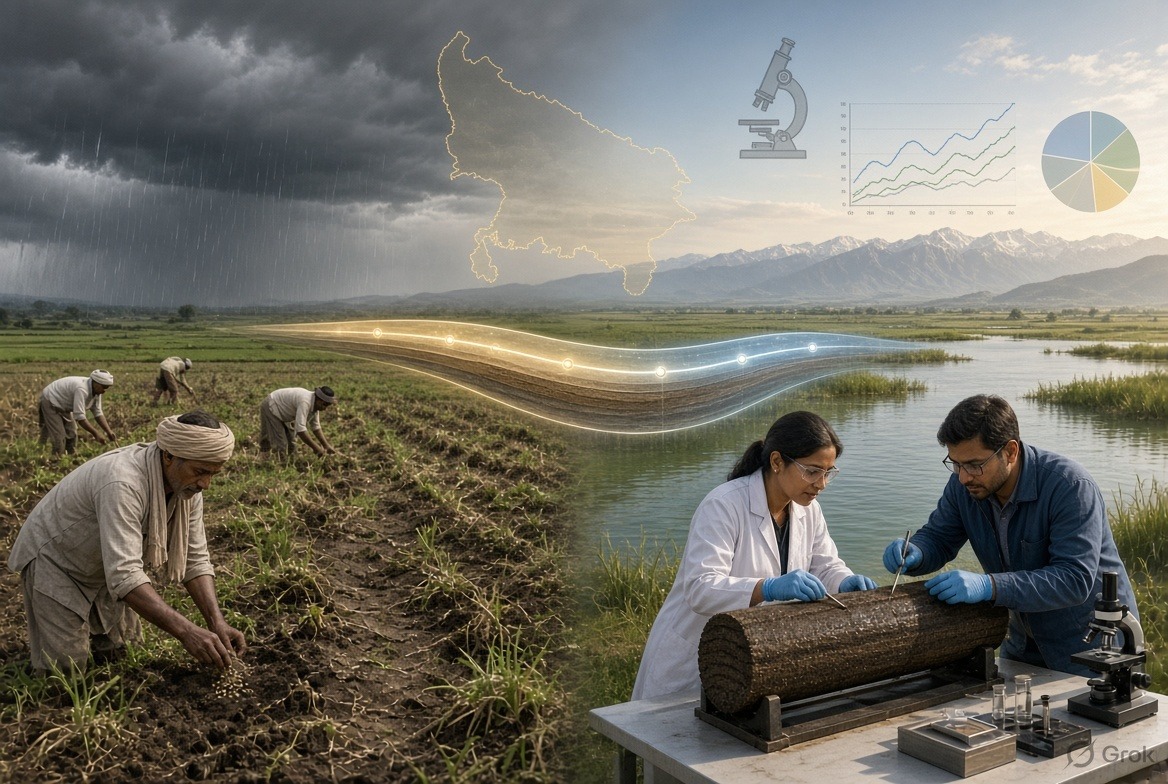

Climate research combining immediate agricultural disruptions caused by El Niño with a 25,000-year rainfall history extracted from sediment cores at Uttar Pradesh’s Bakhira Lake aims to reshape monsoon forecasting. By integrating deep past climate data with modern agricultural challenges, scientists hope to improve farm planning, water management, and weather predictions for India’s monsoon-dependent economy.
Environment Pulse Desk: Two strands of climate research are coming together to reshape how India thinks about its monsoon — one looking at the immediate disruption El Niño causes to farming schedules, and the other digging deep into sediment layers to reconstruct nearly 25,000 years of rainfall history.
El Niño’s grip on the sowing calendar Agricultural scientists continue to flag how El Niño conditions dampen monsoon rainfall overall while making certain regions prone to sudden extremes. That combination is proving especially hard on the kharif sowing window — the narrow stretch when farmers plant paddy, pulses, oilseeds, maize, and soybean.
When the early rains arrive late or fall short, planting gets pushed back, acreage shrinks in several states, and germination becomes patchy, particularly in rain-fed areas that lack irrigation backup. Research has tied El Niño and related climate patterns to simultaneous yield losses across multiple cereal crops, with the sharpest effects showing up in the northwest, central India, and the peninsula. ‘
Farmers try to cope by shifting sowing dates or switching to drought-resistant varieties, but these workarounds often come at the cost of lower yields and shakier household income.
What a Uttar Pradesh lake reveals about the deep past
The second thread comes from Bakhira Lake, a Ramsar wetland in Sant Kabir Nagar district in eastern Uttar Pradesh. Scientists at the Birbal Sahni Institute of Palaeosciences pulled a sediment core from the lake and examined its magnetic properties, grain size, chemistry, and clay content, anchoring the timeline with seven radiocarbon dates. The result is one of the more continuous land-based records of how the Indian summer monsoon has behaved going back roughly 25,000 years.
The core traces several distinct climate chapters: A cold, dry stretch during the Last Glacial Maximum (~25,300–18,100 years ago), when the monsoon was weak
A warmer, wetter phase during the Bølling–Allerød period (~15,300–12,800 years ago) with stronger rains
A return to dry conditions during the Younger Dryas
The Holocene Climatic Optimum (~9,200–4,000 years ago), when monsoon intensity and chemical weathering both peaked
A long dry spell between roughly 4,000 and 2,000 years ago Researchers link these swings to changes in Northern Hemisphere solar radiation, shifts in the Intertropical Convergence Zone, and the behavior of Himalayan glaciers over time.
Scientist Biswajeet Thakur, who worked on the study, described the Central Ganga Plain as one of the most crowded, farming-reliant regions on Earth — which is part of why understanding these historical cycles matters for protecting agriculture, water supply, and rural livelihoods going forward.
Fellow researchers Nazakat Ali and Anupam Sharma noted that the sediment’s mineral and chemical fingerprints function like natural rain gauges and thermometers, capturing how the monsoon reacted to past warming and cooling.
Bringing the two together The hope among researchers is that feeding this long-range paleoclimate record into current forecasting models will sharpen predictions of how a warming climate might reshape monsoon floods, droughts, and rainfall distribution.
Paired with a better grasp of how El Niño disrupts short-term sowing decisions, the work points toward more resilient farm planning, smarter water management in the Central Ganga Plain, and earlier warnings for farmers as monsoon patterns grow less predictable.
Together, the two studies make the same broader point: understanding India’s monsoon-dependent economy increasingly means looking both at next season’s forecast and at 25,000 years of climate history behind it.
Also Read: Rigid Thermal Power Contracts Are Holding Back India’s Clean Energy Transition, Finds CSE Analysis