

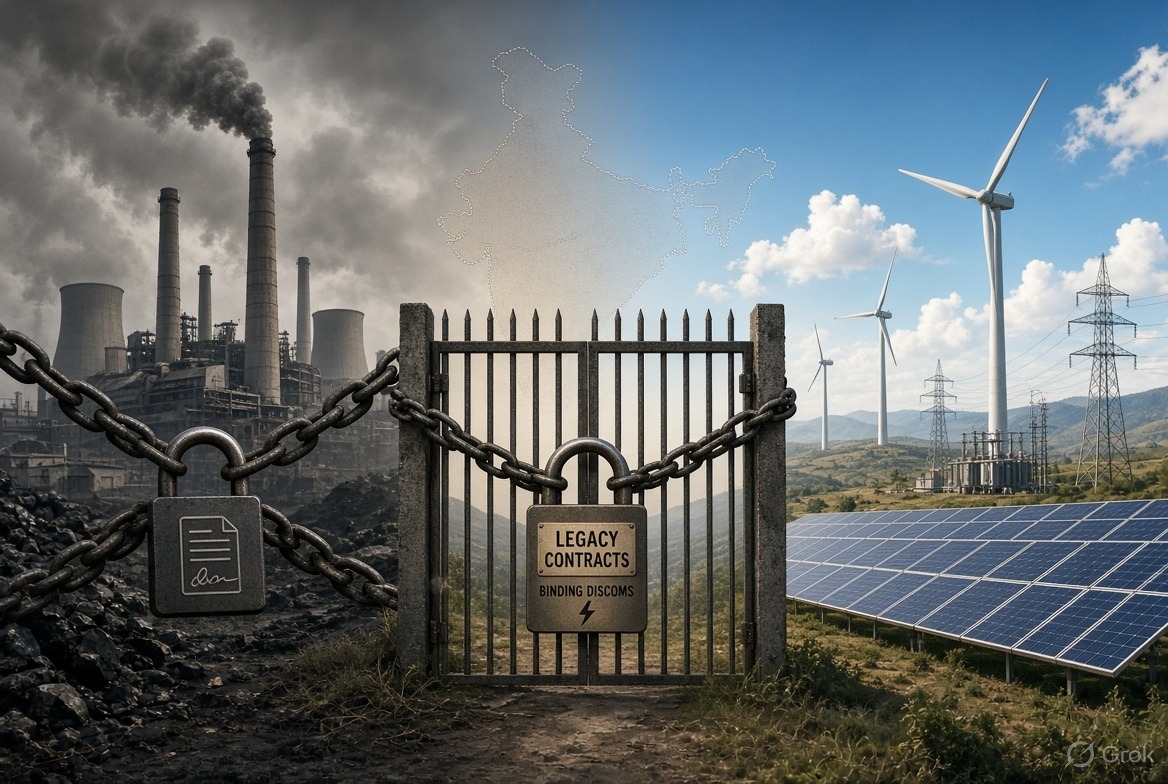

According to a CSE analysis, rigid and long-term thermal power purchase agreements (PPAs) are financially burdening DISCOMs and hindering India’s clean energy transition. With over 70% of thermal power tied to legacy contracts, DISCOMs are forced to make fixed payments for idle coal capacity during peak solar hours. The report recommends shorter contracts, voluntary renegotiation, and policy reforms to seamlessly integrate renewable energy.
Environment Pulse Desk : Long-term thermal power purchase agreements (PPAs) are locking India’s distribution companies (DISCOMs) into costly, inflexible payment structures that are complicating the country’s shift to clean energy, according to a new analysis by the Centre for Science and Environment (CSE).
The report, titled Beyond Baseload: Reforming Thermal PPAs for India’s Energy Transition, draws on an RTI survey covering 67.1 GW of thermal capacity across eight states. It finds that many of these contracts — often running 25 years or more — were designed for a time of power shortages and heavy reliance on coal, and are now increasingly out of step with a power system where renewable energy plays a much larger role.
Of the capacity surveyed, 6.1 GW remains locked into contracts running until 2040 or beyond, even as rising solar generation cuts into daytime demand for coal power. CSE estimates that during peak solar hours, India’s net surplus coal capacity could reach as high as 80 GW — meaning a significant chunk of thermal capacity sits idle while DISCOMs are still on the hook for fixed payments.
“The financial consequences of long-duration PPAs are not merely theoretical,” said Parth Kumar, Programme Manager at CSE’s Sustainable Industrialisation unit. “Extending these contracts simply shifts the burden into a longer commitment, resulting in a substantially higher cumulative payout by DISCOMs.”
According to the analysis, stretching a benchmark coal PPA from 11 to 25 years might lower the annual capacity tariff by 70–114 paise per unit, but more than doubles what consumers end up paying over the life of the contract. More than 70% of India’s thermal power is currently tied up in these long-term legacy agreements, the report notes, which restricts flexibility for integrating renewables and does little to encourage efficiency upgrades or plant modernisation.
Under current terms, generators are guaranteed annual returns of 8–15% on fixed costs — regardless of how much the plant is actually used, how it performs on emissions, or what the grid actually needs. That arrangement made sense when investment certainty was the priority, but it now risks pushing up electricity costs and slowing India’s move away from coal. India has already surpassed 50% non-fossil-fuel installed capacity — five years ahead of its original 2030 target.
But the contracts and tariff structures governing thermal power haven’t kept pace with that progress. CSE Director General Sunita Narain pointed out that the real challenge isn’t simply swapping coal for renewables, but finding a way to integrate the two so that coal is phased out gradually rather than abruptly. Nivit K. Yadav, Programme Director at CSE, added that India is actually well-positioned to push through these reforms, since most coal plants and DISCOMs are still government-owned.
To address the issue, CSE is recommending a revamped PPA framework — one that includes regular portfolio reviews by DISCOMs, clear principles for renegotiating legacy contracts on a voluntary basis, shorter and more flexible contract tenures, and incentives that reward efficient, low-carbon, and flexible thermal generation capable of working alongside renewables.
Without these changes, the report cautions, financial pressure on already-stretched DISCOMs could worsen, consumer tariffs may rise, and India’s broader climate and emissions targets could run into avoidable roadblocks. The findings were shared alongside CSE’s related work on coal plant flexibilisation at a national dialogue held in New Delhi in late August 2026 — a signal of how urgent this policy and contractual alignment has become as India pushes forward with its energy transition.
Also Read: सिर्फ बाघ नहीं, ये नौ प्रजातियां भी बचा सकती हैं भारत की जैव विविधता