


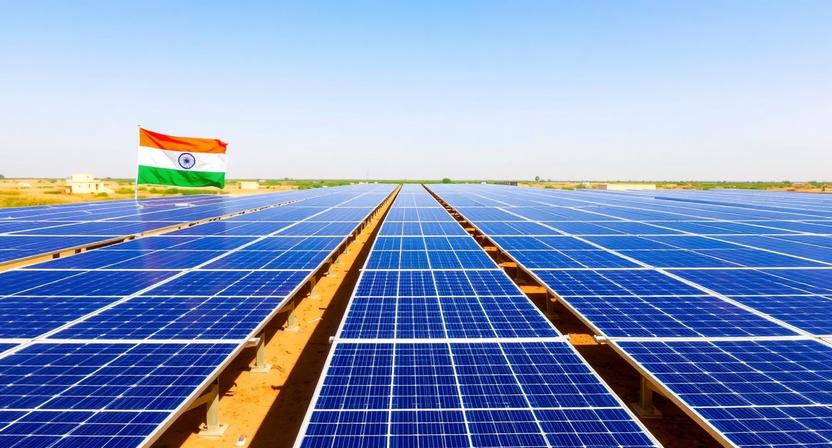

India has officially crossed a major milestone by reaching 100 GW in domestic solar photovoltaic (PV) manufacturing capacity, driven by targeted policies like the PLI scheme and the ALMM framework. While module assembly has grown massively—with total capacity estimates now reaching up to 233 GW—industry experts emphasize the need for stronger backward integration into cells, wafers, and polysilicon. This domestic growth enhances India’s energy security, reduces reliance on imports, and positions the country as a major global exporter in the clean energy supply chain.
Environment Pulse Desk: India has crossed a major milestone in its clean energy journey, with domestic solar photovoltaic (PV) manufacturing capacity officially reaching 100 GW. The achievement, largely reflecting module manufacturing capacity registered under the Approved List of Models and Manufacturers (ALMM), represents a remarkable leap from just 2.3 GW back in 2014 — and stands as a strong endorsement of the government’s push to build a self-reliant domestic solar supply chain.
Union Minister for New and Renewable Energy Pralhad Joshi and the Ministry of New and Renewable Energy (MNRE) described the achievement as a significant stride toward Atmanirbhar Bharat (self-reliant India) and the country’s broader target of 500 GW of non-fossil fuel capacity by 2030. The manufacturer base itself has expanded dramatically too — from just 21 companies in 2021 to nearly 100 today, running more than 120 production facilities across the country.
The growth has come from a mix of established industry players and new entrants, many of whom have brought advanced, high-efficiency manufacturing technology into the fold. Much of this expansion can be traced back to a handful of deliberate policy interventions: the Production Linked Incentive (PLI) scheme for high-efficiency solar PV modules, the ALMM framework that gives preference to domestically made equipment in government-backed projects, and other supporting measures aimed at boosting local manufacturing.
Together, these policies have helped cut India’s reliance on imported modules while pulling in fresh investment across the solar value chain. By mid-2026, total module manufacturing capacity had already grown well beyond the 100 GW mark, with estimates now placing it somewhere between 210 and 233 GW — enough to rank India among the largest solar module manufacturing hubs in the world.
That said, most of this capacity sits at the module-assembly stage. Solar cell manufacturing capacity is still comparatively modest, at around 30–35 GW, while further upstream segments like wafers, ingots, and polysilicon remain in relatively early stages of development. Industry watchers point out that while hitting 100 GW in module capacity is a genuine win for downstream manufacturing, real supply-chain resilience will depend on stronger backward integration — building out capacity in cells and the raw materials that feed into them. Government officials have signalled that cell manufacturing is set to expand significantly in the years ahead, with expectations of reaching around 100 GW of cell capacity in the medium term, driven by fresh investment and ALMM rules that will eventually extend to cells as well.
This growth also feeds directly into India’s solar deployment goals and opens the door to new export opportunities. Domestic manufacturers have already started shipping to international markets, and as the manufacturing base keeps expanding, India is increasingly being seen as a credible alternative in global solar supply chains that are actively looking to diversify away from a handful of dominant suppliers.
Beyond the numbers, the 100 GW milestone carries real weight for India’s energy security, job creation, and its broader move away from fossil fuels. There’s still work to be done — capacity utilisation needs to improve, the gap in cell and upstream manufacturing has to close, and rapid growth will need to translate into genuinely competitive, high-quality output.
Even so, as India keeps adding capacity and deepening integration across the solar value chain, this milestone marks a clear and meaningful step toward a strong, self-sufficient clean energy industry — one built to serve both the country’s climate goals and the wider world’s growing appetite for renewable energy.
Also Read: How Green Banking Is Helping Fight Climate Change