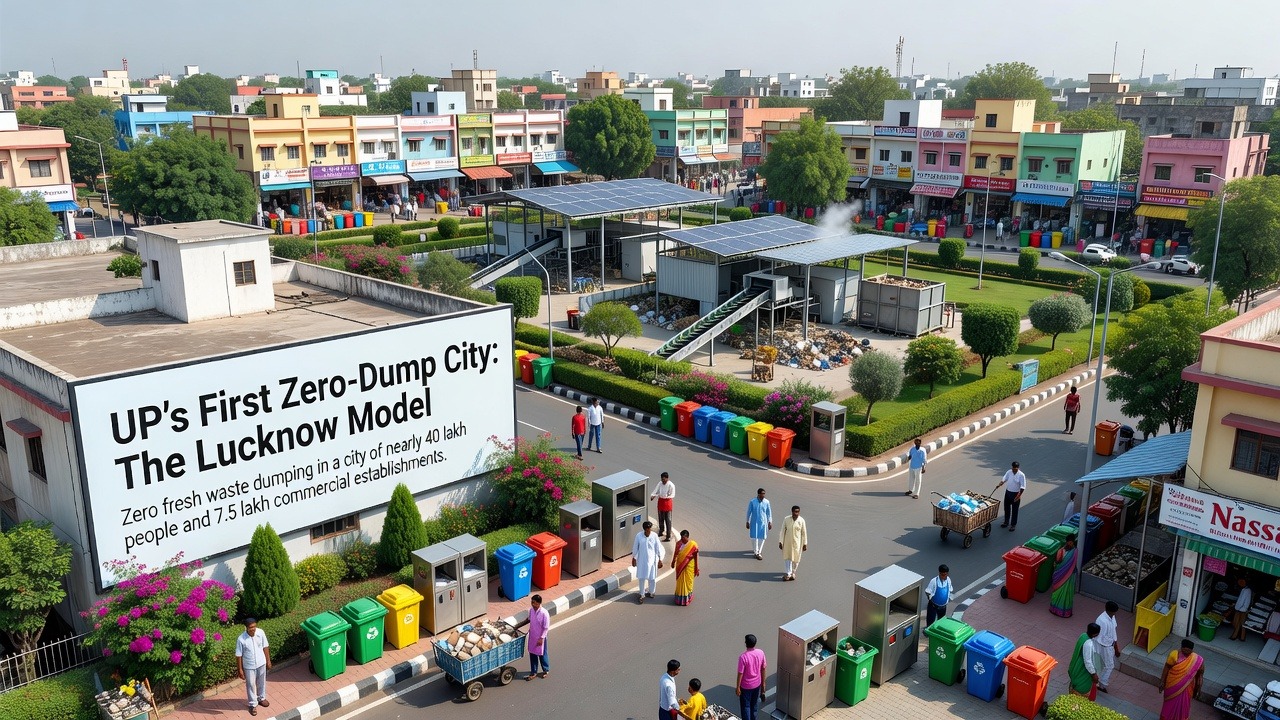

Lucknow has achieved the distinction of becoming Uttar Pradesh’s first “zero fresh waste dump” city, successfully processing all of its daily 2,000 metric tonnes of municipal solid waste scientifically. This milestone was reached following the opening of a third waste processing facility at the Shivari plant, boosting the city’s total processing capacity to over 2,100 metric tonnes per day. The comprehensive system relies on nearly 96.53 percent door-to-door collection, over 70 percent source segregation, and dedicated fleets of electric vehicles and mechanized sweepers to control urban dust and emissions.
Environment Pulse Desk: Lucknow has quietly pulled off something no other city in Uttar Pradesh has managed yet: it no longer dumps a single load of fresh, untreated garbage into the ground. For a city of nearly 40 lakh people and roughly 7.5 lakh shops, offices, and commercial establishments producing about 2,000 metric tonnes of waste a day, that’s not a small feat. It’s the kind of problem that, left unmanaged, turns into mountains of trash, poisoned groundwater, and the kind of stench that becomes a permanent feature of a city’s identity. Instead, under the umbrella of the Swachh Bharat Mission-Urban, the Lucknow Municipal Corporation has engineered a genuine turnaround, and the city now carries the distinction of being Uttar Pradesh’s first “zero fresh waste dump” city, meaning all of its municipal solid waste is processed scientifically rather than simply piled up somewhere on the outskirts.
The moment that sealed this achievement was the opening of a third waste processing facility at the Shivari plant, sometimes spelled Shivri, which added another 700 metric tonnes of daily processing capacity. Paired with two earlier facilities of the same size, built with private partner Bhumi Green Energy, the city’s total scientific processing capacity now tops 2,100 metric tonnes a day. Since that’s comfortably more than what the city actually generates, there’s no longer any real justification for waste to end up in an open dump. It’s a shift from a purely reactive posture, where garbage gets dealt with only after it becomes a crisis, to something more deliberate: treating waste as a resource to be captured and reused rather than a problem to be buried and forgotten.
The mechanics of how this works are fairly elegant once you look at them closely. Waste trucks arriving at the Shivari complex get weighed first, then the material is separated into organic waste, which makes up around 55 percent of the total, and inorganic waste, the remaining 45 percent. The organic portion, essentially kitchen scraps and garden trimmings, goes through windrow composting, a process that converts it into usable compost along with biogas, effectively turning food waste into both soil nutrients and a source of energy. The inorganic fraction gets sorted, with recyclable material pulled out and the rest converted into Refuse Derived Fuel, or RDF, which is then sold to cement and paper factories as a substitute for the fossil fuels they’d otherwise burn. That single move helps decarbonize industries that have historically been difficult to clean up.
None of this works, though, without waste actually reaching the plants in a form that can be processed efficiently, and that’s where Lucknow’s collection and segregation systems come in. Door-to-door collection now covers 96.53 percent of the city, which means almost nothing is left to informal dumping or scattered street litter. Source segregation, where households and businesses sort their own waste before it’s picked up, has crossed 70 percent, and this matters more than it might seem. Better segregation at the source means less contamination downstream, which translates into higher-quality compost, cleaner RDF, and lower costs for running the plants. The physical infrastructure backing all this includes windrow pads, internal access roads, storage sheds, dedicated weighbridges, odour control systems, and dozens of CCTV cameras keeping an eye on operations around the clock. To make sure all of this actually meets environmental standards rather than just looking good on paper, institutions like NEERI Nagpur, IIT Roorkee, and VJTI Mumbai provide independent technical oversight.
Fresh waste is only half the story, though. Lucknow was also sitting on a massive backlog of legacy waste, the kind that had piled up over decades before anyone thought seriously about processing it. At the Shivari site alone, roughly 18.5 lakh metric tonnes of old waste had accumulated by the early 2020s, taking up valuable land and creating ongoing environmental hazards. A remediation project worth more than ₹106 crore, largely funded through the Swachh Bharat Mission, kicked off in earnest in 2024 under Bhumi Green Energy, and since then around 12.86 lakh metric tonnes of that old waste has been scientifically processed. That work has freed up more than 25 acres of land, which is now being repurposed for green spaces and additional processing infrastructure. The by-products tell their own story about how thoroughly this material is being reused: about 2.27 lakh metric tonnes of RDF sent out to industries across the country, 4.38 lakh metric tonnes of coarse material and 2.35 lakh metric tonnes of construction and demolition waste reused in infrastructure projects and land filling, and 0.59 lakh metric tonnes of bio-soil put to appropriate use elsewhere. The remaining legacy waste is still being worked through, with the city aiming for near-complete clearance eventually.
Technology and infrastructure can only go so far without people actually changing their habits, and Lucknow has leaned into that side of things too. Municipal zones run regular awareness campaigns encouraging residents and shopkeepers to swap single-use plastic bags for cloth, jute, or paper alternatives, and these campaigns are backed by real enforcement, including fines issued for banned polythene and littering. Universities have gotten involved as well, enforcing campus bans on single-use plastics and pushing students toward alternatives like earthen kulhads instead of plastic cups. Street plays, public rallies, and the distribution of eco-friendly bags all reinforce the same message repeatedly, which matters because behavioural change tends to require constant reminders rather than a one-time campaign. Reducing plastic at the source also has a practical payoff for the processing plants, since plastic is notoriously hard to process and its removal improves the overall quality of the RDF being produced.
Lucknow’s approach fits into a much larger national push toward scientific waste management, landfill remediation, and resource recovery under Swachh Bharat Mission-Urban, and the city has already earned strong rankings in cleanliness surveys and public participation metrics within the state. Looking forward, there are plans for a 15 MW waste-to-energy plant at Shivari that would consume between 1,000 and 1,200 metric tonnes of RDF daily to generate electricity, which would also solve a logistical headache, since RDF currently has to travel nearly 500 kilometers to reach cement plants. There’s also talk of Bio-CNG plants for wet waste and turning construction debris into paver blocks and tiles, both of which would push the system further toward genuine circularity.
None of this means the job is finished. Keeping segregation rates high requires constant public education, and there are ongoing challenges around maintaining consistent plant performance, dealing with leftover inert material, and bringing informal waste workers into the formal system in a way that’s fair to them. The city’s population and waste generation will keep growing, which means capacity will need to expand too, and ideas like extended producer responsibility for packaging will likely need to enter the conversation. Still, what Lucknow has built offers a genuinely useful template for other mid-sized Indian cities: get collection and segregation right first, build processing capacity that actually matches how much waste you generate, tackle old legacy dumps at the same time rather than after, crack down on single-use plastics, and start planning for energy recovery early. Zero waste is less a finish line than a direction to keep moving in, but Lucknow has shown that even a rapidly growing city can leapfrog the old dump-and-forget model if the political will, private partnerships, and public participation all line up.
Also Read: Nepal’s Deadly Floods Reignite Climate Blame Game