


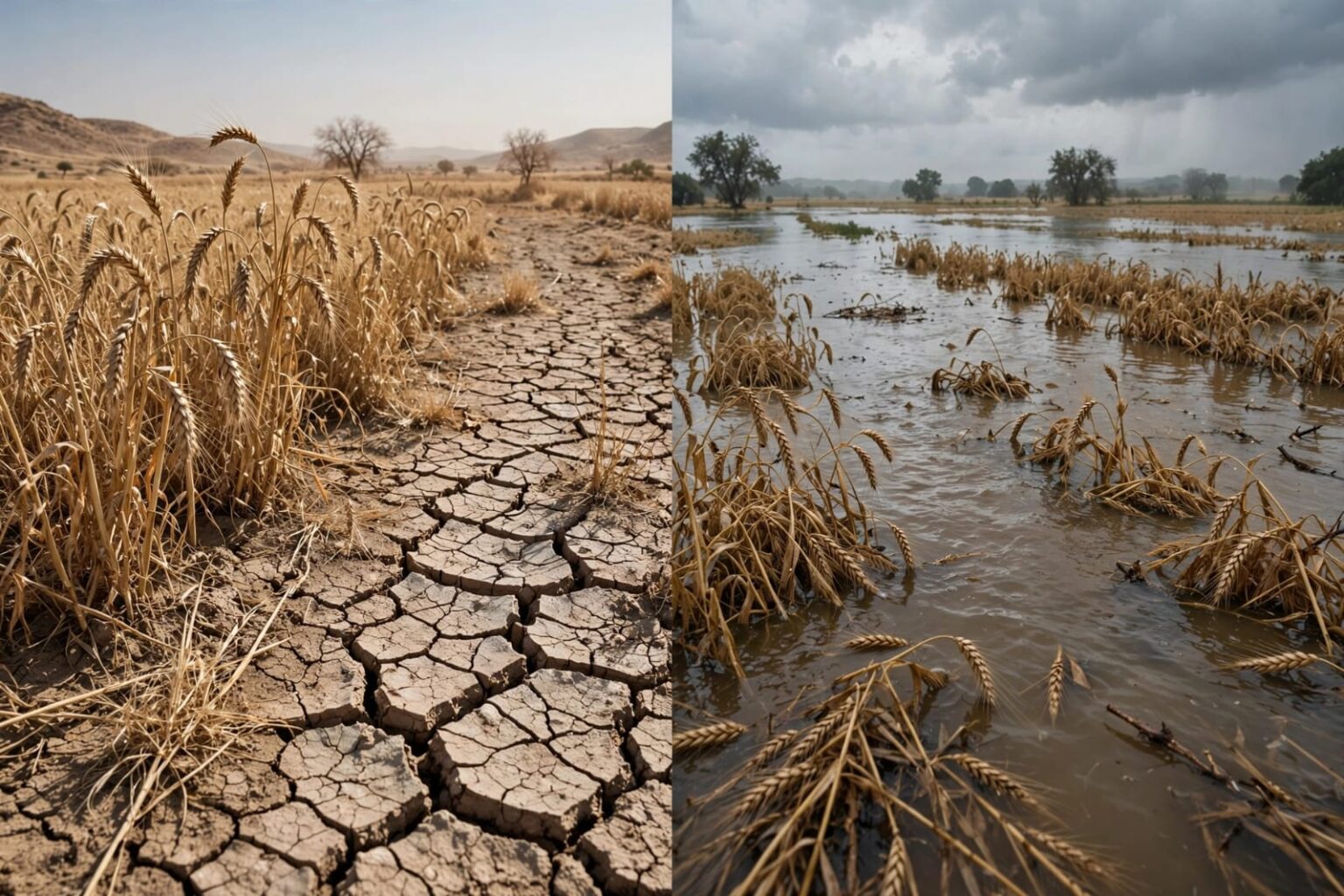

When El Niño—the periodic warming of the Pacific Ocean’s central and eastern waters—interacts with a planet already heated by greenhouse gas emissions, it transforms from a natural climate rhythm into a major threat to global agriculture. El Niño disrupts the Walker Circulation, bringing severe droughts to regions like southern Africa, Central America, and parts of Asia, while soaking other areas. Because warmer air pulls moisture out of soil faster and increases heat stress during crop flowering, compound “hot and dry” extremes become much more frequent, doubling the risks in key croplands compared to normal years.
Environment Pulse Desk: Every few years, the Pacific Ocean does something strange. Its central and eastern waters warm up, the atmosphere above them shifts, and weather patterns thousands of miles away start behaving differently. This is El Niño — the warm phase of a natural cycle called the El Niño-Southern Oscillation, or ENSO. It shows up roughly every two to seven years and usually sticks around for nine to twelve months. On its own, it’s just one of the planet’s many rhythms. But layered on top of a climate system already heated by decades of greenhouse gas emissions, El Niño stops being a curiosity and starts becoming a genuine threat to how the world feeds itself.
How It Actually Disrupts Weather
El Niño works by nudging the Walker Circulation — the great loop of rising and sinking air that governs tropical rainfall — off its usual track. Some regions dry out hard: southern Africa, Central America’s so-called Dry Corridor, the Caribbean, northern South America, Australia, Indonesia, and much of monsoon-dependent South and Southeast Asia. Other places get soaked instead — southern South America, parts of East Africa, the southern United States, and Central Asia often see heavier-than-normal rain.
Temperatures also climb globally during these events, which matters more than it might sound. Warmer air pulls moisture out of soil faster, pushes crops toward heat stress right when they’re flowering or filling grain, and generally raises the stakes for anything growing in the ground.
Climate change doesn’t just sit quietly next to this — it makes it worse. A hotter baseline means the same shortfall in rainfall now causes a deeper drought, because warmer air is simply better at wringing moisture out of plants and soil. Research shows that “hot and dry at the same time” events — the kind that do the most damage to crops — become far more common during El Niño years. In croplands across India, Australia, the Sahel, Brazil, and Mexico, the odds of these compound extremes more than double compared to a normal ENSO-neutral year, and rice-growing regions see some of the sharpest increases in risk.
It’s not simply two problems adding up. Warmer oceans and a warmer atmosphere change how intensely ENSO plays out and can even shift the pathways through which its effects travel. Scientists are still debating whether El Niño itself will become more frequent as the planet warms, but there’s much less debate that each event now does more damage — because crops are already living closer to the edge of what heat and water stress they can tolerate.
Winners, Losers, and a Very Uneven Map
Look at global crop yields during a typical El Niño year and the numbers seem almost mild. Rice tends to dip 1 to 1.5% below trend, wheat sits close to normal, maize barely moves because losses in one place get cancelled out by gains elsewhere, and soybeans often actually do a bit better — up 1.5 to 2% above trend. Stronger El Niño events make these patterns more predictable, but they don’t necessarily make the global averages swing harder.
The global average, though, hides a much rougher regional story.
Southern Africa gets hit again and again. During the powerful 1997–98 and 2015–16 events, maize yields in South Africa fell around 20% below trend, and in Zimbabwe the drop reached 40%. The El Niño of 2023–24 brought another brutal drought: Zambia lost huge stretches of maize-growing land, and some reports put Zimbabwe’s cereal harvest down by roughly 70%. Central America’s Dry Corridor and Haiti have seen harvests collapse by 50 to 70% in past events, tipping communities quickly into food insecurity. India’s monsoon often weakens under El Niño, putting pressure on rainfed rice and maize. Australian wheat production can fall sharply — large cuts were projected for 2023–24 — and palm oil and rice growers across Southeast Asia face their own dryness risks, sometimes with production losses that only show up months later.
Not every region loses out. Argentina and southern Brazil often benefit from wetter conditions that help soybean and maize output, and parts of the United States see gains too. But more rain isn’t automatically good news — it can flood fields, delay planting, and ruin harvests, even while heat stress continues elsewhere. Fisheries and livestock take hits as well: warmer Pacific waters throw off the upwelling that sustains fish stocks off South America, while drought in Africa and Central America leaves animals without enough pasture or water.
A Warming Baseline, Independent of El Niño
Strip El Niño out of the picture entirely, and climate change is already quietly eating into how much food the world can grow. Looking at the major staples — maize, wheat, rice, soybean, sorghum, and cassava, which together supply most of humanity’s calories — researchers have found that every extra degree Celsius of global warming costs roughly 120 kilocalories per person per day in lost production. That’s about 4.4% of a person’s recommended daily intake, gone, for each degree the planet heats up. Over the past several decades, this has already dragged down wheat, maize, and barley yields by a meaningful margin compared to what they’d be without climate change, while rice and soybean have fared somewhat better, partly thanks to the fertilizing effect of extra atmospheric CO2.
Looking ahead, the outlook under high-emissions scenarios is worse still, even accounting for farmers adapting and economies growing richer. Adaptation and income growth might offset around 23% of expected global losses by 2050, rising to about 34% by 2100 under a moderate warming path — but that still leaves large, unavoidable losses for nearly every staple crop except rice. And the pain isn’t evenly spread: it concentrates in both the world’s traditional breadbaskets and in poorer tropical regions that can least afford it. Extreme heat, erratic rainfall, worsening pests and disease, degraded soil, and more frequent compound weather extremes all pile onto the problem — and a warmer climate even makes farming’s chemical inputs less effective and erosion more likely, adding further pressure toward clearing new land.
Why This Becomes a Systemic Crisis, Not Just a Bad Season
The real danger isn’t that yields dip on average — it’s what happens when a sudden El Niño shock lands on top of a slow-burning climate crisis. One failed harvest can drain a family’s savings, push them into debt, force the sale of livestock they can’t replace, and set off migration. In places already dealing with conflict, expensive fertilizer and fuel, or fragile governance, bouncing back becomes that much harder. The 2015–16 El Niño touched more than 60 million people and triggered humanitarian appeals worth billions of dollars. The 2023–24 event followed a disturbingly similar script, and forecasters expect the same pattern whenever the next strong event arrives.
These shocks don’t stay local — food prices ripple out globally. Strong El Niño years have historically pushed up prices for key staples by several percentage points, and export restrictions, like the ones India has placed on rice, only add fuel to that volatility. Sub-Saharan Africa, which relies heavily on imported grain, feels this especially hard. Livestock losses and shrinking pastureland squeeze protein supplies further, and marine heatwaves add yet another layer of stress on the fisheries that coastal communities depend on.
The people who suffer most are usually the ones with the least cushion: smallholder farmers, pastoralists, and the urban poor in countries that import much of their food. Women and children often bear a disproportionate share of the nutritional and economic fallout. And none of this happens in isolation — it tangles together with water scarcity, biodiversity loss, and energy shortages, creating feedback loops that make long-term recovery even harder to achieve.
What Can Actually Be Done
There are real tools available: early warning systems, better seasonal forecasting, drought-resistant crop varieties, smarter water management, insurance schemes tied to weather indices, and more diversified rural livelihoods. Encouragingly, most of what helps communities survive an El Niño event also builds resilience against the broader effects of climate change — the two problems respond to overlapping solutions.
But adaptation has a ceiling. Under high-warming scenarios, some regions currently used for farming will simply become unsuitable for it. Even the most optimistic adaptation assumptions still leave meaningful yield losses on the table. The one strategy that actually addresses the root of the problem is cutting greenhouse gas emissions fast enough to slow the underlying warming trend.
The Bottom Line
El Niño functions like an amplifier bolted onto climate change’s already-troubling effects on agriculture. In any given year, it creates clear regional winners and losers. But climate change is the slower, steadier force — quietly lowering the baseline productivity of farmland everywhere and making every extreme event, El Niño or otherwise, hit harder than it used to. The result is a crisis with many moving parts at once: falling yields, volatile prices, worsening food insecurity, collapsing rural livelihoods, and rising humanitarian need. Understanding it means holding two timescales in mind together — the recurring, predictable rhythm of ENSO, and the relentless, human-driven warming trend behind it. Without much faster progress on both cutting emissions and building targeted local resilience, the strain on global food security is only going to keep growing.
Also Read: Nature Trails In and Around Lucknow: Discovering Uttar Pradesh’s Green Escapes