
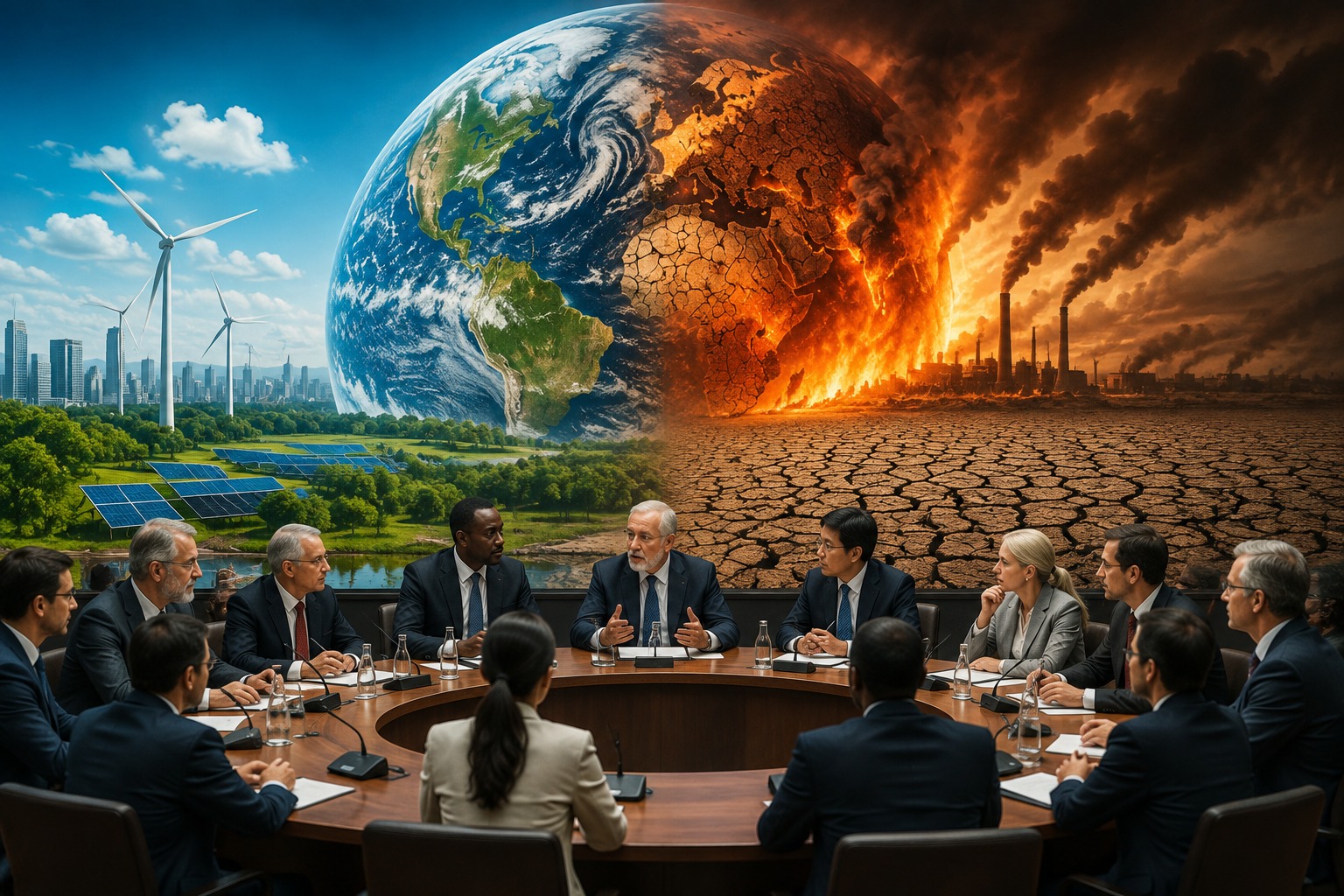

The global dialogue on the climate crisis has shifted from questioning its existence to debating the speed and scale of implementation. While market forces and clean technology are driving progress faster than formal diplomacy, a critical gap remains between policy commitments and what science requires to prevent catastrophic warming.
Environment Pulse Desk: There was a time, not so long ago, when the climate crisis was framed as a distant risk — a problem for future generations to solve. That era is over. The world has moved past the question of whether the crisis is real and into a messier, more consequential phase: figuring out how to respond to a disaster that is already unfolding, at a pace that still falls short of what science demands.
A Crisis Already Underway
The numbers leave little room for ambiguity. 2024 was the hottest year on record, and global greenhouse gas emissions climbed higher still, reaching roughly 57.7 gigatonnes of CO₂-equivalent — a 2.3% jump from 2023. Atmospheric CO₂ concentrations have pushed past 430 parts per million, and multi-decadal average temperatures are now very likely to cross the 1.5°C threshold within the next ten years.
Meanwhile, the human toll has become impossible to ignore: deadly heatwaves, catastrophic floods, wildfires, and storms have driven enormous economic losses and mass displacement, reinforcing what scientists have said for years — that human-caused warming is actively intensifying these disasters right now, not in some hypothetical future.
Diplomacy: Progress, but Not Enough of It The formal, multilateral response to this reality remains centered on the United Nations climate process, and its latest chapter — COP30, held in Belém, Brazil in November 2025 — marked the tenth anniversary of the Paris Agreement. The summit produced some genuine wins: a commitment to triple adaptation finance toward $120 billion annually by 2035, a new Just Transition Mechanism designed to support workers and communities moving away from fossil fuels, formal recognition that the world will likely temporarily overshoot 1.5°C, and the launch of a Global Implementation Accelerator meant to speed up delivery on existing pledges.
UN Secretary-General António Guterres and UN Climate Change Executive Secretary Simon Stiell framed the outcome as proof that multilateralism is still alive, noting that nearly every country present affirmed the shift to a low-emissions economy as irreversible.
Yet the reaction on the ground ranged from lukewarm to outright disappointed. The final deal notably lacked any formal roadmap for phasing out fossil fuels or halting deforestation, despite dozens of countries and civil society groups pushing hard for exactly that.
Colombian President Gustavo Petro and organizations like Oxfam were blunt in criticizing both the shortfall in ambition and the disproportionate burden placed on poorer nations. The numbers back up their frustration: the UN Environment Programme’s Emissions Gap Report 2025, pointedly titled “Off Target,” found that even full implementation of countries’ current climate pledges would still put the world on track for 2.3–2.5°C of warming this century.
That’s an improvement on earlier projections of 2.6–2.8°C, but still far outside the safety margin scientists have long warned about — and current policies, as opposed to pledges, point toward as much as 2.8°C. Only about a third of countries even bothered to submit updated pledges on time, and follow-up talks in Bonn in 2026 collapsed into gridlock over adaptation and mitigation.
There was, however, one striking legal development. In 2025, the International Court of Justice issued an advisory opinion affirming that existing treaties obligate wealthy nations to curb warming — and that failing to do so could carry real legal consequences, including potential compensation claims. Small island states and climate justice advocates welcomed it as a long-sought tool for accountability, though its real-world impact still hinges on political will that has so far been in short supply.
A Leadership Vacuum, Partly Filled Geopolitically, the picture has shifted noticeably. The United States, under the second Trump administration, has once again begun withdrawing from the Paris Agreement and skipped COP30 entirely — the first time in the history of the negotiations that no US delegation showed up.
That retreat has opened space for other players to take the lead. China, while still the world’s largest emitter, has continued deploying renewables at a staggering pace, at times adding more solar capacity in a single year than the rest of the world combined. Europe has pushed for greater ambition but largely settled for incremental progress, and informal “coalitions of the willing” have begun forming outside the official UN process specifically to keep fossil fuel phase-down conversations alive.
The Economy Is Moving Faster Than the Politics
Perhaps the most encouraging thread in this story isn’t diplomatic at all — it’s economic. Renewables and nuclear power together now account for more than 40% of global electricity generation, and in the first half of 2025, renewables overtook coal’s share by some measures. Global electric vehicle sales hit a record share of roughly 22% of all passenger car sales in 2024, powered largely by China’s EV boom.
Private climate finance has surged, nature-based solutions are expanding across parts of Africa, and solar power is reshaping energy markets in countries like Pakistan. Crucially, analysts note that recent political setbacks — including US policy reversals and international aid cuts — are unlikely to fully derail a transition that increasingly makes economic sense on its own terms.
Public Opinion: Concerned, but Distracted Public awareness of climate change is now nearly universal, with about 90% of people acknowledging it exists and most viewing it as a major threat. But concern has plateaued rather than deepened, and climate has slipped down people’s list of priorities as cost-of-living pressures, inequality, and geopolitical tensions compete for attention — in some global surveys, it fell from the second-ranked concern to fourth between 2024 and 2025.
Skepticism remains concentrated in a handful of places, including the US, parts of Eastern Europe, and Gulf states, but hasn’t meaningfully spread beyond them. Civil society, meanwhile, hasn’t gone quiet. COP30 saw unusually high Indigenous participation alongside large protests demanding stronger action on forests, fossil fuels, and climate justice. Youth movements, Indigenous groups, and NGOs continue applying pressure, and climate litigation is gaining momentum in the wake of the ICJ’s opinion.
For a growing number of people in vulnerable regions, adaptation isn’t a policy debate anymore — it’s a lived reality, with many expecting climate-driven displacement within the next decade. Enough to Bend the Curve, Not Enough to Break It Taken together, the world’s response to the climate crisis looks less like inaction and more like incomplete mobilization.
Technological and market forces are genuinely bending the curve of projected warming downward from the catastrophic trajectories once feared. But formal diplomacy remains hamstrung by competing national interests, leadership has only partially filled the vacuum left by US withdrawal, and financial commitments continue to fall short of what’s needed.
The gap between what science demands and what policy delivers remains, in the words of experts tracking it, dangerously wide. Humanity has stopped arguing about whether the crisis exists. What remains unresolved is whether implementation accelerators, private capital, national policy, and public pressure can converge quickly enough to close that gap — before the window for avoiding the most irreversible damage closes for good.