


The Yamuna isn’t just a river to Delhi — it’s the backbone of the city’s water supply. So, when it hit near-record lows this year, the effects were immediate. At the Wazirabad barrage, water levels sank to around 668.5–668.6 feet in late May and early June, roughly five to six feet short of what the system needs to function normally.
Environment Pulse desk
For weeks this summer, huge parts of Delhi didn’t get water from a pipe — they got it from a tanker. Behind that scramble lies a story that’s been building for years: a river running dangerously low, decades of unchecked pollution, and a city getting hot enough, fast enough, to outstrip whatever supply is left.
A River Running on Empty
The Yamuna isn’t just a river to Delhi — it’s the backbone of the city’s water supply. So when it hit near-record lows this year, the effects were immediate. At the Wazirabad barrage, water levels sank to around 668.5–668.6 feet in late May and early June, roughly five to six feet short of what the system needs to function normally.
That shortfall rippled straight through to the treatment plants. Wazirabad, which can process about 110 million gallons a day, and Chandrawal, rated for 90 MGD, were both forced to run below capacity — at times as low as 60–85% of normal output. During peak periods, that meant a gap of 50 to 100 MGD or more, water that simply never made it into the system. When the Water That’s There Isn’t Fit to Drink Low quantity is only half the problem. Even the water that does reach the plants often isn’t clean enough to treat easily.
A relatively short 22-kilometre stretch of the Yamuna — from Wazirabad down to Okhla, barely 2% of the river’s total length — carries most of its pollution burden. Industrial discharge, sewage pouring in from 22 major drains (Najafgarh and Shahdara among the worst offenders), and dangerously high ammonia levels routinely overwhelm what the treatment plants are built to handle.
The numbers from the Delhi Pollution Control Committee tell a grim story. At key points along the river — ISBT, ITO, Nizamuddin, Okhla — dissolved oxygen has measured at zero, meaning those stretches can no longer support aquatic life at all. Faecal coliform counts run tens to hundreds of times above safe limits further downstream.
And ammonia spikes, often blowing past the 1 mg/l threshold treatment plants can cope with, have repeatedly forced operators to cut intake or shut down altogether. Delhi does have substantial sewage treatment infrastructure on paper — around 814 MGD of installed capacity — but gaps in how well it’s actually run, combined with industrial units operating outside the rules, mean untreated waste keeps finding its way into the river anyway. ‘
The Heat Makes Everything Worse
Layer on top of that the city’s urban heat island effect, and you get a demand problem as bad as the supply one. At the height of summer, Delhi needs somewhere between 1,200 and 1,260 MGD of water — against a typical supply closer to 1,000 MGD. That’s a structural deficit of 200 to 250 MGD, heat crisis or not. And the heat itself makes the shortage worse in more ways than one.
Higher temperatures speed up evaporation from an already-shrinking river and its storage systems. Meanwhile, the loss of green cover and the relentless spread of concrete across the city mean less rainwater soaks back into the ground, and surface temperatures climb even higher — a feedback loop with no easy exit.
The people who feel it most are the ones at the end of the line — literally. Tail-end colonies, low-pressure zones, and neighbourhoods with old, patchy pipe networks bore the brunt: irregular supply, weak pressure, and in some cases, water that wasn’t even safe.
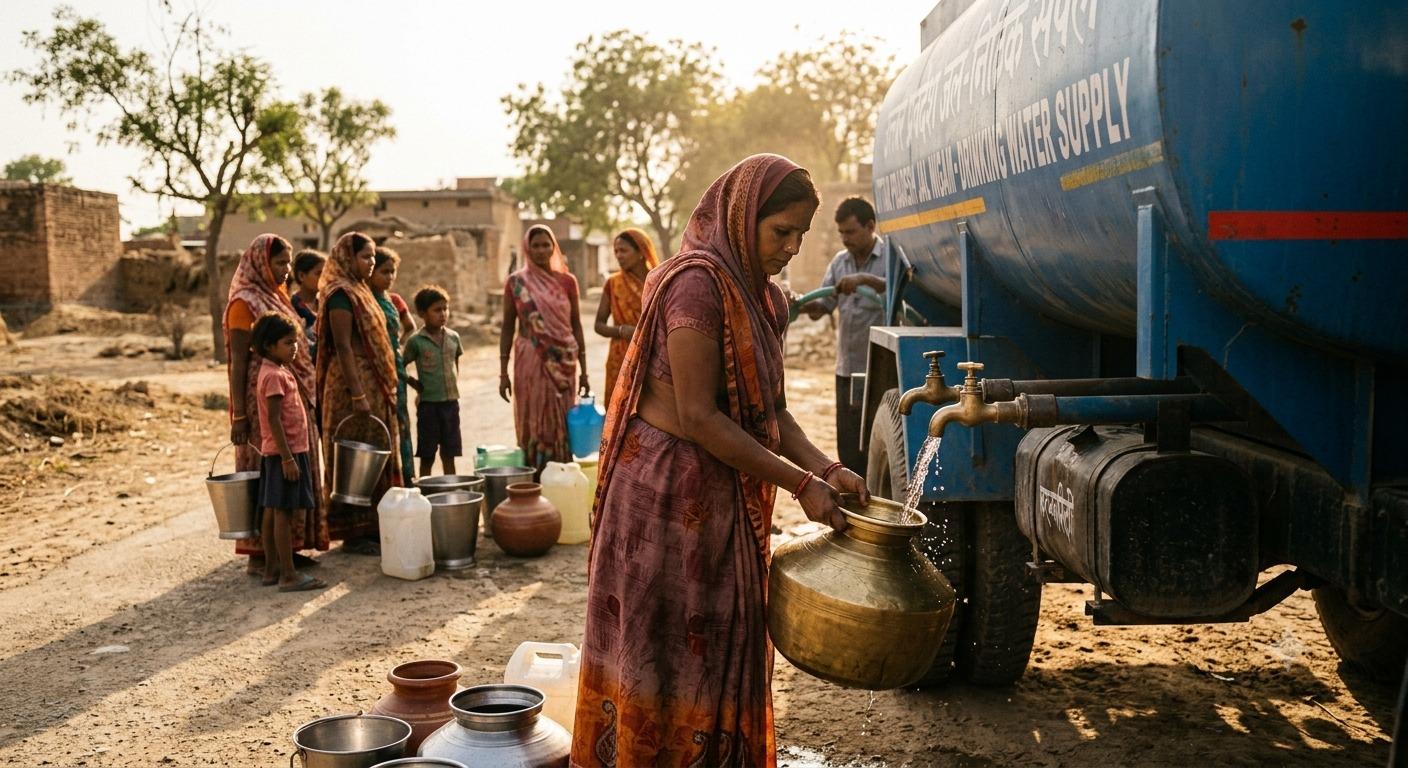
The scale of the response tells its own story — Delhi Jal Board tanker trips jumped 77% year-on-year in May 2026 alone, topping 188,000 trips, with hundreds of tankers rolling out daily at the peak of the crisis.
Patching the Gap, For Now Faced with a shrinking river, authorities did what they could. Excavators and dredgers cut channels into the riverbed itself to funnel whatever water remained toward the treatment plant intakes. More water was released through the Munak Canal from Haryana. Tanker fleets were expanded.
Additional borewells sunk into the Yamuna floodplain added a modest 10.5 MGD of relief. These are stopgaps, and officials know it. Longer-term, the Delhi Jal Board is building out new sewage treatment capacity — including smaller, decentralised plants — with the goal of a major capacity boost by 2027–28.
There are also plans to improve the river’s environmental flow by releasing highly treated wastewater downstream of Wazirabad, to treat pollution directly at the drains where it enters the river, and to tighten controls on industrial effluent. Talks with neighbouring Haryana and Uttar Pradesh over shared water flow and pollution control have picked up as well, under closer central oversight.
A Problem Built Over Decades
What happened this summer wasn’t a one-off. Experts point to the same underlying causes every year: too much water pulled from the Yamuna, sewage and industrial waste that never gets properly treated, a river that’s been starved of its natural flow, and now a warming climate making the whole system less forgiving.
Emergency fixes and new infrastructure can buy time, but without a real, sustained cut in pollution, protection of the river’s natural flow, and smarter management of demand, Delhi is likely to find itself back here — tankers rolling through the streets — the next time the mercury climbs and the monsoon falls short. For now, with temperatures still elevated and rainfall as unpredictable as ever, Delhi’s water security remains tied to a river that is, by almost every measure, in trouble.
Where implemented consistently, tools such as early-warning systems, solar and bee fencing, organised crop-guarding, and habitat restoration have shown real promise in reducing conflict. But such measures remain unevenly distributed, and many known elephant corridors still lack formal legal protection, leaving them exposed to further encroachment and development.
Conservationists are largely united on one point: the answer is not to cap wildlife numbers but to expand usable habitat, secure and legally protect corridors, improve landscape-level planning, and deepen genuine partnership with the communities who share these spaces. India’s wildlife recovery over the past few decades has been a genuine success story. But the current wave of conflict — spilling out of parks and into farmland, villages and forest fringes — is a clear signal that protected areas alone cannot indefinitely absorb growing populations of large, wide-ranging animals.
As elephants continue moving across northern Chhattisgarh and tigers push beyond the limits of crowded reserves, the defining conservation challenge of the coming years will not be protecting wildlife within parks, but learning to share an increasingly fragmented countryside with them.
(AI image)