


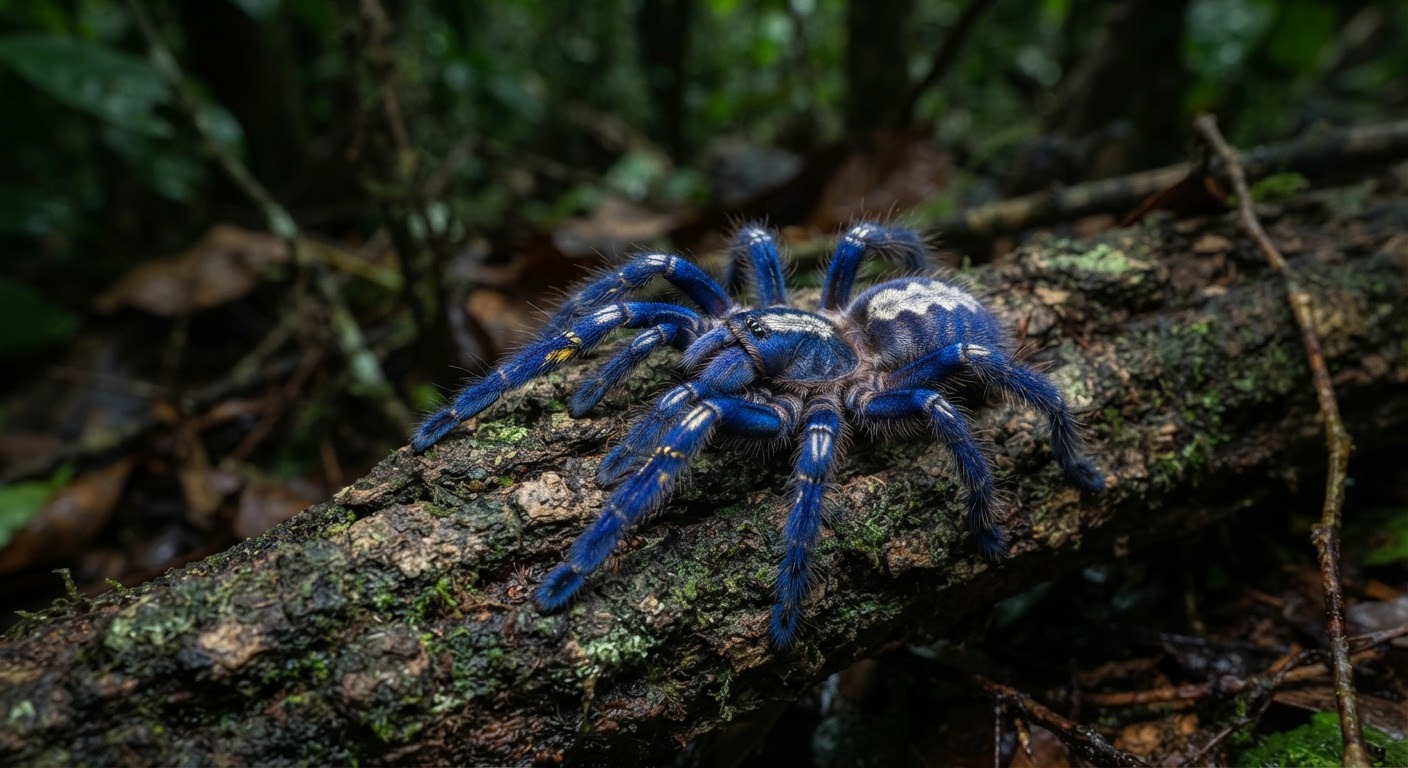

The Andhra Pradesh Forest Department, in collaboration with the Eastern Ghats Wildlife Society, has initiated a comprehensive conservation survey for the critically endangered Peacock Tarantula (Poecilotheria metallica). Centered within the Nagarjunasagar Srisailam Tiger Reserve (NSTR), the initiative aims to map population distribution, assess habitat threats, and gather crucial data to safeguard the species. Known for its striking metallic blue-and-green coloration, the spider is strictly endemic to a tiny forest patch under 100 square kilometers between Nandyal and Giddalur in the Eastern Ghats.
Environment Pulse Desk: Wildlife officials in Andhra Pradesh have kicked off a detailed conservation survey for one of India’s most visually striking — and most vulnerable — creatures: the Peacock Tarantula (Poecilotheria metallica), better known to most people as the peacock spider.
The survey is being carried out by the Andhra Pradesh Forest Department alongside the Eastern Ghats Wildlife Society, with fieldwork centred in the Nagarjunasagar Srisailam Tiger Reserve (NSTR), one of the largest tiger reserves in the country. The goal is straightforward but urgent: figure out exactly where this spider still lives, how many remain, and what’s threatening them, before it’s too late to act.
The Peacock Tarantula isn’t just rare — it’s classified as Critically Endangered by the International Union for Conservation of Nature (IUCN), which puts it among the most at-risk species on the planet. Its entire known range is squeezed into a forest patch of under 100 square kilometres between Nandyal and Giddalur in the Eastern Ghats. Nowhere else in the world does it naturally occur. Part of what makes it so recognisable is its appearance — a shimmering metallic blue-and-green coloration that has earned it the nickname “rare jewel of the Eastern Ghats.”
It’s an arboreal species, meaning it lives in trees rather than burrows, and it depends heavily on mature trees and undisturbed forest cover to survive. That dependence is exactly what makes it so fragile. Logging, firewood collection, and general forest degradation chip away at the habitat it needs. On top of that, its striking looks have made it a target for illegal collection feeding the international exotic pet trade — a pressure that hits an already tiny population especially hard.
The plan is to systematically map where the spiders are found within the protected NSTR landscape, get a clearer estimate of population numbers, and pin down the specific threats in each area. Officials say this kind of granular data is what’s needed to build real habitat management plans and long-term conservation strategies, rather than acting on guesswork.
There’s also a broader point being made here: conservation efforts in India have historically centred on high-profile, “charismatic” animals like tigers. This survey signals a shift toward recognising that rare, endemic invertebrates — species with no media spotlight and no obvious public appeal — matter too, both for their own sake and for the ecological roles they quietly play.
Deputy Chief Minister Pawan Kalyan and other state leaders have pointed to the survey as part of a wider push to protect lesser-known species that often get overlooked in conservation planning. Given how narrow the Peacock Tarantula’s range already is, officials are blunt about the risk: a single serious disturbance — a large fire, a wave of logging, a spike in illegal collection — could be enough to wipe it out in the wild entirely.
Conservationists are hopeful the survey’s findings will lead to stronger protections for the species, but they’re also framing it as something bigger: a template for how India might approach conservation for other overlooked, narrowly distributed species hiding in its biodiversity-rich landscapes. For a country whose conservation identity is so often tied to tigers and elephants, a serious effort to map and protect a single small, jewel-toned spider is itself a notable shift in priorities.
Also Read: India Steps Up Efforts to Harness Geothermal Energy as Reliable Low-Carbon Power Source