


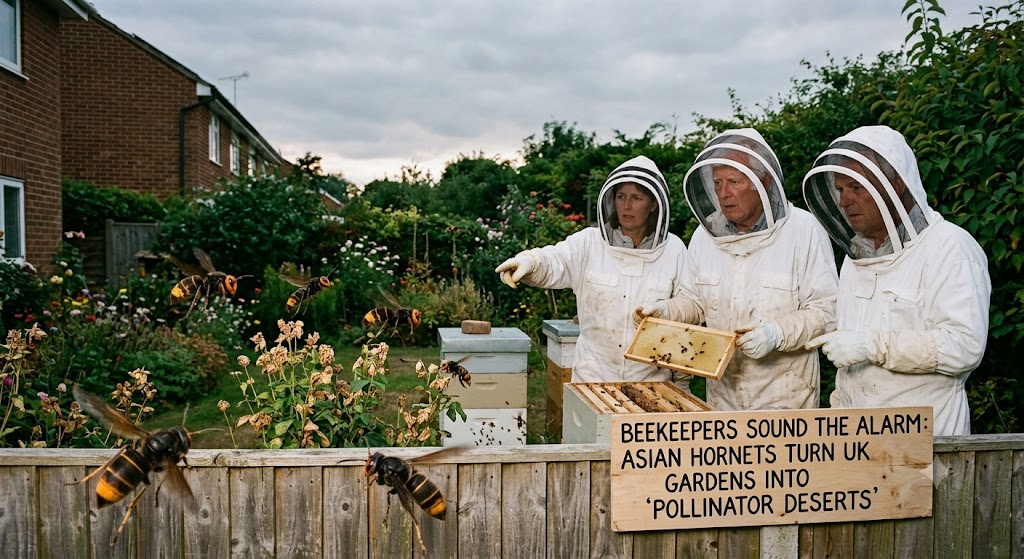

Beekeepers and officials across the UK, led by the British Beekeepers Association (BBKA) and the National Bee Unit, are sounding the alarm over the invasive Asian hornet (yellow-legged hornet).
Environment Pulse Desk: Across the UK, beekeepers are sounding a warning that’s growing harder to ignore: the invasive Asian hornet is quietly hollowing out pollinator populations, and with them, a slice of the country’s food security.
The insect — also called the yellow-legged hornet — has become public enemy number one for anyone who keeps bees. Industry groups, led by the British Beekeepers Association (BBKA), say the hornet’s relentless appetite for honeybees and other native insects is leaving whole areas eerily empty of the pollinators that crops depend on. Now they’re pushing for something bigger than nest removal: a full-scale public awareness campaign to catch outbreaks before they take hold.
“Asian hornets leave behind pollinator deserts, with a serious impact on food security and agricultural economy,” says Lucie Chaumeton, a BBKA trustee who also sits on the organization’s yellow-legged Asian hornet committee — and keeps bees herself.
It’s a concern shared inside government. Kate Wilson, who heads the National Bee Unit within the Animal and Plant Health Agency, puts it plainly: these hornets “cause significant damage to native pollinators, including our much-loved honeybees.”
A Fast-Moving Invader
The yellow-legged hornet isn’t native to Europe at all — it hitched a ride from south-east Asia roughly two decades ago, first appearing on the continent around 2004. It didn’t take long to spread. The UK recorded its first sighting in 2016, and while officials have managed to stop the species from fully establishing itself here — largely through swift nest destruction — the numbers keep climbing. Last year alone, the National Bee Unit tore down a record 161 nests.
More troubling still: genetic testing has shown that some queens have survived the winter and founded new nests on their own, hinting that a self-sustaining, home-grown population may already be taking root.
The Damage Adds Up Fast
The scale of what a single nest can do is staggering. One colony can devour more than 11kg of insects in a season — tens of thousands of individual pollinators. And the hornets don’t need huge numbers to do damage. Just a handful hovering outside a beehive, picking off returning foragers, can cut a colony’s foraging activity in half, pushing bees toward stress, lower honey yields, and in the worst cases, collapse.
The fallout isn’t limited to honeybees, either. Wild bees, hoverflies, and other insects essential to pollinating crops and sustaining broader biodiversity are just as vulnerable.
What’s Being Done — and What’s Needed
The government has actually had this threat on its radar since 2011, when it first ran a risk assessment, and a contingency plan has been in place ever since. But officials are clear that plans on paper only go so far — spotting the hornets early depends heavily on ordinary people noticing and reporting them, particularly during two critical windows: when new queens emerge each spring, and when mating season arrives in early autumn.
Beekeepers are urging anyone who spends time outdoors to learn the telltale signs — a dark body, yellow legs, and a distinctive orange face — and to report sightings through the Asian Hornet Watch app or other official channels. One firm piece of advice: never approach a nest directly, since the insects can turn defensive if disturbed.
Without a stronger, more coordinated push for public vigilance, experts warn the Asian hornet could dig in even deeper, adding fresh strain to pollinator populations that are already under pressure — and putting more of the UK’s farming output and natural ecosystems at risk.
Also Read: अगले दो दशकों में भारत में हर साल 15–40 अतिरिक्त अत्यधिक गर्म दिन आने का अनुमान