


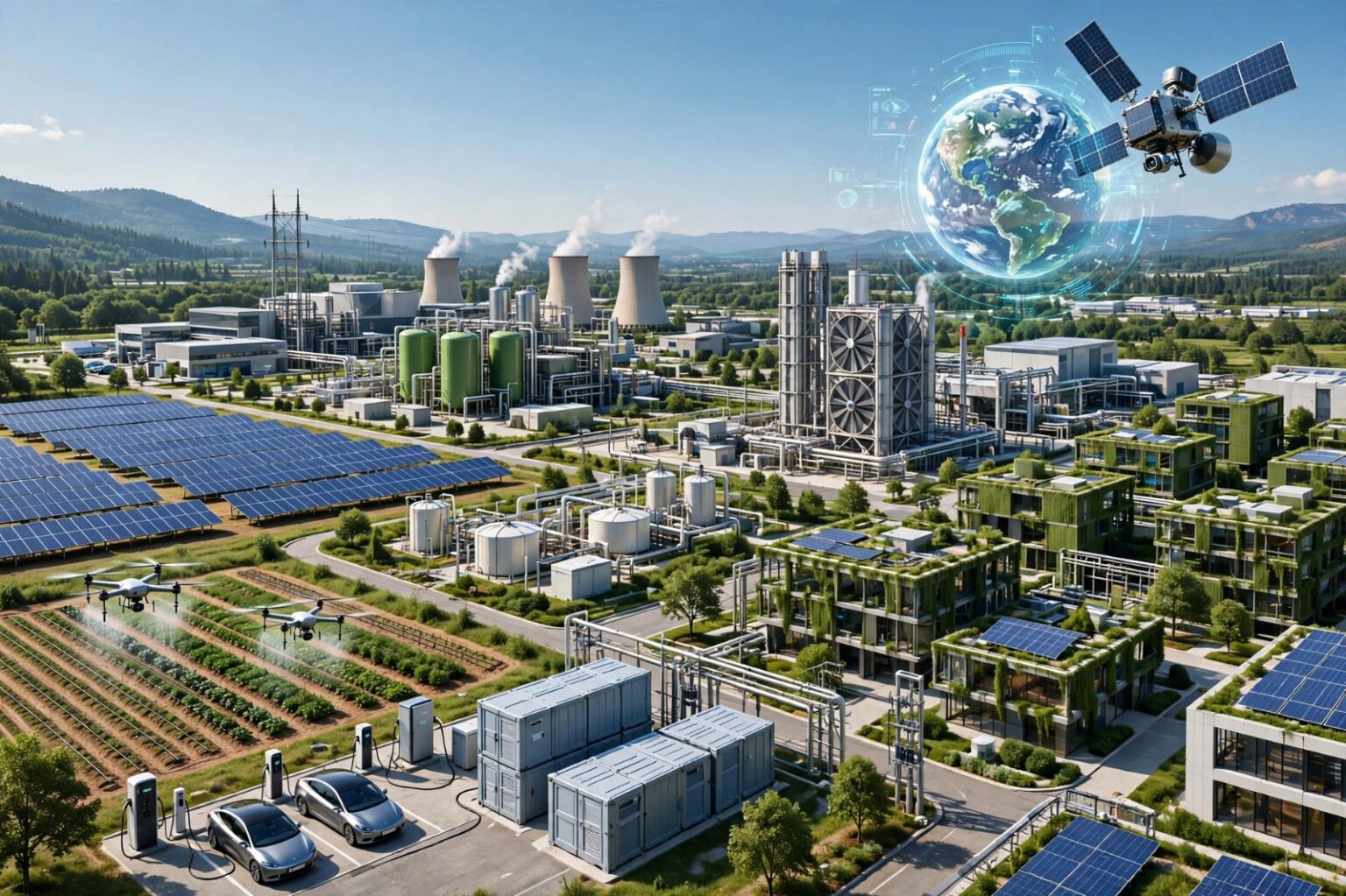

Modern technological innovations are revolutionizing how the world generates power, produces food, predicts natural disasters, and removes carbon dioxide, moving beyond simple individual conservation efforts. Key developments include advanced energy storage technologies (such as lithium-ion, sodium-ion, and pumped hydro) that make solar power viable even after sunset, and the rise of green hydrogen as a clean fuel alternative for heavy industries and transport.
Environment Pulse Desk: Climate change once seemed as if it would be resolved through the simple acts of planting trees and turning off lights. However, a recent influx of innovative technologies has altered the way the world generates power, produces food, anticipates natural disasters, and removes carbon dioxide from the atmosphere. The following are examples of some of the current working models that will most likely have the greatest impact on our future over the course of the next ten years.
Solar energy is currently the most affordable form of new electricity generation in many parts of the world. What makes this possible is not so much the solar panels themselves; rather, it is the storage technology. Lithium-ion battery costs have decreased by over 80 percent within the last decade. Furthermore, new battery types such as solid-state, sodium-ion, and iron-air offer less expensive, longer-lasting storage options for communities and urban areas. For example, in India, there are solar-powered facilities equipped with batteries that can provide power during the evening peak hour — the time after sunset, yet residents and businesses require electricity. Additionally, pumped hydro — a method of generating power through the use of water — is experiencing a resurgence as well. Pumped hydro works by pumping water up a hill when there is excess solar energy available, then releasing the water at night to produce electricity.
Green hydrogen, which uses renewable energy to split water into its constituent parts, produces no greenhouse gas emissions when burned. This form of hydrogen is also used as a replacement for battery-powered systems in several sectors such as steel manufacturing, fertilizer production, marine transportation and long distance truck hauling. The Government of India has established a National Green Hydrogen Mission to develop the country as a major producer and exporter of green hydrogen. Pilot projects using green hydrogen technology have been implemented in the states of Gujarat, Rajasthan and Odisha. While cost remains an issue for widespread adoption of green hydrogen technology, costs associated with electrolysis technologies are decreasing rapidly.
Artificial intelligence (AI) has become an early warning device for our planet’s climate. The latest AI models are now capable of predicting extreme weather events such as flooding, heat waves, tropical storms/cyclones, and failed harvests multiple days before they occur. Additionally, these models provide greater precision in terms of localized forecasting than previous versions did. In India, AI-powered monsoon and flood forecasts assist farmers in determining the best time to plant crops, while providing local governments with enough notice to safely evacuate residents prior to severe flooding. Furthermore, AI combined with satellite imagery allows researchers to monitor methane emissions, illegal logging activities within the Amazon rainforest, and melting glaciers in the Himalayan Mountains on a near-real-time basis.
Direct air capture uses a very different method than traditional carbon capture. It uses machines to extract CO2 directly from the air and either put it underground or use it to produce fuels and building products. There are currently operational plants in Iceland and the United States, and there may be even more efficient materials available such as metal-organic frameworks (MOFs) that can reduce the amount of energy required to operate them. Some critics say direct air capture is expensive and will not be able to offset all emissions. Others argue that direct air capture is necessary for those sectors such as cement, aviation and steel, which are difficult to decarbonize.
Some of the best ways to conserve water are some of the most basic. Soil moisture sensor drip irrigation systems, crop mapping drones and weather advisory mobile phone applications help farmers reduce their water usage from 50% to 70%. Drought-resistant millet, heat-tolerant wheat, and flood-tolerant rice varieties, created through collaboration between ICAR and international seed bank organizations, are now available to millions of smallholder farmers across India and Africa.
Smart grid software (which manages solar, wind, battery, EV and load profiles) makes up the second half of the equation for achieving zero-emission transportation. Vehicle-to-Grid (V2G) technology is expected to allow parked electric vehicles to supply electricity to the grid at times of high demand. Delhi’s EV Policy 2.0 has been developed to promote the use of electric two-wheelers, charging stations and battery-swapping systems as part of its plan to accelerate the adoption of V2G technologies.
In addition to being a source of about 8 percent of the world’s total carbon dioxide, the construction industry is also a major contributor to greenhouse gases. New developments such as low carbon cements, green steel produced using hydrogen and mass timber buildings can reduce the carbon footprint of the industry. Examples of sustainable building practices in India include the use of fly ash bricks, recycled steel and cool roof coatings that help to lower electricity costs and emissions.
However, the largest challenge to implementation is not innovation. A lot of this technology currently exists. It is just unknown as to who will receive the technology. Developing countries require financial assistance and technology transfer. These two requirements were major demands at COP30 in Brazil. Without inexpensive financing, local production capabilities, and training, the technology may remain with rich countries. Experts believe that the next step is the use of the technology; moving the technology into rural areas, small cities, and smaller manufacturing facilities.
There is no one thing we can invent that will fix climate change. Instead, it will require a series of clean energy, storage, smart farming, AI prediction, and equitable financing. This chain of solutions has finally begun to form.