

A catastrophic flash flood in northern Nepal on August 26, triggered by a rock and ice avalanche from the Langtang Lirung peak, has resulted in over 1,300 deaths and severe infrastructure damage across river systems extending toward the Indian border. The disaster has reignited international climate debates regarding historical responsibility. Nepali officials, emphasizing that the nation contributes minimally to global emissions, initially filed loss-and-damage claims and urged major emitters like China, the U.S., and India to show accountability. Foreign Minister Shisir Khanal later moderated the stance, focusing instead on recognizing the Himalayas as a shared, rapidly warming ecosystem requiring joint preparedness and international aid, while thanking India for rapid rescue efforts. India responded by highlighting its low per-capita emissions, advocating for the principle of “common but differentiated responsibilities,” and promising continued reconstruction support. Experts emphasize that the disaster underscores the urgent need for cross-border early-warning systems, shared glacial data, and enhanced climate resilience across the vulnerable Himalayan region.
Environment Pulse Desk: Late August’s catastrophic flash floods in northern Nepal have reopened a familiar but increasingly urgent argument: who owes what to whom when a warming planet drowns a country that barely contributed to the problem.
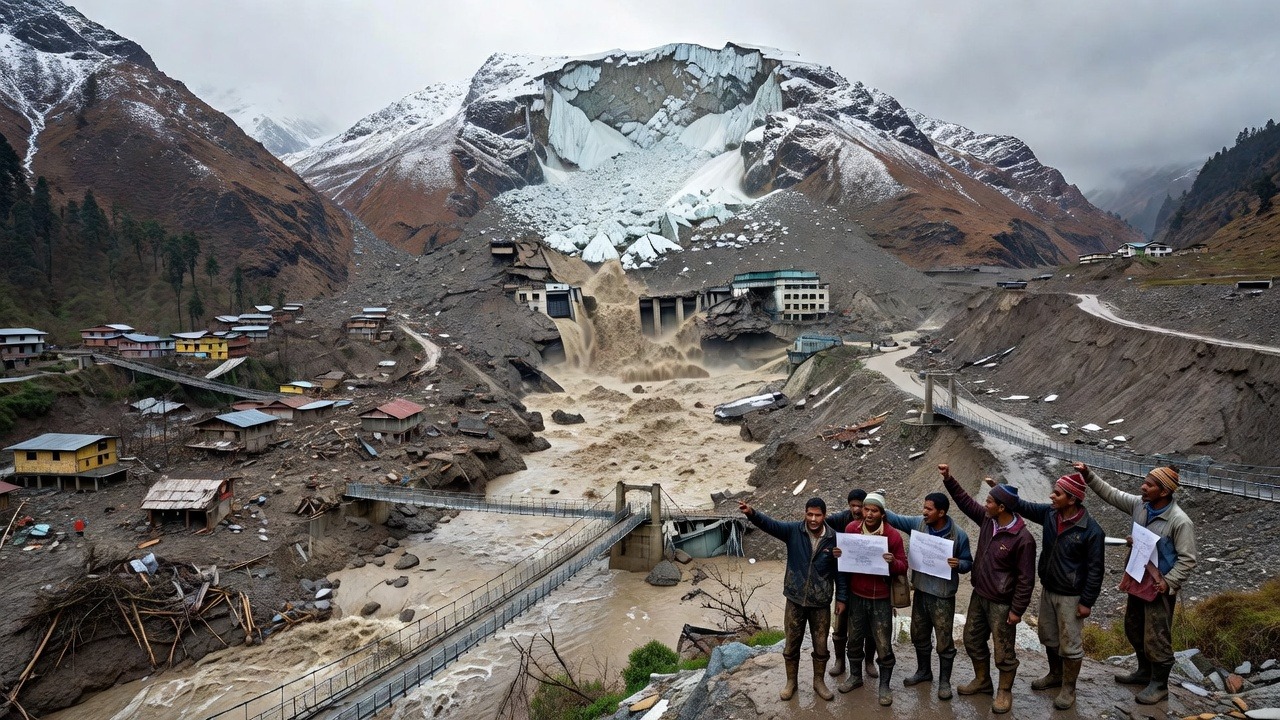
The disaster began on August 26, when a massive chunk of rock and ice broke off Langtang Lirung peak inside Langtang National Park.
What followed was a wall of water, mud, and debris that tore more than 100 kilometers downstream through the Lhende Khola, Bhote Koshi, and Trishuli river systems — flattening villages, sweeping away bridges and roads, and wrecking hydropower plants along the way.
Some of the destruction reached areas near the Indian border. Weeks later, Nepal’s official death toll sits above 1,300, with thousands still unaccounted for. The victims include not just locals but hundreds of foreign nationals — many of them Indians who were either on pilgrimage or working in the region.
Nepal, for its part, produces roughly a tenth of one percent of global greenhouse gas emissions and depends heavily on hydropower for its energy needs — which made the disaster feel, to many Nepali officials, like an injustice imposed from outside.
Foreign Minister Shisir Khanal captured that sentiment sharply, saying his country was done asking for charity and had moved on to demanding accountability. He pointed a finger at the world’s three largest absolute emitters — China, the United States, and India — arguing they carry a historical debt to smaller, more vulnerable nations.
Nepal’s Finance Ministry has reportedly filed formal loss-and-damage claims with international partners and turned to mechanisms like the UN’s Loss and Damage Fund, with rebuilding cost estimates running into the billions of dollars.
Khanal later walked back the sharper edges of that framing, clarifying that Nepal hadn’t actually issued a direct demand for compensation from India, China, or the U.S. specifically.
His revised message leaned more toward asking the international community to recognize the flood as a climate disaster affecting a shared mountain ecosystem — and to back that recognition with real support for preparedness and long-term aid.
He also thanked India for its quick relief response and called for tighter cooperation among India, China, and Nepal going forward.
India’s response, delivered through Ministry of External Affairs spokesperson Randhir Jaiswal, stuck to a familiar diplomatic script: the principle of “common but differentiated responsibilities,” which holds that wealthy, historically high-emitting nations should shoulder more of the burden — both in cutting their own emissions and in funding and equipping poorer countries to adapt.
India was careful to note that despite ranking third globally in total emissions, its per-capita footprint remains low, and it framed itself as a fellow developing nation rather than a peer of the West on this issue.
Officials also pointed to the aid India had already sent — relief supplies, specialist rescue teams — and promised continued help with reconstruction. Beyond the diplomatic sparring, the floods have sharpened a broader conversation about the Himalayas themselves.
Often nicknamed the “Third Pole,” the range is heating up faster than the global average, which is speeding up glacier retreat, thawing permafrost, and raising the odds of glacial lake outburst floods and sudden rock-ice avalanches like the one that struck Langtang. Because Himalayan river systems cross borders freely, experts warn that these hazards don’t respect national boundaries — a landslide in Nepal can just as easily become a flood threat downstream in India.
That’s fueled calls for more serious cross-border coordination: shared real-time data on rivers and glaciers, joint early-warning systems, and better-monitored infrastructure in unstable terrain. India already runs some relevant programs, including its National Mission for Sustaining the Himalayan Ecosystem and glacial lake monitoring efforts, but analysts say these still fall short of a truly integrated, multi-hazard, cross-border system.
Zooming out, the disaster lands right in the middle of the international loss-and-damage debate ahead of upcoming climate conferences. For South Asia specifically, it’s a stark illustration of the gap between countries developing on their own terms and the mountain ecosystems — shared, fragile, and warming fast — that hundreds of millions of people downstream depend on for water.
Nepal is still recovering, and the risk of further collapses hasn’t gone away. If anything, the episode has made the case that averting the next disaster will take more science, more money, and more political trust between neighbors than currently exists.
Also Read: प्रवासी फ्लाईकैचर पर वैज्ञानिक जानकारी का अभाव, संरक्षण के लिए सीमा-पार निगरानी बढ़ाने की जरूरत