


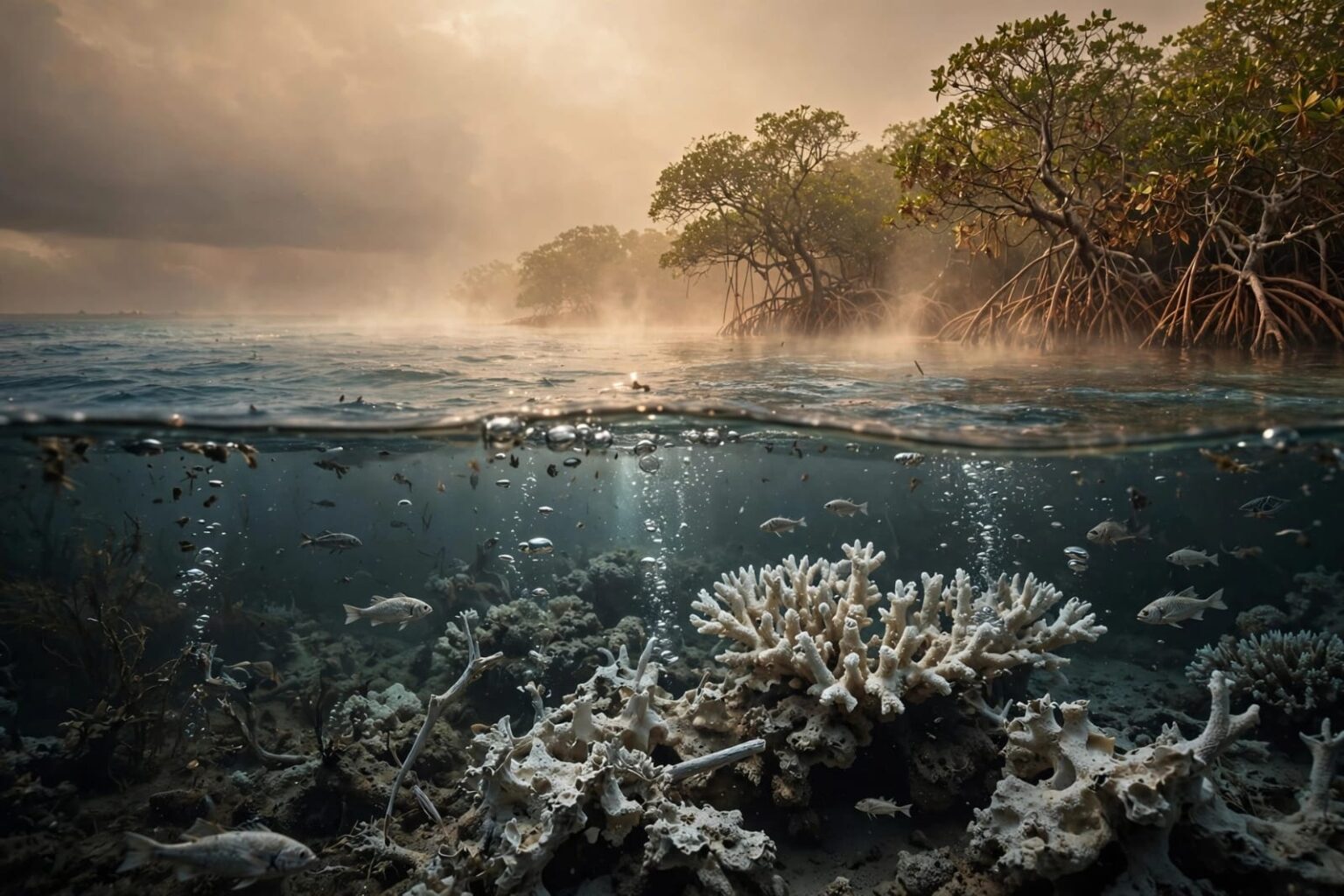

The oceans have historically acted as a crucial buffer against climate change by absorbing about 90% of excess heat and 30% of carbon dioxide. However, this capacity is declining, and marine ecosystems are facing severe stress from three major challenges: warming, acidification, and deoxygenation.
Environment Pulse Desk: For years now, the ocean has quietly done us a favor. The ocean takes in approximately 90% of the extra heat that we put into the air and around 30% of the carbon dioxide that we emit. However, it seems like the price of that favor is becoming too expensive for many species of marine life.
The ability of the ocean to absorb CO2 has declined by approximately 6% over the past ten years according to recent assessments made by UNEP. As a result, a smaller amount of CO2 is being absorbed from the atmosphere and additional strain is placed upon the ocean. In addition, marine biologists are currently facing three challenges; namely warming, acidification, and declining levels of oxygen.
Warming: when the water gets too hot
The current temperature of the sea’s surface is approximately 0.9°C higher than it was prior to the industrial revolution, with over sixty percent of the world’s oceans experiencing a marine heatwave during the years of 2023-24. One degree Celsius can make a significant difference for many types of organisms. When coral is stressed, it releases the algae that provides food for it, causing the coral to lose its color and become white. As a result, more than half of the world’s coral reefs have bleached since 2016. In addition, there have been five major mass bleaching events in the Great Barrier Reef in the past eight years. Despite covering less than one percent of the floor of the ocean, coral reefs provide shelter for about one-fourth of all marine life.
Fish are moving too. Atlantic cod, mackerel, and Indian oil sardine are moving toward the poles at 50 to 100 kilometers per decade. The warming in the Arabian Sea has decreased the number of phytoplankton that provide the base for the whole food chain.
Acidification: chemistry turning against life
CO2 creates carbonic acid when it is dissolved in seawater. As of 1800, the pH of the world’s oceans has decreased by 0.1 units. This decrease represents a 26 percent increase in acid content. Many species such as oysters, mussels, and pteropods (tiny sea snails) find it difficult to grow their shells. Hatcheries in the US Pacific Northwest are reporting that oyster larvae are dying off and pteropod shells are becoming thin enough to cause harm to the fish, whales, and birds that rely upon pteropods for food.
Deoxygenation: the growing dead zones
As the temperature of water increases, so does the amount of oxygen it can hold; thus, warmer waters will contain less oxygen than colder waters. Warm water also tends to mix less than cold water. Since 1960, the overall amount of open ocean oxygen has decreased by approximately 2%. In addition, the number of areas with very little or no oxygen (i.e. low oxygen zones) has increased by four times. Tuna, shark, and billfish species have moved into shallower depths because those depths have higher levels of oxygen, which makes them much easier for commercial fisherman to harvest. Crabs and shrimp are dying in coastal dead zones located in waters near India, Mexico and the Baltic Sea.
Blue carbon at risk
Mangroves, seagrasses and salt marshes are the Earth’s natural carbon vaults. Mangroves store roughly 407 million tons of CO₂ per year and provide habitat for approximately 75 percent of the world’s tropical commercial fish. However, mangroves are lost each year by 1 to 2 percent, and as they decay, the carbon that was stored within the plants is released into the atmosphere.
People depend on this
Climate-driven changes may reduce catch potential in tropical areas by 20 to 30 percent by 2050; more than 3 billion people depend on the sea for protein (FAO).
What needs to happen
There is a growing consensus among scientists that the health of our oceans cannot be separated from climate actions. This includes decreasing greenhouse gas emissions; creating more real-time monitoring of oceans; rebuilding blue carbon habitats (e.g., seagrass beds, salt marshes, mangroves); and developing marine protected areas based on the movements of marine organisms rather than fixed geographic boundaries.
The ocean has protected us from the most extreme impacts of climate change, and today its animals are letting us know that they will no longer be able to protect us on their own.
Also Read: The Animals Are Already Feeling It