
Namibia’s capital, Windhoek, is emerging as a global blueprint for arid cities dealing with climate change, extreme heat, and severe water scarcity. Located in one of the driest regions of southern Africa, the city has adopted a tiered approach prioritizing water security and dry-climate nature-based solutions. Windhoek operates one of the world’s most advanced direct potable reuse systems, recycling wastewater directly to drinking standards and artificially recharging local aquifers to minimize surface evaporation losses. Recent investments of N$1.6 billion have further boosted capacity despite depleted dams.
Environment Pulse Desk: Windhoek, the capital of Namibia is increasingly being seen as a model for the worlds arid cities ready to cope with climate change. The plan’s integrated response to both water shortages and extreme heat serves as an example for other semi-arid cities in Africa and beyond might adopt.
The city occupies one of the driest areas in southern Africa. But the temperatures can rise above 40 °C, rain is sporadic, drought may last years and flash floods are common. Rapid urbanization, manifested in informal settlements expansion has compounded the stress. The response from Windhoek has been a tiered approach prioritising water security, and is now beginning to incorporate dry climate contextualised nature based solutions.
In water, the city has led for decades. Windhoek operates one of the most ancient but still advanced direct potable reuse systems for water-recycling, wastewater to drinking standard. Moreover, it charges local aquifers, either further reducing surface dam evaporation losses. It has recently installed plants to reclaim and treat waste water, at a cost of N$1.6 billion, to boost capacity while most of Namibia’s dams are overdrawn or dry up completely. Tiered drought restrictions, PR campaigns and managed aquifer recharge have allowed the city to weather many dryspell after dryspell.
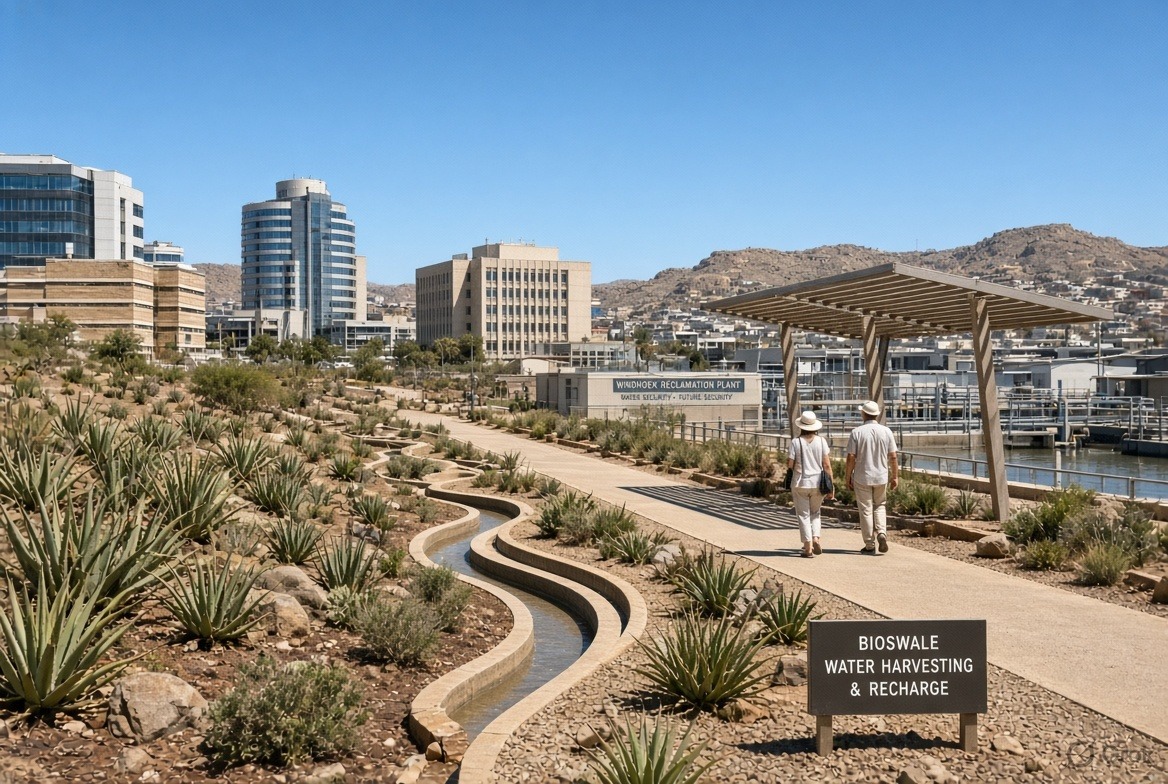
On heat and more broadly, the approach is what researchers and planners have dubbed Brown is Beautiful. Instead of replicating expensive water-hungry greening models from wetter climates, the idea was to work with Windhoek’s dry innate landscape. The suggested measures include:
- Xeriscaping with indigenous, drought-tolerant plants
- Bioswales and contour swales to harvest and filter precious rain
- Soil berms to manage runoff
- Community-led dryland permaculture gardens
In totality, these all serve to reduce urban heat islands, enhance rainwater infiltration and mitigate flooding risk — all while requiring minimal irrigation.
The lag is particularly evident in consensual formal planning with national and city climate strategies still largely reliant on grey infrastructure, according to research published earlier this (6) down that same line. It also identified several promising grassroots practices and a genuine opportunity for Windhoek to lead by example in this field. Pioneering: Experts say the city could serve as a blueprint for other rapidly growing dryland centres like Gaborone by blending local expertise, cultural identity and climate-specific natural solutions in an arid context.
Windhoek’s experience, as a dry city accustomed to making the maximum use of limited natural resources by design rather than by chance offers one clear lesson: when it comes to adaptation—especially in the face of rising heat and water stress across the continent—it’s usually better adapted solutions that go with the environment than against it and treat scarcity as a design input not an output.
Also Read: Punjab’s Water Crisis Is Also a Fairness Crisis, New Study Says


