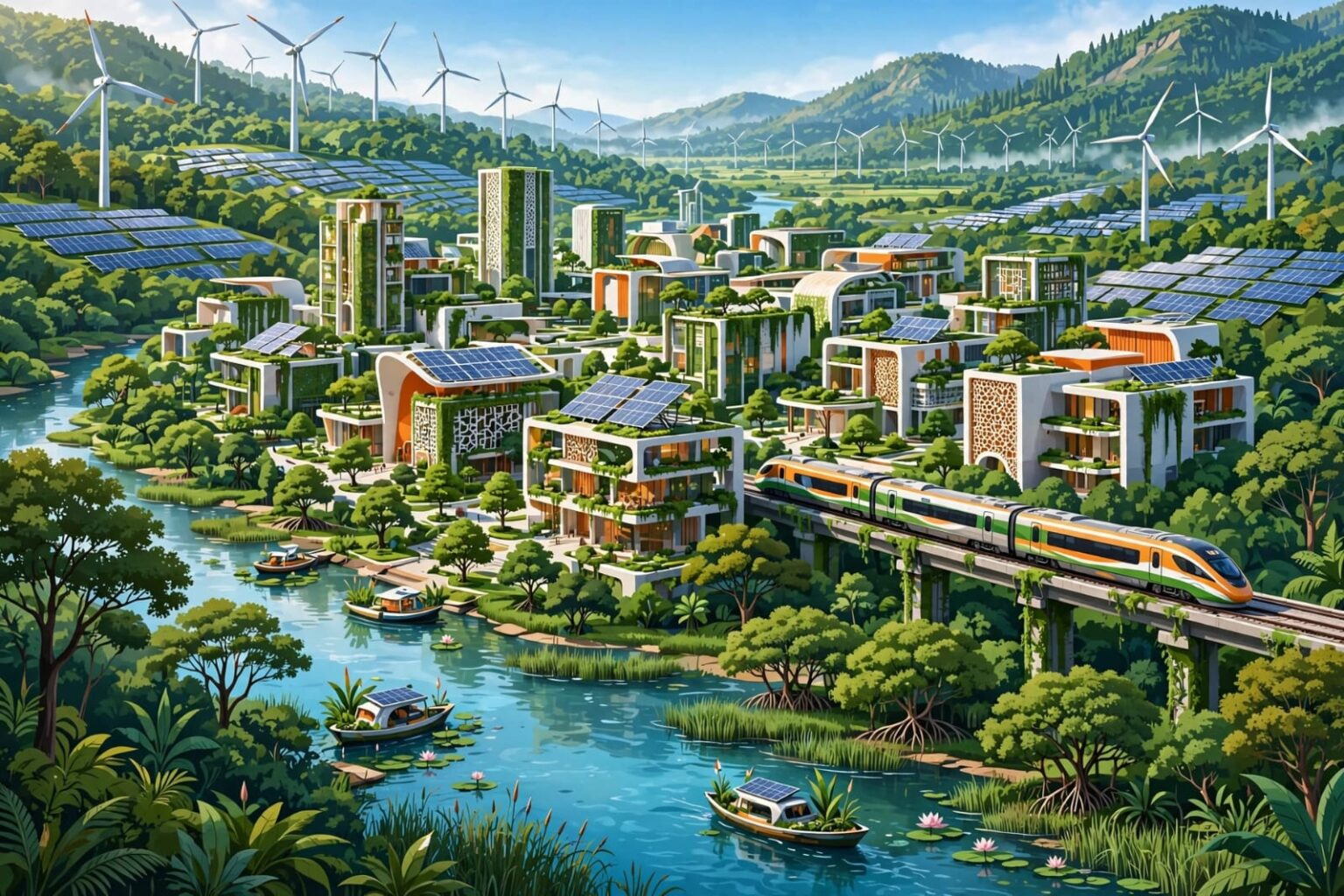

As India approaches its centenary of independence in 2047, the nation aims to transition into the world’s first major green superpower by balancing economic growth with ecological sustainability. Built on the core principle of a developed and green India (“Vikasit Bharat, Harit Bharat”), the comprehensive 2047 roadmap is structured around five strategic pillars: achieving energy independence through massive renewable expansion and green hydrogen, transforming urban mobility and infrastructure with electric transport and climate-smart cities, driving large-scale ecological restoration to build massive carbon sinks, fostering a circular economy that generates green jobs, and mobilizing youth skilling and green finance to turn sustainability into a nationwide movement.
Environment Pulse Desk: As India approaches its 100th year of Independence, the vision for 2047 is not just about becoming a developed economy, but about becoming the world’s first major green superpower. The India Green Mission for 2047 lays out an ambitious, holistic roadmap to balance growth with ecology, making sustainability the core of national progress.
The Mission is built on the principle of Viksit Bharat that is also Harit Bharat – a developed India that is also a green India. It integrates five critical pillars that will define the next two decades.
Energy Swaraj: Powering India with Clean Energy
The cornerstone of the 2047 Mission is energy independence. India has set a target to achieve 50% of its electricity from non-fossil fuel sources by 2030, and 100% clean energy capacity by 2047. This includes scaling solar power to 1,000 GW, wind energy to 200 GW, and a massive push for green hydrogen as the fuel of the future.
The National Green Hydrogen Mission, launched with an outlay of Rs 19,744 crore, aims to make India the global hub for production and export of green hydrogen. By 2047, every major steel, cement, and refinery plant is expected to run on green hydrogen, drastically cutting industrial emissions.
Green loans and green bonds are fueling this transition, allowing farmers to install solar pumps, MSMEs to adopt energy-efficient machines, and households to embrace rooftop solar under the PM Surya Ghar Yojana.
Green Mobility and Sustainable Cities
By 2047, the Mission envisions 100% electric public transport in major cities and 80% of all new vehicle sales being electric. The FAME scheme, expansion of metro networks, and development of over 10,000 green, energy-efficient Amrit Bharat stations are steps in this direction.
Cities will be redesigned as climate-smart cities with green buildings, extensive urban forests under the Nagar Van Yojana, zero-waste systems, and circular water management. The concept of 15-minute neighbourhoods, where work, school and markets are within 15 minutes of cycling or walking, is being piloted.
Ecological Restoration and Carbon Sinks
India’s Green Mission goes beyond energy. The goal is to increase forest and tree cover from 24% to 33% by 2047. Initiatives like the Green India Mission, Miyawaki forests in urban areas, restoration of 26 million hectares of degraded land, and rejuvenation of 13 major rivers will create massive carbon sinks.
The Mission Amrit Sarovar, which created over 60,000 water bodies, will be expanded to ensure water security for every village. Mangrove and wetland restoration will protect coastlines while supporting biodiversity.
Circular Economy and Green Livelihoods
A key shift by 2047 will be from a linear ‘take-make-dispose’ economy to a circular economy. Single-use plastic is targeted to be completely phased out by 2030. Waste-to-wealth startups, bio-CNG plants, and e-waste recycling hubs will create over 10 million green jobs.
For farmers, the Mission promotes natural farming, organic certification, and carbon credits. Farmers practicing sustainable agriculture will be able to earn additional income by selling carbon credits in global markets – turning green practices into direct profit.
Youth and Finance as Green Catalysts
The success of the 2047 Mission rests on two catalysts: youth and finance. Green skilling programs are being introduced in schools and ITIs to create solar technicians, wind turbine engineers, and sustainability auditors. Simultaneously, RBI’s framework for green deposits and SEBI’s guidelines for green bonds are channeling public and private capital into green projects.
Ultimately, India’s Green Mission for 2047 is not a government program alone; it is a people’s movement. It embodies the Indian ethos of living in harmony with nature – where progress is measured not just in GDP, but in cleaner air, purer water, and a healthier planet for the next 100 years.
Also Read: Green Loans: A New Paradigm in Sustainable Finance Powering India’s Green Future