



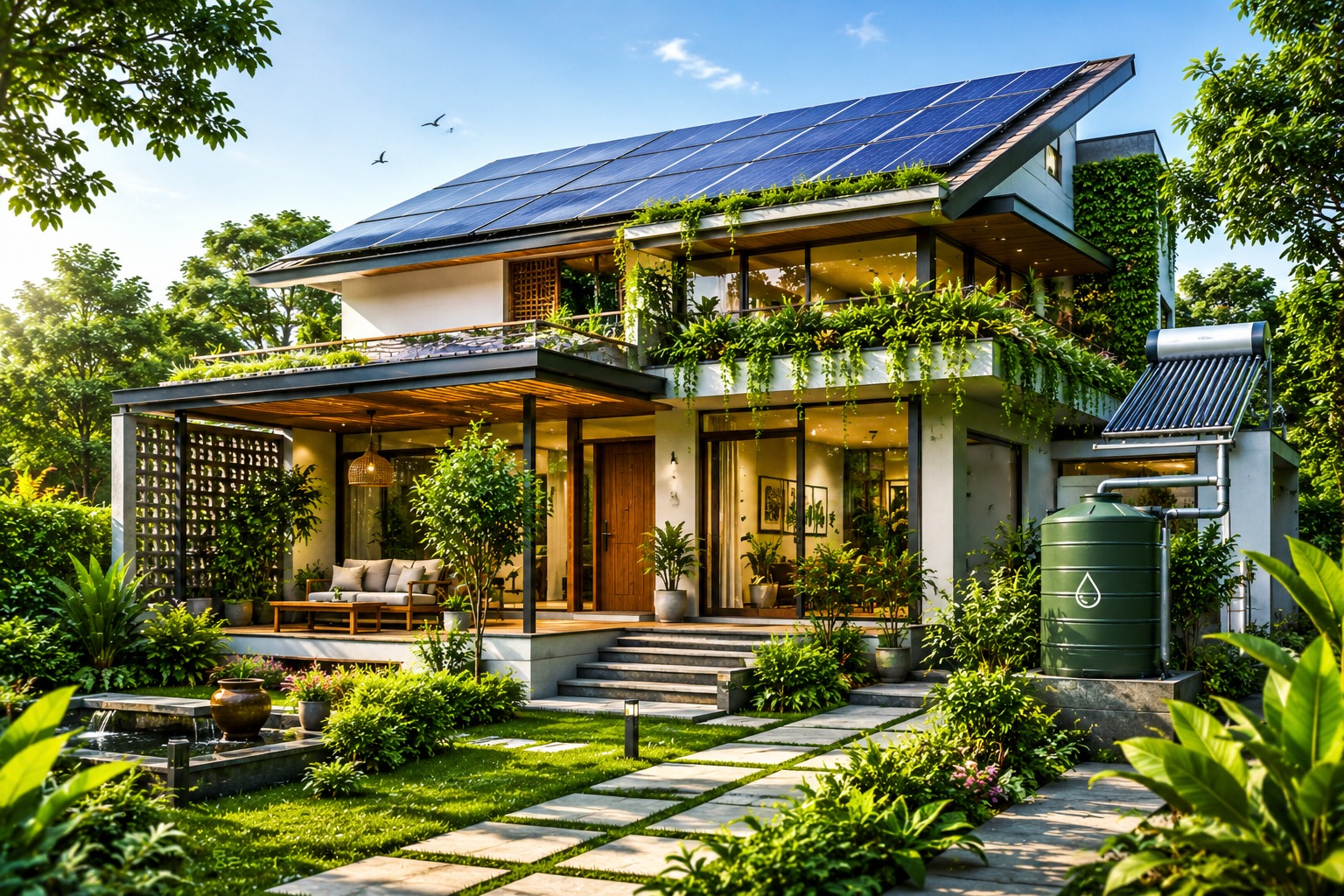
How PMAY-U 2.0, eco-building codes, and PM Surya Ghar: Muft Bijli Yojana are bringing green homes to middle- and low-income families.
Passive cooling, recycled materials, and smart water harvesting pave the way for India’s 2070 net-zero targets amidst rapid urbanization.
Environment Pulse Desk
In India, numbers tell a tale. A latest statistic suggests – by 2050, nearly half of India will be living in cities. Not “some people.” Half the country. And every single one of those people is going to need a place to live.
People cannot stop talking about the sheer scale of this number. However amidst all the din, what gets missed is the talk about how we build all those homes, and honestly, that question might matter more than the number itself.
From the emission standpoint, reportedly buildings in India already account for roughly a quarter of the country’s emissions. This is owing to cement and steel doing most of the damage. The story goes beyond India needing more houses. It’s “India needs more houses that don’t quietly wreck the climate while we’re building them.”
This is where sustainable housing stops being some feel-good add-on and starts looking like a necessity.
It’s Not Just for the Rich Anymore
While popular perception is that green buildings are a luxury thing — glass towers with solar panels, marketed to people who can already afford granite countertops. That’s changing, and faster than most people realize.
Rating systems like GRIHA, IGBC, LEED, and EDGE have been quietly building out frameworks suited to Indian conditions for years now. And India isn’t lagging behind on this — in 2024, the country landed third globally in LEED certifications, with 370 projects covering 8.5 million square meters. That’s not a rounding error. Green-certified buildings across the country are saving close to 200 billion litres of water a year and cutting tens of millions of tonnes of carbon emissions.
Government policy has actually been doing some heavy lifting here too, which isn’t always something you can say. The Pradhan Mantri Awas Yojana — PMAY, and now PMAY-U 2.0 — has been pushing affordable housing while quietly baking in sustainability requirements: things like fly-ash bricks and autoclaved aerated concrete instead of the usual energy-hungry materials.
As per the Eco-Niwas Samhita energy standards specifically for homes, working alongside the Energy Conservation Building Code for commercial buildings, states are sweetening the deal — extra floor space, lower development charges, property tax breaks, faster approvals — to get developers on board. Andhra Pradesh, for instance, has stopped treating these incentives as something only premium projects deserve.
Rooftop Solar Is the Real Game-Changer
So where does the genuine shift lie. Ordinary families experience their electricity bill, it’s rooftop solar. The PM Surya Ghar: Muft Bijli Yojana, launched in 2024, is aiming for a full crore of households with rooftop solar. By mid-2026, more than 50 lakh homes had already made the switch — with subsidies up to ₹78,000 for a typical 3 kW system, net metering, and financing that doesn’t require a small fortune upfront.
Plenty of households are already talking in terms of electricity bills dropping to nearly nothing, with surplus energy actually generating credits back to them. The scheme is specifically expanding to reach economically weaker households, including PMAY beneficiaries.
There are already some states like Odisha where they continue to include solar directly into affordable housing projects, which lowers the total cost of owning a home over lifetime.
Building With the Climate in Mind, Not Against It
India boasts of a diverse bouquet of climatic conditions. Hot and dry in one region, warm and humid in another, temperate up in the hills, freezing in parts of the north. A house that works in Rajasthan is a bad idea in Kerala, and sustainable design in India has had to grapple with that seriously.
It maps various categories including courtyard layouts that pull in natural ventilation, shaded windows that cut down on cooling needs, cool roofs that reflect heat instead of absorbing it, and thicker, better-insulated walls. This typifies smart design that reduces how hard a building has to work to stay livable.
Water gets the same treatment — rainwater harvesting, greywater recycling, dual plumbing systems, efficient fixtures. And materials are shifting too: fly ash, industrial slag, recycled aggregates, agricultural waste turned into building products. The green materials market is expected to grow substantially, helped along by updated building codes and a bigger push toward recycling construction waste instead of just dumping it.
IoT sensors tracking energy and water use, super-efficient air conditioners, and prefabricated construction methods that cut down on both waste and build time. Programs like the Global Housing Technology Challenge under PMAY have been showcasing what disaster-resilient, eco-friendly housing can actually look like across different regions of the country.
But Let’s Be Honest — It’s Not All Smooth Sailing
Upfront costs for green features still scare off a lot of developers and buyers, especially in the affordable housing segment, even when the long-term savings clearly outweigh the initial spend.
And there’s a bigger, quieter problem underneath all of this: informal and low-income housing, often sitting in the most climate-vulnerable areas, barely gets any attention when it comes to resilience upgrades.
Where This Is All Heading
Despite the gaps, the direction is fairly clear. India’s net-zero target for 2070, combined with pushes like Smart Cities and AMRUT, gives sustainable housing a real policy backbone to grow from. Residential construction is expected to expand massively over the next several years, and sustainability is slowly moving from “nice bonus” to “just how things are done.”
Also Read: Ladakh Gets Ready for India’s First High-Altitude Wildlife Safaris